Once a couple of profiles are running, the natural next thought is to automate the rest. It feels like tidying up. Everything you do by hand becomes a rule, the rules go into the engine, and you stop being the bottleneck. The problem is that a setup being profitable and a setup being automatable are two separate properties, and they are not especially correlated. Some of the best trades I take are ones I would never hand to a machine, and it cost me twice to work out why.
Four properties do the damage. Thin liquidity, dependence on an event, exits that need a judgement call, and a sample too small to have produced a rule in the first place. A setup with any one of them is worth a hard look before it goes into a profile. A setup with two of them stays manual.
Thin liquidity turns your own order into the signal
This is the one that costs money quietly. In a thin book your order is not a small event in a large market, it is a meaningful fraction of what trades in the next few minutes, and the price you get is partly a consequence of your having asked.
By hand you manage this without thinking about it. You look at the book, see that the offer is thin, and decide to work the order, or split it, or skip the trade because the spread is wider than the move you were expecting. None of that judgement survives automation. The profile sees a signal and sends the same order whether the spread is four basis points or forty.
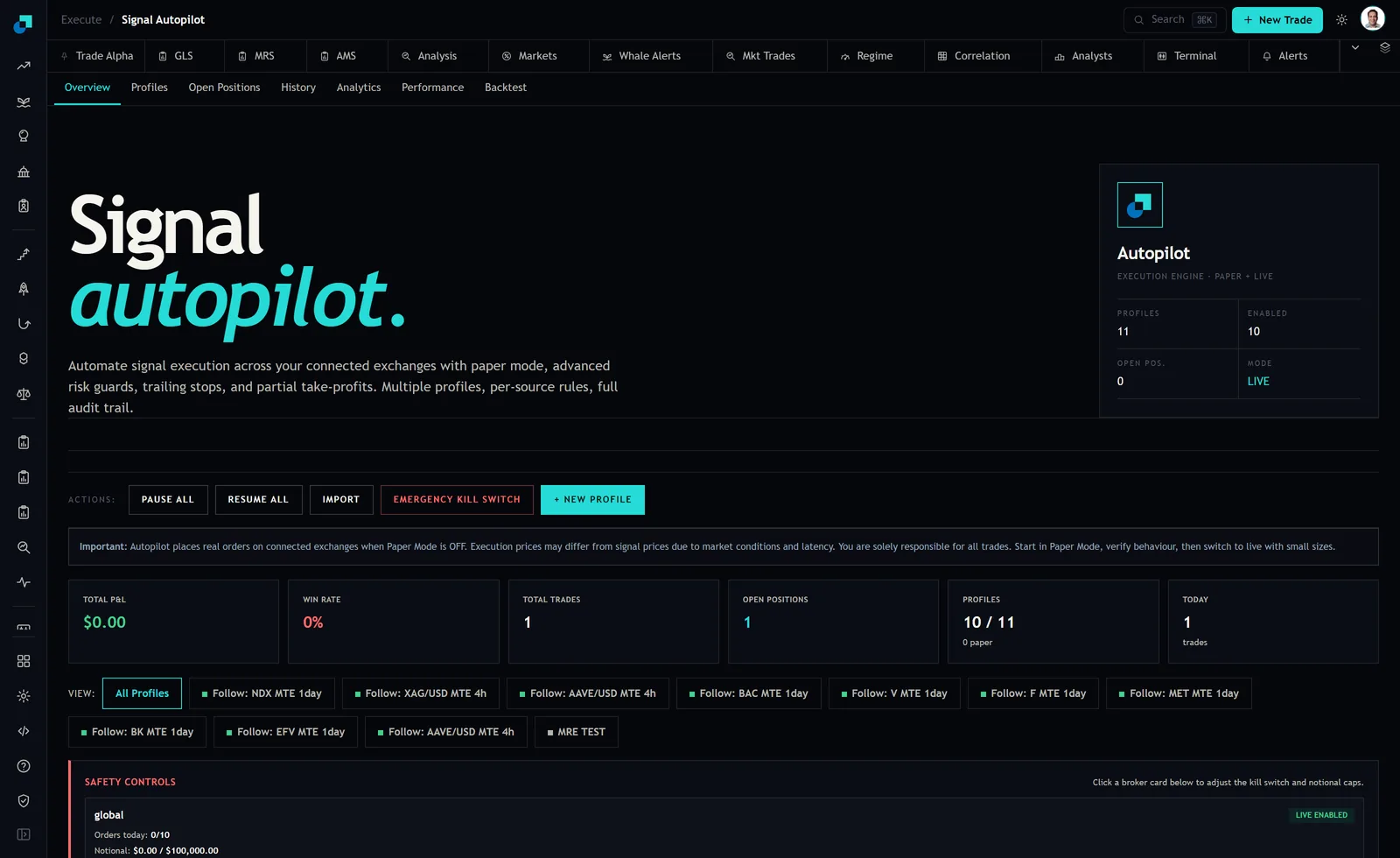
The arithmetic is worth doing once in dollars. On a two thousand dollar position, a spread that costs you thirty basis points on the way in and thirty on the way out is twelve dollars round trip. If the setup fires forty times a year, that is nearly five hundred dollars of friction against an edge you probably estimated from a backtest that assumed you got the mid. On a small account that can be the entire result. The guardrail here is a hard per order notional cap plus a deliberately short instrument list, and it is a real control, but notice what it does: it limits the damage, it does not stop the profile from repeatedly paying a spread that a human would have refused.
Event dependence means the rule is right and the day is wrong
Plenty of good setups are a bet on how the market reacts to a scheduled thing. An earnings release, an economic print, a listing, a decision. You take the trade because you have a view about the reaction function, and part of that view is knowing what the event was.
An automated profile does not know what the event was. It knows a price series and whatever conditions you encoded, and price series before and after an event look like price series. So the profile takes the same setup on a day when there is no event and the pattern is noise, and it takes the setup at the moment of the event when the spread has widened, the depth has evaporated and the fill is nothing like the historical one.
You can partly encode this. A calendar filter that blocks trading in a window around known events is a real and useful guardrail, and if the setup only works away from events, that filter turns a bad candidate into a workable one. What you cannot encode is the other half, where the setup only works because of the event and you need to have read the release to know whether it qualifies. That version stays manual, and the tell is simple: if your written rule contains the words unless it is a genuine surprise, it is not a rule.
The failure mode when you automate it anyway is not a slow bleed. It is one large loss on the day the profile traded straight through a release with normal size, and that trade will look, in hindsight, exactly like the trade you would have skipped.
Exits that need a judgement call cannot be written down
Entries are easy to automate because the conditions are usually mechanical. Exits are where discretion actually lives, and people underestimate how much of theirs is there.
Test it honestly. Take your last twenty exits on this setup and try to write the rule that produced them. Not roughly. Exactly, so that someone else applying it to the same charts would exit at the same bar. If you can, automate it. If your description keeps reaching for phrases like when it stops going up, or if the move looks exhausted, or when the volume dries up and the buyers are gone, then the exit is a judgement and encoding it will produce something that is not your strategy.
The half automated version is worse than either extreme, and it is the most common outcome. The profile takes the entry, you take the exit by hand, and within a fortnight you are overriding entries too, because a position you did not choose to open is one you have no conviction in and you will close it at the first sign of trouble. Now you have a strategy with a mechanical entry, a discretionary exit made under mild irritation, and no record of what the original rule would have done. Nothing about that combination is measurable, so you can never tell whether it worked.
If the exit is judgement, keep the setup manual. If you want the engine involved, the honest use is alerts: let it tell you the entry fired and take the trade yourself.
A small sample is a hunch with a chart attached
The fourth property is the least visible because it looks like a real strategy in every respect except the one that matters. You have a setup, you know what it looks like, you have taken it eleven times and eight of those worked.
Eight of eleven feels like a lot. It is not. Sequences that lopsided appear constantly in random data, and it feels compelling because you were there for all eleven and remember the three losses as unusual circumstances. That is not a flaw, it is what remembering is like.
The specific danger in automation is that it removes the natural brake. Trading a hunch by hand, you take it when you notice it, which might be once a month, and the position size drifts down when you are unsure. A profile applies it every time the condition appears, at full size, without the doubt. If the setup is an artefact of eleven observations, automation is the fastest way to find that out and it charges you fees the whole way. My rough floor before a setup goes into a profile is around thirty occurrences that I did not select after the fact, and below that the honest move is to keep logging it manually until the sample exists.
Keeping the manual list from becoming a hiding place
The risk is that the manual bucket becomes the place where the undisciplined trading lives. Automated is where the rules are, manual is where you do whatever you feel like, and because the manual trades are not in the engine's history they never get counted properly.
Two things stop that. Keep one log for every manual trade with the same fields you would have needed to define a rule: the trigger, the intended exit, the size and the reason. And review the manual list every quarter against the four properties, because setups move between categories. An instrument gets more liquid, an event stops being scheduled, a sample of eleven becomes a sample of forty. When a setup no longer has any of the four properties, it becomes an automation candidate, and it goes through the same trial you would give any new profile rather than straight to live.
One last thing about the automated side, because it is easy to finish here feeling that the automated portfolio is the settled part. It is not. Every profile that passed this test still needs watching, because none of the four properties is the reason automated strategies mostly fail. They fail on stale data, on venue outages, on a signal source that stopped updating without saying so, and on the owner overriding a decent rule at the worst possible moment. Choosing the right setups keeps a category of avoidable losses out of the engine. It does not make what remains safe to leave alone.