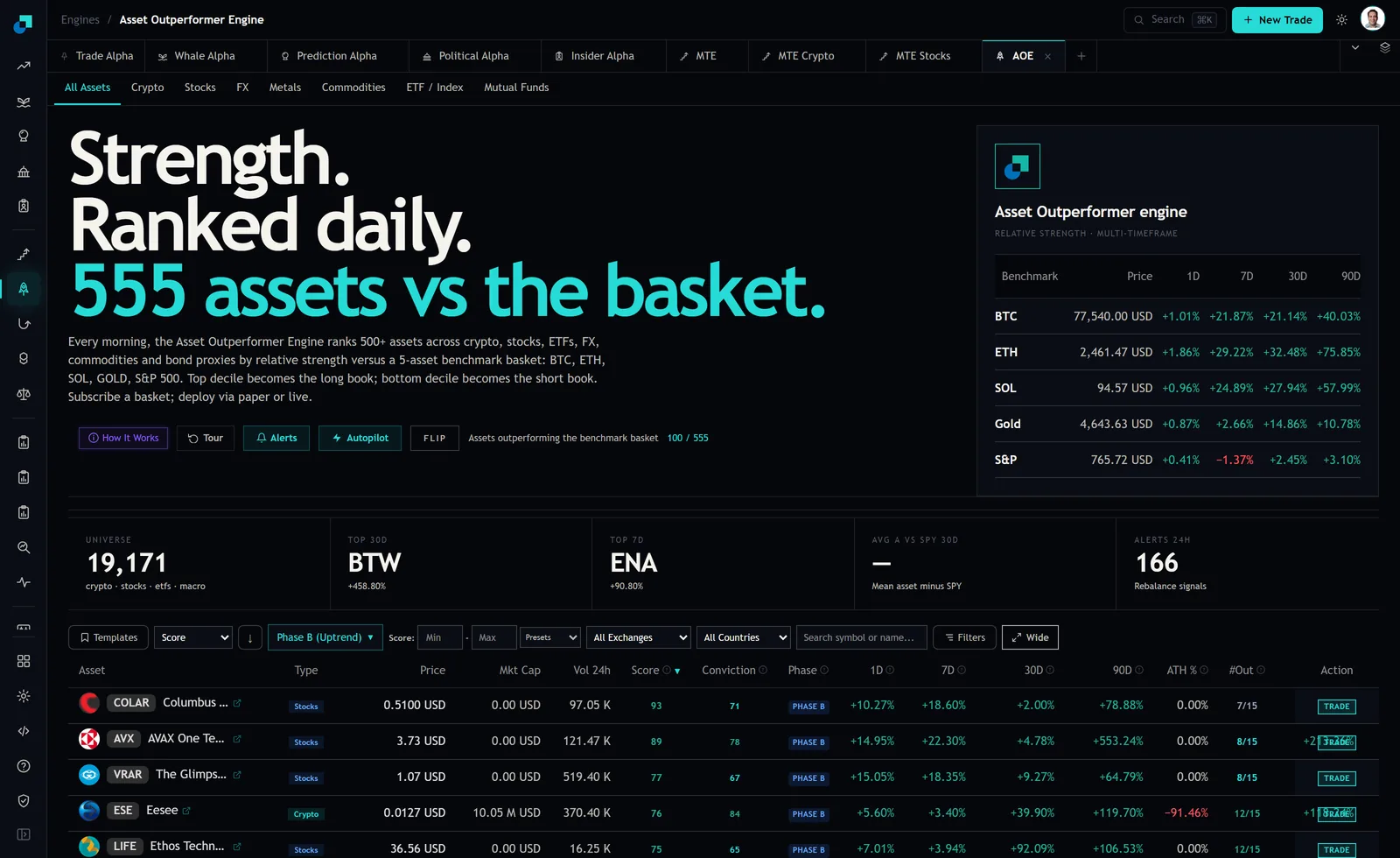
The Asset Outperformer Engine compares every asset in its universe against five benchmarks: Bitcoin, Ethereum, Solana, Gold and the S&P 500. That list arrives as a product default and is easy to accept without reading it, which is a mistake, because the basket is the single most consequential parameter in the whole ranking. Every score, every relative strength reading and every decile boundary downstream is defined relative to those five. Adopt the ranking and you have adopted the basket, whether or not anyone wrote it down.
What the basket asserts about your opportunity set
A benchmark basket is a claim about what the money could otherwise have done. Five assets, three of them crypto, is a specific and quite aggressive claim: that a majority of the relevant alternative to any position is digital assets, and that gold and US large-cap equity together account for the other forty percent of the comparison.
For a crypto-native mandate that is close to right and the basket needs no defending. For a multi-asset sleeve it is a live question, and for a traditional balanced mandate it is almost certainly wrong as stated. Nothing in the ranking is broken in those cases. The ranking is doing exactly what it says. The problem is that the number arriving on your desk is answering a question your investment policy statement did not ask, and the gap will not surface until someone asks in a review why a position was held.
The mandate question each of the five raises
Take them one at a time, because they fail differently.
Bitcoin is the least contentious. It has the longest series, the deepest market and the widest institutional acceptance as a reference asset, and if you hold any digital asset exposure at all it belongs in the comparison. The question it raises is narrower than it looks: whether your policy treats it as a distinct asset class or as a risk-asset proxy, because those two readings imply different tolerance for the ranking's crypto tilt.
Ethereum and Solana together are where the weighting decision actually lives. Two of five benchmarks are large-cap smart contract platforms whose returns are strongly related to each other and to Bitcoin. That is not five independent hurdles. It is closer to three, with crypto counted repeatedly, and the practical effect is that the bar for the whole board rises and falls with a single risk factor. If your policy has a crypto sleeve limit, the basket is quietly asserting a comparison weight well above it.
Gold is the one that most often survives review unchanged, because a real-asset hurdle is defensible in nearly any mandate and because it behaves differently enough from the other four to add information rather than repeat it.
The S&P 500 is the one to argue about hardest, and not because it is inappropriate. It is the reference asset for most of the capital in the world. The issue is that a single US large-cap index is standing in for the entire traditional book, so a sleeve benchmarked this way is silent on duration, credit, non-US equity and the dollar. If any of those are in your mandate, the basket does not price them, and an asset that outperforms on all fifteen benchmark and timeframe checks may still be a poor holding against the liabilities you actually run.
The bar moves with the loudest benchmark
The basket is not a fixed hurdle. It is five moving series, and the difficulty of clearing it changes materially with market conditions. The benchmark strip in the module makes this observable. On the reading I am working from, ETH showed +32.48% over 30 days and +75.85% over 90, BTC +21.14% and +40.03%, SOL +27.94% and +57.99%, while Gold showed +14.86% and +10.78% and the S&P line showed +2.45% and +3.10%, with the 7-day S&P figure negative at -1.37%.
In a stretch like that, a name clearing all five benchmarks has done something genuinely rare, and a name clearing three has very likely cleared gold and equity while losing to everything digital. Six months of quieter crypto and the same board would sort differently for reasons that have nothing to do with the assets on it. This is the property that most needs writing down, because it is the one that generates the awkward review question: was the sleeve's good quarter selection, or was it a period in which the benchmark composition happened to be easy?
An allocator should be able to answer that from documentation rather than from memory. In practice that means recording the benchmark strip readings at each rebalance date alongside the positions taken, so the difficulty of the hurdle at the time of the decision is part of the file.
Overriding the basket without discarding the ranking
You cannot rewrite the five, but you have more control over the comparison than the default view suggests, and the useful overrides are structural rather than cosmetic.
The first is population. The module separates the universe into type tabs covering crypto, stocks, FX, precious metals, commodities, ETF and index, and mutual funds, and it carries exchange filters spanning NASDAQ, NYSE, LSE, XETRA, TSE, HKEX and others. Running the ranking inside a single asset type against the same five benchmarks produces a far more defensible comparison than the combined board, because the cross-sectional population then matches something a mandate can describe.
The second is to read the benchmark checks individually rather than as a single count. The per-benchmark and per-timeframe structure is the point of the design. A policy that says the sleeve is judged against gold and equity, and that the crypto benchmarks are recorded but not binding, is a legitimate override that keeps the ranking machinery intact while restoring the mandate's actual hurdle.
The third is cadence. The engine runs a full scan every six hours. Your review cycle almost certainly does not, and matching your rebalance interval to the scan interval is a decision to inherit the basket's short-horizon noise. Sampling the ranking at your own frequency is a policy choice too, and a cheaper one than most.
What belongs in the IPS and what belongs in the review file
The investment policy statement should carry the basket explicitly, named asset by asset, with a sentence on why three crypto benchmarks are acceptable or a stated override if they are not. It should say whether the fifteen benchmark and timeframe checks are binding in aggregate or whether a subset governs. It should state the population the ranking is run over, meaning which type tab and which exchange filter, because a ranking run over the combined board and a ranking run over US listed equities are different signals wearing the same name.
The review file needs less prose and more dating. Benchmark readings at decision time, the population setting in force, the scan timestamp the decision was taken from, and the score and phase classification of each position when it was opened. None of that is onerous, and all of it is the difference between explaining a drawdown and being asked to justify one. The uncomfortable version of that conversation begins with an allocator discovering, after the fact, that the hurdle their manager beat was chosen by a product default nobody had read.