An insider sleeve is easy to pitch and hard to approve, and the gap between those two is almost never about whether the signal works. It is about whether the person proposing it has done the unglamorous half of the work, which is capacity, turnover, compliance and a written account of how the thing fails. This is the pack I would want in front of me if I were sitting on the other side of the table, assembled from what the module can actually substantiate rather than from what a strategy deck usually asserts.
Lead with the measurement convention, not the return
The first slide should not contain a performance number. It should contain the definition of the number, because every question that follows depends on it and a committee that discovers the definition on slide nine will discount everything before it.
The Insider Alpha performance view states its own convention on the page. For every past insider filing it tracks the actual forward return at 7d, 30d, 90d and 1yr and compares it to SPY over the same window, describing itself as proof of edge with no cherry picking and every scored filing counted. That is a population statistic over filings. It is not a portfolio, and the distinction is the single most important thing to establish before a discussion of returns begins.
Say what follows from that plainly. There is no equity curve on the page, no drawdown, no turnover, no position count and no holding period. A forward return attribution answers the question of whether the raw material contains any edge. It does not answer whether a portfolio built from that material would have been ownable, and those are the two separate approvals you are asking for.
What the panel substantiated on the day, stated with its date attached
Give the committee the reading verbatim, with filters and date, and resist the temptation to round it into a headline. At capture, with the range on last 1yr, the side selector on All and the size dropdown on Any size, the header read N filings of 20,000 and a notional field of 1089.83 trillion dollars. The 7D forward return tile showed plus 0.25 percent against SPY at plus 0.07 percent, a 46 percent win rate, on 20,000 scored filings. The 30D, 90D and 365D tiles each showed a dash and zero scored filings.
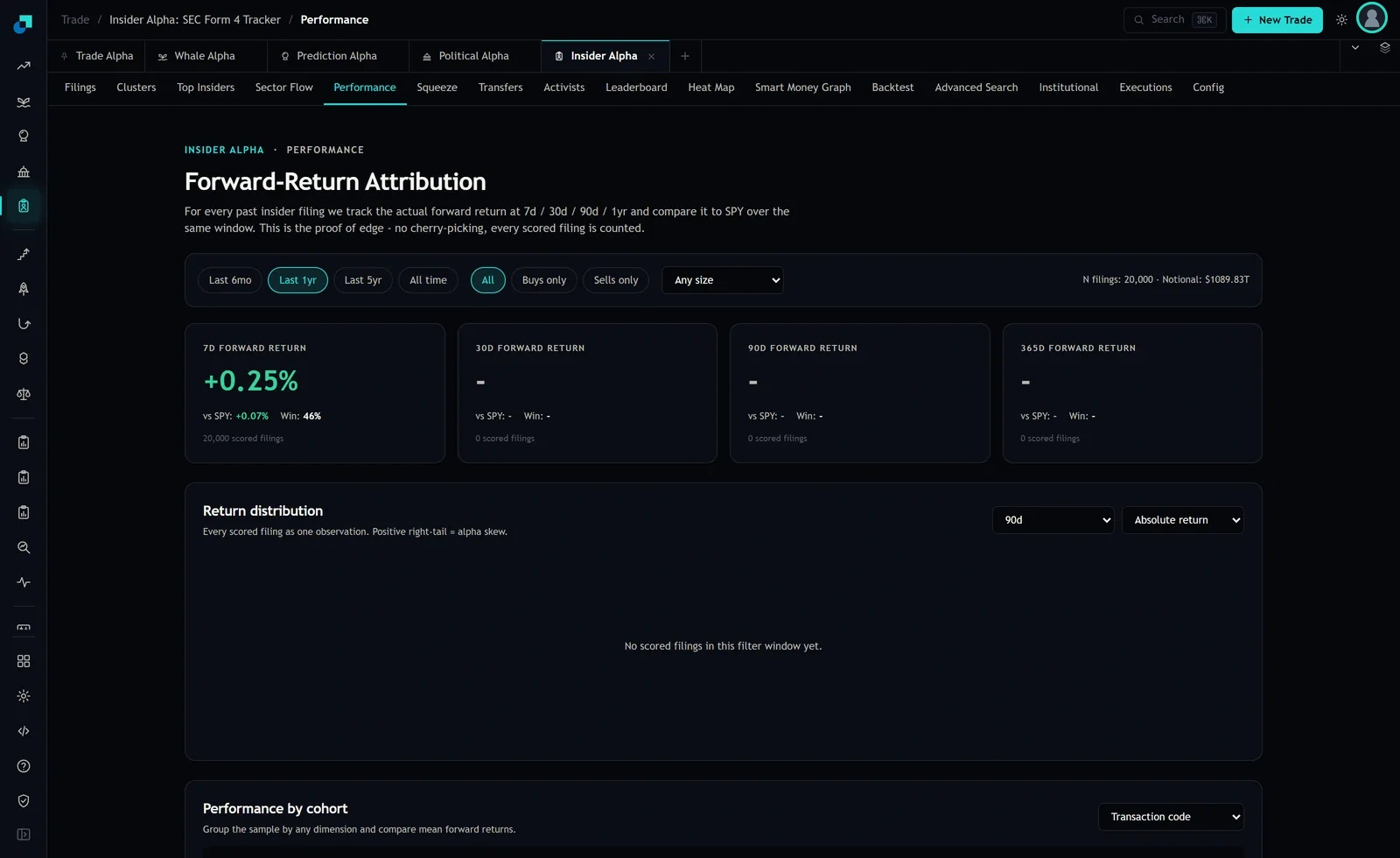
Three honest qualifications belong in the same breath as those numbers, and putting them in yourself is worth more to your credibility than anything else in the pack. Twenty thousand is a round number, which usually means a cap rather than a population, so this is not a claim about every filing in the year. Zero scored filings at three horizons is missing data rather than a flat result, and it means the module could not confirm a thirty or ninety day edge on the day. And a notional figure in the trillions of dollars alongside twenty thousand filings cannot be a literal dollar total of anything, so it should not appear in any calculation until someone can say what it sums.
A committee that hears you volunteer those three points will spend the rest of the meeting on the strategy. A committee that finds them itself will spend the rest of the meeting on you.
Capacity and turnover, which is where the approval actually turns
Eighteen basis points of gross relative return over seven days is the whole edge as measured. Every structural question the committee will ask reduces to whether that survives contact with your book.
Turnover first, because it is the multiplier on everything else. A seven day signal implies roughly fifty round trips a year per name slot if you rebuild the position each time. Present the round trip cost estimate by liquidity bucket and show the product. If your cost estimate is ten basis points round trip in the most liquid quartile, you have consumed more than half the gross edge before delay, and in anything thinner the arithmetic goes negative. The correct response is not to argue the cost estimate down. It is to propose the longer holding period, and then to say honestly that the panel reported zero scored filings at thirty and ninety days, so the longer horizon is a hypothesis you intend to test rather than a result you are citing.
Capacity second. Derive an eligibility floor from your own book rather than from the screen. Fix a participation cap, fix a completion window, decide the smallest position that justifies the research and risk line it will generate, and invert to get the average daily volume a name must trade to be eligible. Then count how many filings a quarter clear that floor. That count, multiplied by the maximum position the floor permits, divided by the average holding period in quarters, is your deployable capital estimate. If it comes in below the allocation being discussed, say so before anyone else works it out, and offer the two options rather than one: lower the floor and accept measured execution costs, or cap the allocation and label the sleeve capacity constrained.
The compliance section that a good allocator will read first
Filings based strategies attract compliance attention out of proportion to their risk, and the pack should meet that head on rather than treating it as an appendix.
Establish the source. Everything here derives from public SEC disclosures, and the module's coverage description is explicit about what it ingests: every Form 4 from US listed companies, officer, director and ten percent owner transactions, open market buys, open market sells, option exercises and 10b5-1 plan sales, activist 13D disclosures, institutional 13F holdings for cross reference, and insider transfers and gift filings. There is no non public input in that list, and saying so in one sentence removes the question that everyone is actually thinking about.
Then cover the parts that are genuinely yours to manage. Personal account dealing policy, because analysts reading a filings feed all day will see things they want to own. Restricted list interaction, because a corporate access or advisory relationship elsewhere in the firm can make an otherwise clean signal unusable and the sleeve needs a documented block rather than a case by case argument. Ownership thresholds, because position sizes that are trivial in a large cap can push you across a disclosure line in a small one, at which point you acquire a filing obligation and a much slower exit. And record retention, because the defence of any filings strategy is the audit trail showing what you saw and when.
Name the failure modes yourself, in the document, before the drawdown
The section that separates an approved sleeve from a rejected one is the one that describes how it goes wrong, written while things are calm and signed by the person proposing it.
Name at least these. Cost overrun, where realised shortfall exceeds the budget and the sleeve is quietly unprofitable while the signal is still working, detected by comparing realised fills against arrival price monthly rather than annually. Sample thinning, where a filter set that looked robust leaves a few hundred filings and a fraction of a percentage point gets treated as a result. Horizon drift, where positions are held longer than the tested window because selling is uncomfortable, which converts a measured strategy into an unmeasured one. Crowding, where a published screenable signal in a thin name is acted on by everyone at once, so your participation assumption is worst exactly when the signal fires. And concentration by sector, since insider buying clusters in industries for reasons that have nothing to do with the individual companies, which can leave a sleeve that looks diversified by name and is not diversified by factor.
For each one, write the observable that would tell you it is happening and the pre agreed response, including the size of the cut. The value of that table is not that it prevents the failure. It is that when the sleeve is down and the committee asks what happened, you can point at the row you wrote before it happened and describe the action you already took, rather than improvising an explanation in a room where nobody is inclined to believe one.