The score presets in the Asset Outperformer Engine look like a convenience feature and they are actually the most consequential filter on the page. The bands are fixed and stated: Elite covers 70 to 100, Solid covers 40 to 69, Emerging covers 20 to 39, Weak covers 0 to 19, and there are two open-ended options for above 50 and above 30 alongside an unfiltered Any Score. Choosing among them feels like choosing quality. What you are really choosing is where in an asset's life you want to arrive, and that decision commits you to a holding period whether or not you have thought about it.
The bands are a filter, not a rating
The composite score is built from short-term momentum over 1, 3 and 7 days, medium-term trend over 30 and 90, long-term strength over 180 and 365, and the consistency of outperformance against the five benchmarks. Because the long horizons are in there, the score is slow. It rewards things that have already been working for a while, and it takes time to acknowledge things that have only just started.
That lag is the whole reason the bands mean different things. A high score is not a claim that an asset is better. It is a claim that an asset has been outperforming for long enough and consistently enough for seven timeframes to agree. A low score is often the same asset a few months earlier. The band you filter to is therefore a statement about timing, and treating Elite as simply the good list is how people end up buying strength at the point it has the least room left.
Elite buys strength that is already visible
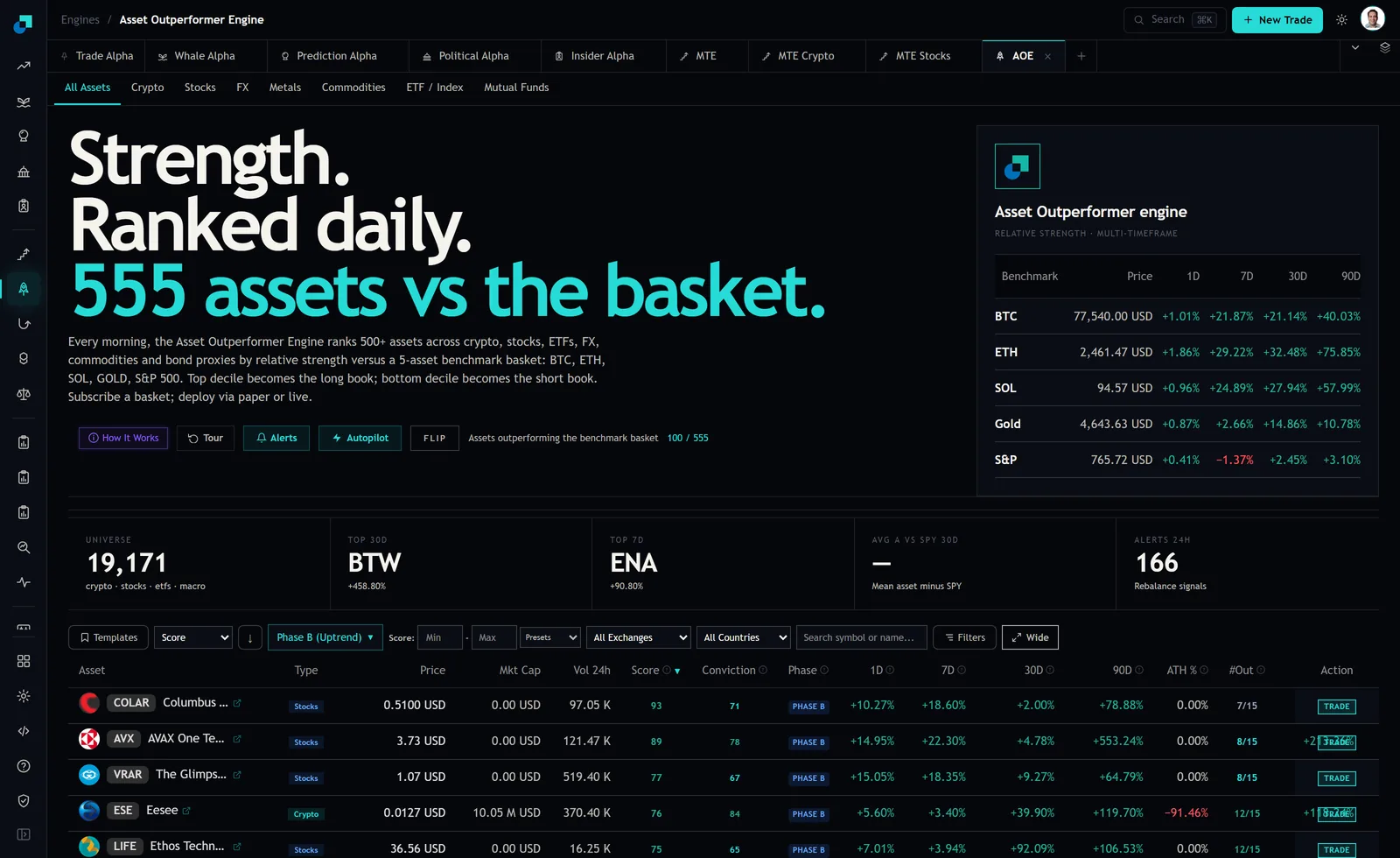
Filtering to Elite gives you the names where the case is settled. At capture the top of the board ran from 93 down through 89, 85, 82, 77, 76, 75, 75, 74, 74, 73, 73, 72, 72 and 72, and every one of those rows carried the same phase label, PHASE_B, which the module defines as a confirmed uptrend.
That homogeneity is the honest description of what the Elite band gets you. It is a crowded set of names doing the same thing, which is exactly what you want if your plan is to hold something that is working and not think about it for a few weeks. It is also the band where the interesting move is most likely behind you. Look at the same rows' 30-day figures and the picture sharpens further: COLAR at 93 had moved +2.00% over 30 days, CRWN at 85 had moved +0.80%, and 0KQK at 72 had moved +0.75%. High score, very little recent movement. The score is being carried by the longer windows.
Emerging buys the turn and charges you for it
The Emerging band, 20 to 39, holds assets where the short and medium windows have started to work and the long ones have not caught up. Some of those are genuine early turns. Most are not, and that ratio is the entire tradeoff.
The cost of fishing here is not primarily money, it is time and attention. A name in the twenties that is genuinely turning will take weeks or months to make its way up the bands, because the 180 and 365 day components physically cannot move faster than that. You are committing to hold something that will look wrong for a while, through a period where nothing confirms your decision. If you are the sort of person who checks positions daily, this band will talk you out of every good trade you make in it.
The Solid band, 40 to 69, is the compromise and it is where I spend most of my time. The medium and long windows have started to agree, the move is not yet obvious to everyone running a screener, and the holding period required is measured in weeks rather than quarters. The captured crypto tab was thick in the upper half of this band, with a run of names at 69, 69, 69, 69 and 68, 68, 68, 68 across consecutive rows.
Matching a band to the holding period your account can support
Here is the part that decides it for a small account, and it has nothing to do with which band produces better assets.
Every band implies a holding period, and every holding period implies a number of trades per year, and every trade costs you a spread plus fees whether it works or not. On a five thousand dollar account with thousand dollar positions, a round trip that costs you one percent all in is ten dollars. Twelve of those a year is a hundred and twenty dollars, which is two point four percent of the account, which is a real hurdle you have to clear before you have made anything. Rotate weekly instead of monthly and the hurdle roughly quadruples.
The Elite band's slow, consistent names are cheap to hold because they do not demand frequent action. The Emerging band demands patience, which costs nothing directly but requires you to leave money tied up in something unconfirmed for months. The Weak band is not a trading band at all for a long-only retail account. Note also that a band with a floor of zero collects unscored rows, since assets the engine could not price show a score of 0 with dashes in the price and market cap cells, so a list built from that preset needs the blank rows stripped before it means anything.
Running one band at a time
The practical mistake I see most is flipping between presets in a single session, taking a name from Elite and a name from Emerging and a name from Solid, and ending up with a book that has three different holding periods and no coherent exit rule. Each of those positions needs to be managed differently and you will manage them all the same way, which means you will sell the slow one out of boredom and hold the fast one too long.
So pick one band and work it for a defined stretch. If you want confirmed strength you can hold through noise, run Elite, size normally and set a time horizon of a month or more before you reassess. If you want to be earlier and you have the patience for it, run Solid, accept smaller positions and expect a longer wait. Leave Emerging alone until you have done the other two long enough to know how you behave when a position does nothing for six weeks.
One operational note that applies to all of them. The engine runs a full scan every six hours, so band membership is not static and a name near a band edge will cross it repeatedly without anything meaningful happening. If you built your list from the Elite preset on Monday, do not be surprised to find a name in Solid on Thursday at a score of 69. That is a rounding boundary, not a signal, and reacting to it is the fastest way to turn a monthly rotation into a weekly one you never intended to run.