A Form 4/A is an amendment to a Form 4 that has already been accepted. It arrives with its own accession number and its own acceptance timestamp, days or weeks after the filing it corrects, and it does not annotate the original in any way you will notice unless you went looking. If your insider store overwrites on receipt, or worse, if it never ingests amendments at all, you are carrying an error rate you have never measured and cannot quote when somebody asks.
This is not a theoretical hygiene problem. Amendments change the fields that research actually keys on, including the transaction code, which is the field that determines whether an event is a purchase or a payroll mechanic. A restatement that turns a code P into a code M does not degrade your signal. It reverses it.
What actually changes in a 4/A
Across the amendments I have read, the corrections fall into a small number of buckets, and they are not equally dangerous.
- Share count and price corrections. Common, usually small, and they matter mainly for notional-weighted aggregates rather than for the direction of a signal.
- Transaction code corrections. Rare and severe. A grant reported as a purchase, an exercise reported as an acquisition, a disposition to the issuer reported as an open-market sale.
- Transaction date corrections. These move an event across your point-in-time boundary and can silently change which rebalance a filing belongs to.
- Ownership form corrections, direct against indirect. This changes who is economically exposed, and it changes any concentration or beneficial ownership calculation built on top.
- Footnote additions. The transaction table stays identical and the meaning changes completely, most often because a trading plan and its adoption date get disclosed after the fact, or because a pledge is added.
- Reporting person additions or removals, including filings originally submitted under the wrong insider or the wrong issuer.
Note that the last two categories leave the numeric row untouched. Any reconciliation that compares only the numbers between the original and the amendment will report no change and will be wrong.
Why an as-first-reported store is not a research asset
There are two defensible states for an insider database and one indefensible one. You can hold as-first-reported data, which is what a decision maker could have seen at the time. You can hold fully restated data, which is what is true now. What you cannot do is hold whichever version happened to arrive last, keyed on a single row per accession, because that is neither, and it means your backtest sees corrections that had not been published on the date it is trading and your live signal misses corrections that have.
The uncomfortable part is that both defensible versions are necessary and they answer different questions. As-first-reported is the only honest basis for simulating a decision. Restated is the only honest basis for attribution after the fact, because when you are explaining a position that went wrong, the question is what the transaction actually was, not what the first submission claimed. Keep both and label every extract with which one it is.
Measuring your own amendment rate rather than quoting someone else's
I am not going to give you an industry amendment rate, because any number I quote would be a number you cannot check against your own universe, your own market cap band and your own date range, and those three things move it around considerably. Measure yours. The query is short and you only need to run it once a quarter.
Take every 4/A your ingest received in the period. Join each back to the original accession it amends. Diff the two on a fixed field list, which should include code, transaction date, shares, price, ownership form, reporting owner and the footnote text as a whole blob. Then report four numbers to the desk: the share of original filings that were later amended, the share of amendments that changed a transaction code, the median lag in calendar days between the original acceptance and the amendment acceptance, and the same figures restricted to the filings your strategy actually acted on. That last cut is the one that matters, because a high amendment rate on filings you ignore is trivia and a two percent rate on filings you traded is a live risk.
Do the same thing to any vendor before you rely on them, including this one. Ask whether amendments are stored as separate events or applied in place, whether the original is retained, and what timestamp the history is keyed on. If the answer is that corrections are applied in place, you know exactly how much your backtest can be trusted.
Sanity checks on aggregates, and a live example of why
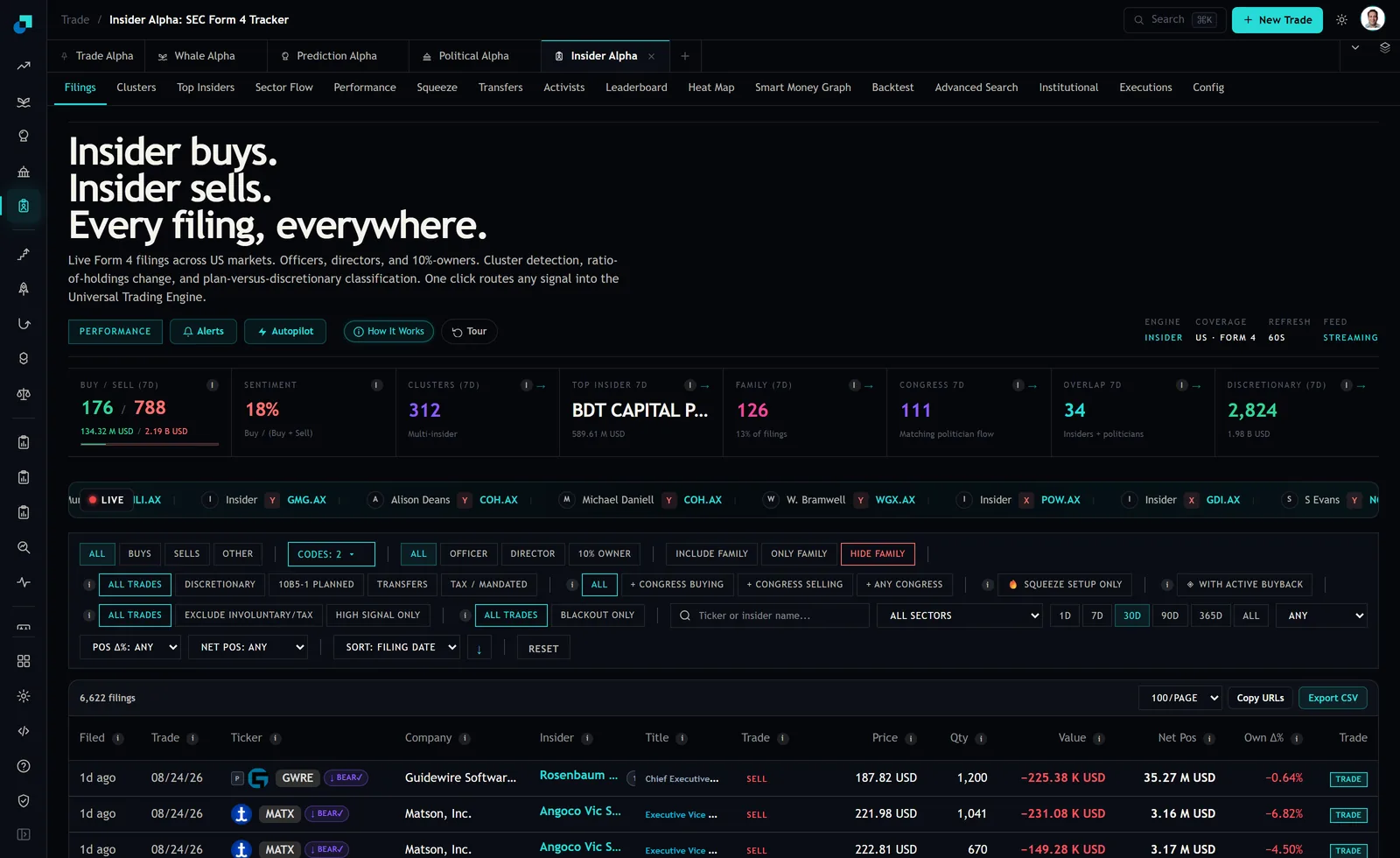
Restatement is one source of quiet error and aggregation is another, and they compound. The Insider Alpha performance view is a useful illustration because it is honest about its own gaps. At the time of writing it showed a seven day forward return of +0.25% against SPY at +0.07% with a 46% win rate over 20,000 scored filings, and the thirty, ninety and three hundred and sixty five day buckets sat empty with zero scored filings behind them. Two things follow from that. The average filing is not an edge, which is the correct and unglamorous starting point for any insider research. And a panel can be populated at one horizon while being entirely unpopulated at another, so any figure you lift from a dashboard needs its sample size lifted with it.
The same view reported an aggregate notional of $1089.83T behind those filings. That figure cannot be right by several orders of magnitude, and the useful reaction is not to distrust the module but to remember that summed notional columns are the single most fragile thing on any filings dashboard. Units drift, derivative rows get counted at underlying value, one bad price on a thinly traded name propagates. Sanity check every aggregate against a rough independent estimate before it goes into a memo, and never let a summed dollar figure be the number a position size is anchored on.
What this buys you in an investment review
The payoff for all of this arrives on the day a position built on an insider signal has gone against you and somebody senior asks what the process saw. With a bitemporal store you can answer precisely. Here is the filing as it stood when we acted, here is the version that exists today, here is the diff, here is the acceptance timestamp of the amendment, and here is whether our decision would have differed had the corrected version been available. Sometimes the honest answer is that the original was wrong and nobody could have known, which is a data risk you accepted knowingly. Sometimes the answer is that the correction had been public for nine days and your pipeline had not picked it up, which is an operational failure and a fixable one.
Those are very different conversations, and you only get to have the right one if the record supports it. A store that silently overwrites gives you no way to tell them apart, which means every such incident defaults to looking like the second kind.