Most macro alerts die the same way. You set one, it fires, you look, nothing has really changed, you close it. It fires again three weeks later, you glance and close it. By the fourth time you are not reading it at all, and the one that actually mattered arrives into an inbox where you have already learned that this particular notification means nothing.
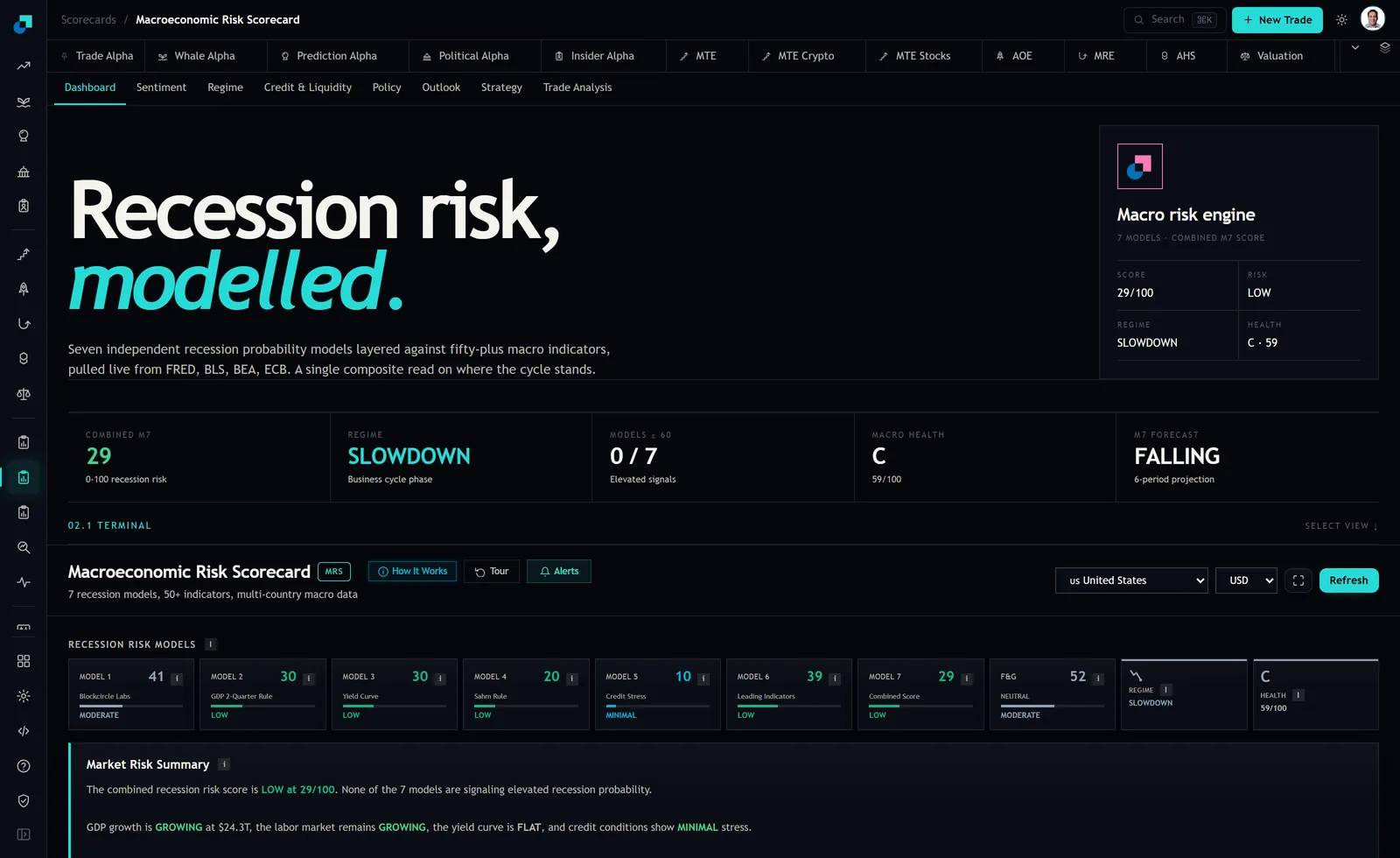
That failure is a design failure, not a discipline failure. The Macroeconomic Risk Scorecard combined score currently reads 29 out of 100, with a regime label of SLOWDOWN sitting next to it. Deciding what movement in that number deserves to interrupt your week is a piece of arithmetic you can do once and then live with, and it is worth doing before you set anything, whether the trigger ends up being a real alert or a monthly reminder in your calendar.
Start with how many alerts you can afford
Work backwards. How many times a year are you willing to stop what you are doing, open the dashboard, and think for ten minutes about your allocation? For most people running their own money alongside a job, the honest answer is two or three. Not twelve. Certainly not thirty.
That number is your budget, and it constrains everything else. A rule that would have fired eight times last year is not a rule you can run, no matter how theoretically sound the threshold is, because you will have stopped reading it by the fourth fire. Setting the sensitivity is therefore not a question about macroeconomics. It is a question about your own attention, and the correct answer is deliberately, almost uncomfortably insensitive.
Where the noise in this particular number comes from
The composite pulls from more than fifty macroeconomic indicators across FRED, the BLS, the BEA and the ECB, and those inputs do not update on the same clock. Some of them are monthly official releases. Others, the dollar index, credit default swap levels, high yield spreads, move every trading day.
That matters for alert design in a specific way. Movement in the composite between official releases is mostly the market-priced half of the inputs shifting, and market-priced inputs mean revert constantly. Movement that survives across a monthly release is a different animal, because it means the slow data agreed with whatever the fast data was already saying.
So the noise is not evenly distributed in time. It is concentrated in the gaps between releases, which tells you immediately that the right alert is not a threshold on the live number.
The three conditions that make a macro rule survive
Every alert rule worth running has these, and most rules people set have none of them.
- A minimum move. Not a level, a move, and not a small one. On a zero to one hundred composite that is built to be slow, anything under about ten points over a quarter is inside the range this number wanders in without meaning anything.
- Persistence. The condition has to hold on two consecutive monthly readings before it counts. This single requirement kills most false alarms, because the reversals happen fast and the real moves do not. It costs you a month of lateness. Given the actions a macro alert should trigger, a month is affordable.
- A reset gap. The level that turns the alert off must be well below the level that turned it on. If your alert arms at a rise of twelve points and disarms the moment the rise falls to eleven, you have built a machine that fires repeatedly around one boundary. Arm on twelve, disarm only when the score returns to within four points of where it started.
Those three are not specific to macro. They are what separates a usable trigger from a flapping one anywhere. But they matter more here than almost anywhere else, because the underlying process genuinely moves slowly and the temptation to make the alert sensitive is therefore strongest.
The rule I would set on a retail account
Concretely, three conditions, any one of which is worth ten minutes of your time. All three are things you can evaluate from the dashboard header in under a minute.
- The move rule. The combined score is at least twelve points above its lowest reading in the previous three months, and it has been at least twelve points above for two consecutive monthly checks.
- The regime rule. The regime label changes, and the new label is still showing at your next monthly check. A label change is a discrete event rather than a continuous one, so persistence is doing more work here than a magnitude test would.
- The agreement rule. The count of models at or above 60 goes from zero or one to three or more. This one is the most informative of the three and the least likely to fire on noise, because it takes several independent models crossing the same line rather than an average drifting.
My honest guess is that this set fires once or twice a year in a normal environment, which is inside the budget. I say guess deliberately. I have not backtested those thresholds and I am not going to present them as though I had. What I can defend is the structure: a magnitude condition, a persistence condition and an agreement condition, each of which requires something different to be true before it interrupts you.
The ninety seconds after it fires
Have the response written down before the alert exists, because the whole point is to remove the decision from the moment you are stressed.
When one of those conditions trips, you open the scorecard and check three things. Which rule fired. Whether the other two are anywhere near firing. And whether the regime label and the health grade are pointing the same way as the score, or against it. Then you look at your own account and answer one question: has anything drifted from the weights I wrote down, and am I carrying leverage I would not add today.
Most of the time the answer is no and you close the tab, and that is the alert working correctly rather than the alert wasting your time. An alert that only ever fires when action is required is not an alert, it is hindsight. What you are buying with this rule is a small number of scheduled moments where you look at a slow-moving risk measure with fresh eyes instead of finding out about it from a price move.
One thing not to do: do not attach the alert to a trade. A rule that says "if the score rises twelve points, sell twenty percent of equities" converts a coarse macro reading into a precise instruction it cannot support, and it will hand you a realised loss and a taxable event on a number that is back at 29 by the next quarter. The alert opens the review. Your written allocation policy decides what happens in it.