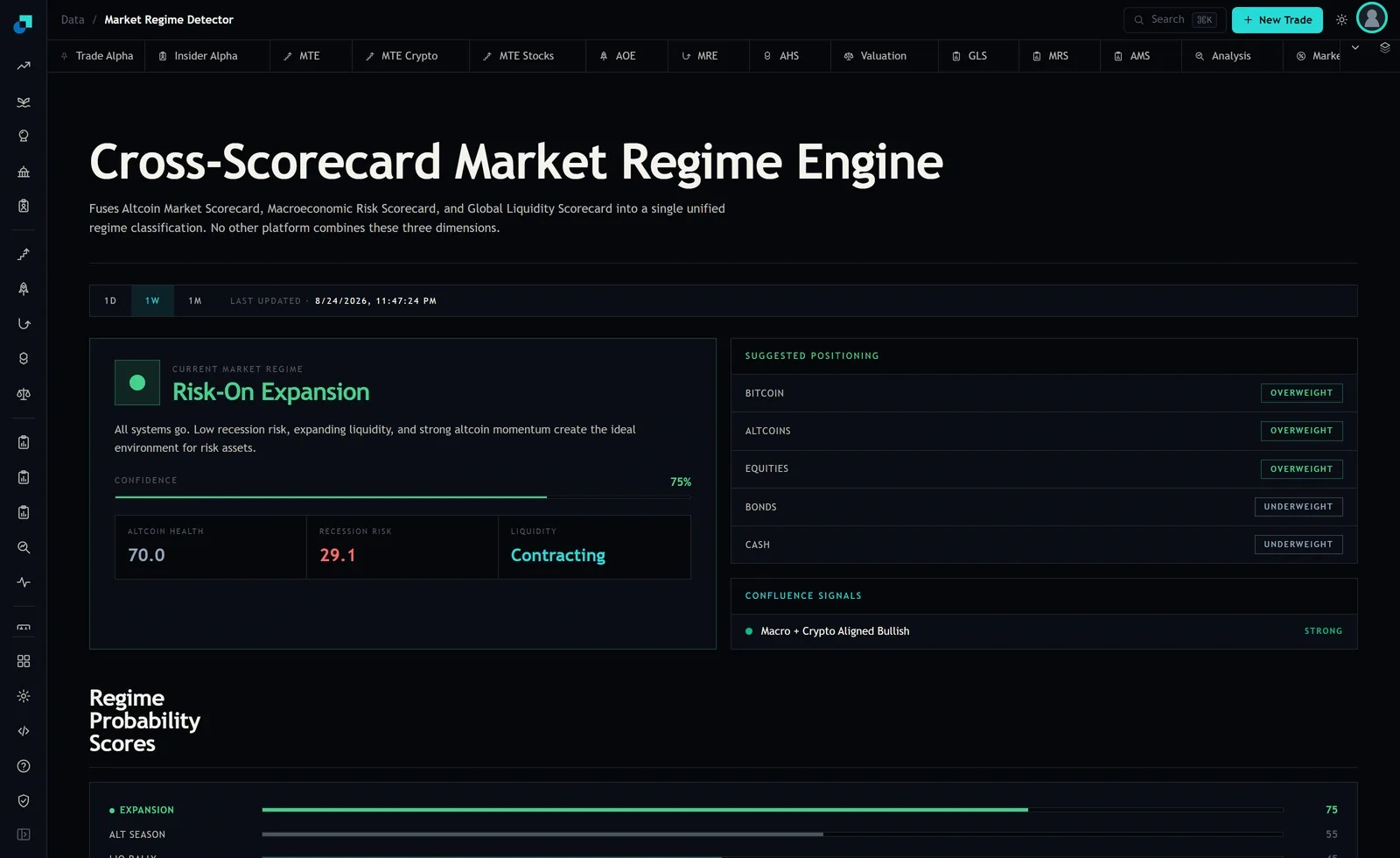
The Suggested Positioning panel is the most actionable thing on the regime screen and the hardest to act on, because it hands you five words and no numbers. At the capture I am working from it read bitcoin overweight, altcoins overweight, equities overweight, bonds underweight, cash underweight.
Five instructions, zero sizes. That gap is where most people either do nothing or do something wildly out of proportion, and closing it is arithmetic rather than judgement.
The labels are directions, and directions need a starting point
Overweight means more than your normal. It does not mean a lot, it does not mean a specific percentage, and it cannot mean anything at all until you have written down what your normal is. The panel does not know your baseline and does not ask, so the first move is not a trade. It is a piece of paper.
Write your neutral allocation, the weights you would hold if you had no view whatsoever, and make it sum to 100. If you have never done this, the exercise will take twenty minutes and it will be the most useful twenty minutes of the week, because without it every future signal you read has nothing to attach to.
For the worked example below I am using a mixed account at bitcoin 15, altcoins 10, equities 50, bonds 15, cash 10. That is not a recommendation, it is a set of numbers I can do arithmetic on. Substitute yours.
Three plus, two minus, and why a uniform tilt does not balance
The obvious approach is to pick a tilt size, say five percentage points, and apply it to every line. Do that here and you add fifteen points to the overweights while removing ten from the underweights, which leaves you five points over budget and no way to fund it. The panel gives you three positives and two negatives, and there is no rule inside it that makes them net to zero.
So work in the other direction. Decide what you are willing to release from the two underweights first, and treat that pool as the entire budget for the three overweights. Funding first, allocation second. This ordering is what keeps the arithmetic honest and it also stops you from quietly financing a risk-on tilt with money you never had.
On the example baseline, cut bonds by a third of the sleeve, five points, and halve cash, another five points. Ten points released. On a 40,000 dollar account that is 4,000 dollars, and that number is the whole of what you have to work with.
Splitting the pool proportionally rather than evenly
Now split 4,000 dollars across bitcoin, altcoins and equities. There are two defensible ways and they produce very different portfolios.
An even split gives each sleeve 3.33 points, or roughly 1,333 dollars. Look at what that does proportionally. It grows the equity sleeve by under seven percent of itself and grows the altcoin sleeve by a third. Three labels of equal weight on the panel become three wildly unequal changes in your actual risk, with the smallest and most volatile sleeve taking the largest proportional increase. That is how a modest tilt turns into a crypto bet.
A proportional split allocates the pool in the ratio of the existing overweight sleeves, which here are 15, 10 and 50, summing to 75. Bitcoin takes 15 divided by 75 of the pool, altcoins 10 divided by 75, equities 50 divided by 75. In dollars on a 40,000 dollar account that is 800 to bitcoin, 533 to altcoins and 2,667 to equities.
The resulting portfolio is bitcoin 17.0, altcoins 11.3, equities 56.7, bonds 10.0, cash 5.0. It sums to 100, every sleeve moved in the direction the panel indicated, and the shape of the portfolio survived. That last property is the one I care about. A regime tilt should change how much risk you are carrying, not what kind of investor you are.
The two underweights are where this usually breaks
Everything above assumed you own bonds and hold meaningful cash. Plenty of self-directed accounts hold neither, and for those accounts the panel's two underweights are instructions with nothing behind them.
If your bond sleeve is zero, underweight bonds is already satisfied and releases no money. If your cash is at two percent because you deploy everything, halving it releases one point. The pool is one point instead of ten, and the honest response is to make a one point tilt, not to invent funding by selling something the panel did not tell you to sell.
Underweight cash deserves particular care in the other direction too. Cash in a personal account is doing a job that has nothing to do with market regimes, which is covering the months when income and expenses do not line up. That reserve is not part of the investable portfolio and should never appear in the baseline you tilt. Decide the split once, keep the reserve out of the arithmetic entirely, and then underweight cash means only the tactical cash inside the investable pot.
There is a third case worth naming. If the tilt the arithmetic produces is smaller than about two percentage points of the account, skip it. On 40,000 dollars that is 800 dollars spread across three purchases, and the combination of spreads, commissions and the odds of a taxable gain on the bond sale makes the round trip cost a real fraction of anything the tilt could plausibly earn. Costs are the reason small accounts should tilt rarely and in larger steps rather than continuously in small ones.
Three overweight labels are one bet, not three
The last thing to internalise before placing the orders is what you are actually taking on. Bitcoin, altcoins and equities are all risk assets, and in the environment this panel is describing they tend to move together. The card said so in its own words. The confluence signal in the same column read macro and crypto aligned bullish at strength STRONG, which is the module telling you the three overweights come from one underlying call.
So do not congratulate yourself on diversifying across three overweights. You have one position, expressed three ways, and the correct way to size it is against the total, not line by line. If a simultaneous fifteen percent drawdown across all three would breach what you can tolerate, the tilt is too large, and the fix is a smaller pool rather than a cleverer split.
The one number to write in your notes today is the pool. Not the regime name, not the confidence figure, the dollar amount you released from bonds and cash to fund this tilt. When the panel eventually flips to underweight on the risk assets, that number is the size of the trade you will need to reverse, and knowing it in advance is what makes the reversal a decision rather than a scramble.