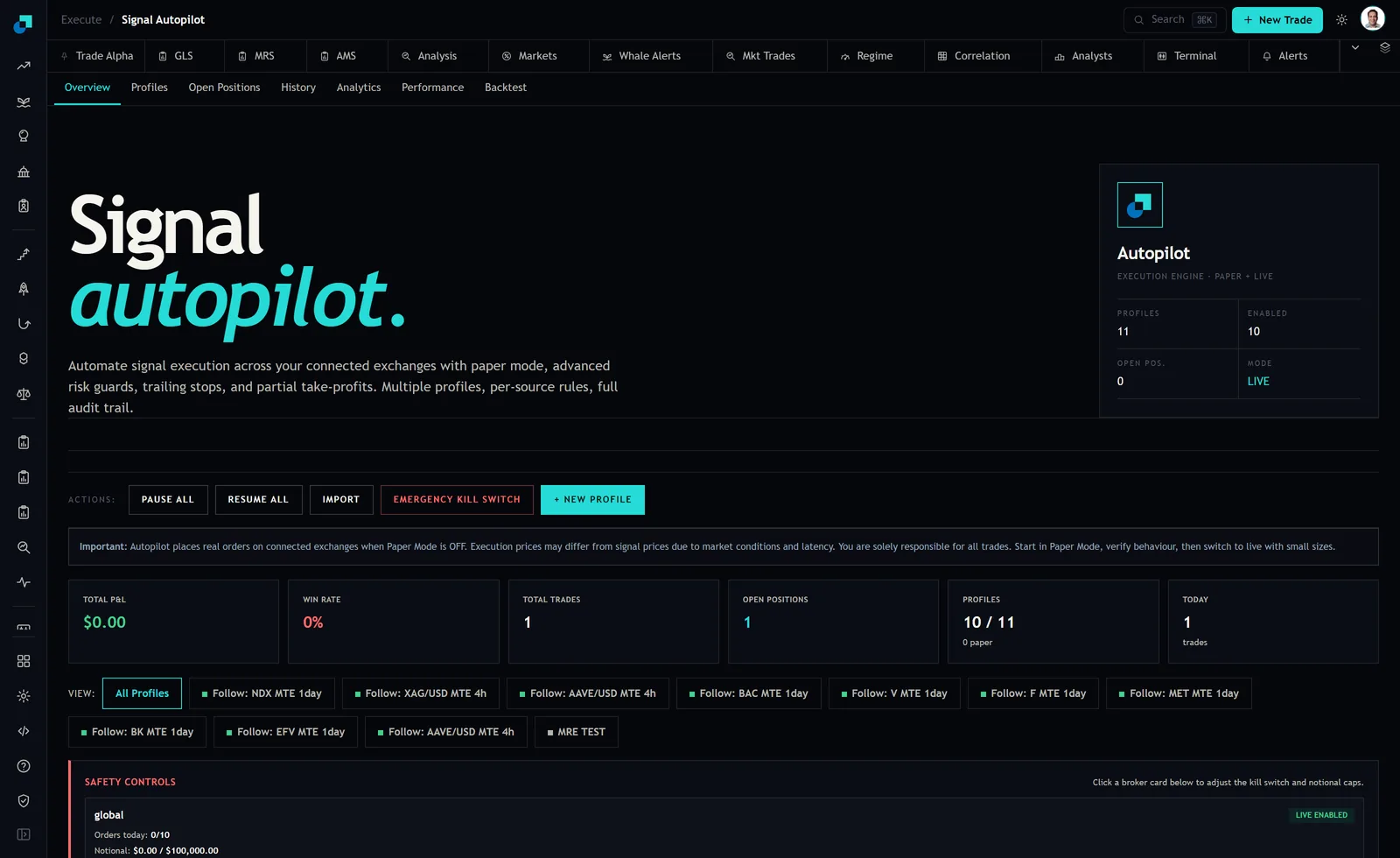
Alert only is a posture rather than a button. It means the profile is running, producing signals, and is not permitted to touch your capital under any circumstances for a fixed period. On Blockcircle the mechanism for that is paper, which the engine runs alongside live and reports separately: the overview badges itself PAPER + LIVE and counts how many of your profiles are in each. Mine read 0 paper at the time of writing, which is the state most accounts are in, because paper feels like a delay between you and the thing you actually want to do.
It is worth the month. Not for the reason people assume, though. A month is far too short to tell you whether a strategy makes money, and anyone who tells you otherwise is selling something. What a month tells you is whether the plumbing works and whether you can live with the thing, and both of those will stop you losing money in ways that a backtest never could.
The month is testing you and your setup, not the edge
Be clear about what is being evaluated, because it changes what you record and what conclusions you are allowed to draw at the end.
You are testing three things. Whether signals actually reach you reliably, which is an infrastructure question with a yes or no answer. Whether the profile trades the way you were told it trades, in terms of frequency, instruments and hold time. And whether you agree with its decisions often enough that you will not spend your live months fighting it. That third one is the expensive discovery and it is the one people skip entirely.
You are not testing profitability. Paper fills are optimistic almost by construction, since they tend to assume you got the price you asked for, in full, without queueing behind anyone. Real fills on anything thin will be worse. So treat the profit column in your log as directional colour and nothing more, and specifically do not let a good paper month be the reason you size up.
Week one is plumbing, and you evaluate nothing
Get the profile running in paper and then deliberately judge none of its decisions for seven days. The temptation to start grading it immediately is strong and it corrupts the log, because a signal you evaluate on day two, before you have written down what you would have done, is a signal you will remember wrongly.
What you are doing instead is confirming the pipe. Does the signal arrive, and where. Does it arrive once or three times. How long after the market event does it show up. Does it come through when your laptop is shut. Send yourself a test on a weekend and find out whether you actually see it or whether it lands in a notification list you check on Tuesdays.
Also open the Open Positions and History tabs at the end of each of those seven days and just read them, so that by week two you can parse them in ten seconds rather than thirty. That sounds trivial. It is not, because the day you need to read those tabs quickly is a day when something is going wrong.
The log, and the column everyone leaves out
A spreadsheet is enough. Seven columns, filled in as signals arrive, and one hard rule attached to them.
- Timestamp the signal arrived, and separately the timestamp the profile acted, if those differ.
- Instrument and direction.
- Price at the signal.
- Size the profile intended to take.
- Would you have taken this trade by hand? Yes, no, or unsure. Written within the hour, before you know anything about how it went.
- What the profile's own exit rule produced, filled in when the position closes.
- Whether you felt an urge to intervene, and what you would have done instead.
Column five is the one everyone leaves out and it is the reason to do any of this. It has to be recorded before the outcome is known, and it must never be edited afterwards. The moment you know a trade worked, you will remember having liked it, and you will remember it sincerely. That is not dishonesty, it is how memory works, and it is why the column is worthless unless it is time stamped and frozen.
Column seven is the second most useful. Count the entries at the end. Every one of them is a live trade you would have interfered with, and interference is the failure mode that kills automated profiles at retail scale. Not bad signals. Bad overriding of decent signals at the worst moments.
The four criteria that decide it
Set these before week one so you cannot move the posts at the end. Each is a yes or no.
Delivery. Every signal produced during the month reached you and was logged. Not most. If you missed signals because a notification silently failed, the month restarts once you have fixed it, because a signal you cannot see is a live trade you cannot supervise, and you will find that out later at a cost.
Sample. The month produced enough entries to mean something. My working floor is around fifteen. Below that you have an impression rather than evidence, and the honest response is to extend the trial rather than to conclude. If a daily timeframe profile produced three signals in four weeks, you need three months, and that is useful information about the strategy in itself.
Agreement. You would have taken a clear majority of the signals by hand, from column five. Roughly two thirds is where I stop worrying. If you disagreed with half of them, you are about to hand your money to a process you do not believe in, and you will start second guessing it in week two of live trading. That is not a reason to run it smaller. It is a reason not to run it.
Composure. Column seven has a low count. If you wanted to intervene more than about once a week with no money at stake, live capital will convert those urges into actions, and each action breaks the strategy's statistics in a way you will not be able to unpick afterwards.
Notice that none of the four mentions profit. That is deliberate. A month of paper profit is not evidence and a month of paper loss is not evidence either, and using either as your criterion means the decision is being made by noise.
Week five, and going live at a size that cannot hurt
If all four pass, go live at roughly a quarter of the size you eventually intend, and set the exposure ceiling low enough that a bad run over the first month is an amount you would spend on something else without much thought. On a twenty five thousand dollar account that is a few hundred dollars of risk, not a few thousand.
Keep the log running unchanged, with the same columns, including column five. You now have a comparison nobody else has: the same profile, the same log format, paper against live. Two things typically show up in that comparison within a few weeks. Fills are worse than paper suggested, and the size of that gap tells you how much slippage your instruments really cost. And your agreement rate in column five will drift, usually down, because disagreeing with a machine is easier when it is spending your money.
Both of those are things you can act on. Neither of them is visible to someone who went straight to live on day one, which is the version of this where the first month of real trading is also the first month of finding out that the notifications do not arrive at weekends.