The common experience of a listing goes like this. You see the announcement, you feel early, you wait for the token to appear on the exchange so you can trade it, and by the time the chart exists the interesting part has already happened. That sequence is not bad luck and it is not a slow phone. It is what happens when you treat a listing as a single moment when it is really a sequence of four, and the one you can act on is not the one you were watching for.
The listings ledger is useful here precisely because of what it does not do. It tells you which side of go-live a row is on, and it gives you a date. Everything finer than a day has to come from somewhere else, and knowing that up front changes how you use it.
What the three streams tell you and what they leave out
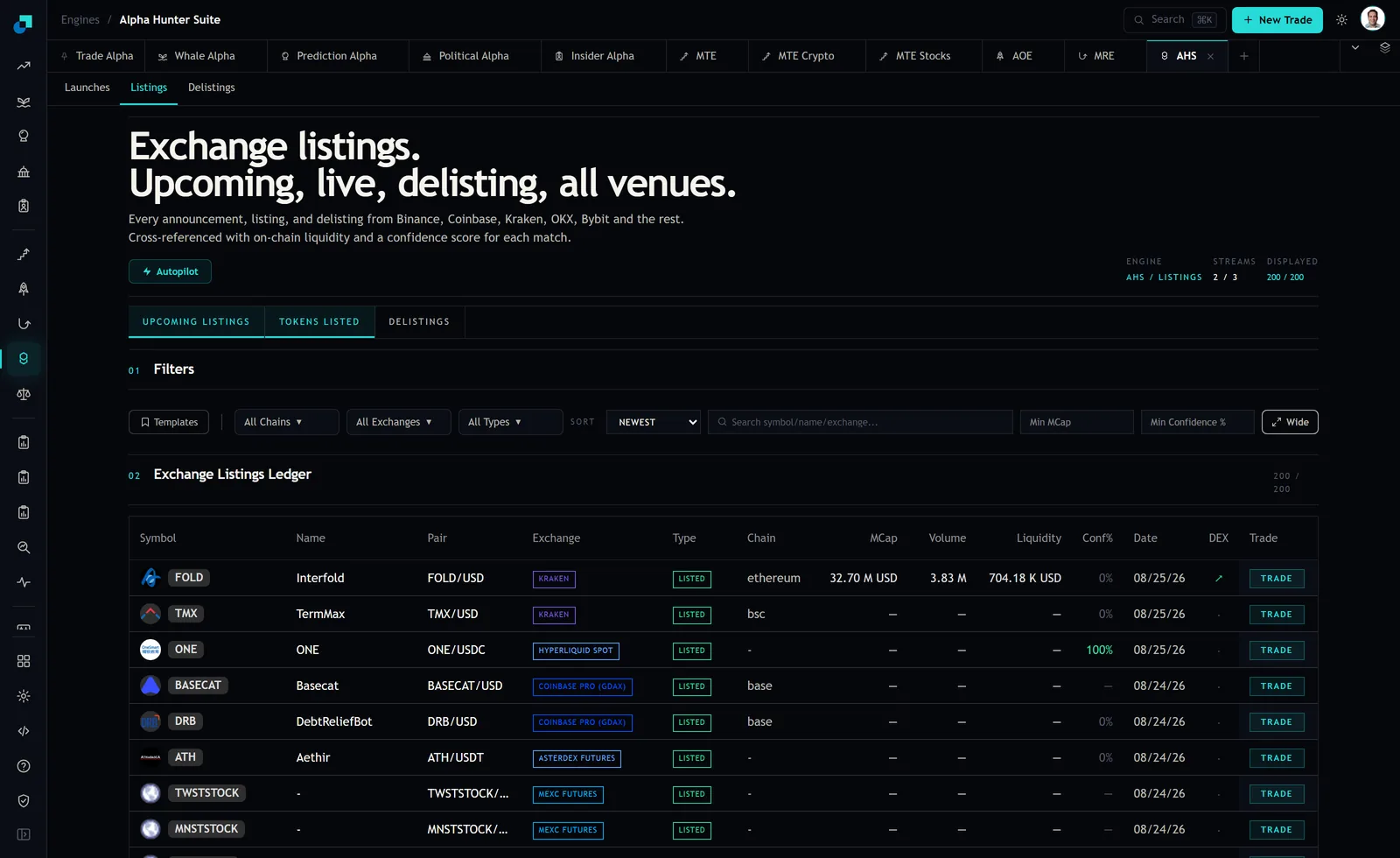
The exchange listings screen splits into Upcoming Listings, Tokens Listed and Delistings. Those are states, not timestamps. A row sitting in Upcoming is a token with an announcement attached and no trading yet. A row in Tokens Listed has crossed over. Turning both streams on showed 200 of 200 rows at capture, and turning all three on showed 300 of 300.
The Date column is a date. The rows on screen read 08/25/26, 08/24/26 and so on. There is no hour on the ledger, which means the ledger will tell you that a listing is today and it will not tell you that order entry opens at ten past two. That is the boundary. For anything inside the day, the exchange's own announcement is the source, and it is worth reading it in full rather than reading the headline, because the phases are usually spelled out there in plain language and almost nobody looks.
The four phases, and which one is the trade
Split the window into what actually happens on the venue, because each phase changes a different thing.
- Announcement. The exchange publishes. Nothing about supply or demand on the venue has changed, but every venue that already trades the token has just repriced, and so has the on-chain market if one exists.
- Deposits open. Holders can move tokens onto the exchange. This is the moment potential supply starts arriving at the venue, and it usually opens hours or days before anyone can sell.
- Order entry. The book accepts orders. Depending on the venue this may be a pre-market or call phase where orders rest without matching. Price discovery begins here, even if no trade has printed.
- First match. Trading is live and the chart exists. This is the moment most people are waiting for and it is the last of the four.
The reason the move often looks finished by phase four is mechanical, not mysterious. If the token already trades somewhere, whether that is another exchange or a DEX pool, then the announcement has a reference price to move immediately and the venue's opening price has to be somewhere near it. The listing venue is not discovering a price from nothing. It is joining a market that has already had hours to react.
The second reason is on the supply side. Deposits opening means tokens are arriving at the venue with the intention of being sold into the listing. That inventory builds through phases two and three and it is sitting on the book before the first print.
Where the window is actually lost
For most retail traders the window is not lost to slow reactions. It is lost to logistics, and logistics take longer than decisions.
To trade the open on a venue you need funds on that venue. If you need to open an account, that is identity verification and it is measured in hours or days, not minutes. If you need to fund it, that is a transfer with its own confirmation time. If you hold the token elsewhere and want to sell into the listing, you need to have deposited it during phase two, which means noticing phase two, which is the phase nobody watches.
This is why the useful reading of an Upcoming row is a logistics checklist rather than a trade idea. Do I have an account on this venue. Is it funded. Is the quote asset on the row one I actually hold. If the answer to any of those is no, then the announcement is not actionable for you at the open no matter how early you saw it, and the honest thing is to say so at the point of reading rather than at the point of the print.
The trade you can actually take instead
If you cannot be positioned before order entry, you are not trading the listing. You are trading what happens after it, and that is a different setup with different sizing, so it deserves to be named rather than fallen into.
The post-listing trade is a normalisation trade. The day-one book is unusually deep and unusually crowded, and both of those decay. Your entry is later, your depth is worse, and the catalyst is behind you. None of that makes it a bad trade, but it does mean you should not size it as though you caught the event, and you should not use day-one volume figures to estimate what you can get out of.
The other honest option is to trade the announcement rather than the listing, on whichever market is already open. If the token trades on chain, the on-chain market reacts at phase one, and the listings ledger carries a Chain column and a DEX link for rows where that resolution exists. That route has its own problem, which is that you have to be certain the on-chain asset is the same asset the exchange announced, and the ledger's confidence field exists precisely because that match is not always clean.
A checklist for the next Upcoming row you read
Three things, in order, and the whole thing takes a minute.
First, read the row for state and venue. Which stream it is in, which exchange, and which pair, because the pair tells you which asset you need to be holding to participate at all.
Second, open the exchange's own notice and write down the three sub-day times: deposits, order entry, first match. This is the step that converts a date into a plan and it is the step that gets skipped.
Third, decide before any of those times which phase you are trading, and be willing to answer none. A listing you cannot reach until phase four is not an opportunity you missed by being slow. It is an opportunity you never had, and treating it as a miss is what leads to buying the first candle at the top of a move that started while you were reading about it.