The mistake I see most often with automated execution is not a bad strategy. It is a cap set as a percentage, by someone who was thinking about their whole account, applied by an engine that was only ever thinking about itself. You set fifty percent, you feel prudent, and then you discover the profile was measuring fifty percent of something you had not defined, while the eighteen thousand dollars of stock you bought by hand last month sat in the same account being counted by nobody.
Autopilot advertises advanced risk guards, and the guard worth deciding before anything else is the ceiling on how much of your money the profile is allowed to have in the market at any one time. The field is a five second change. The number is the part that takes an evening, and it is worth the evening, because a cap chosen properly is the difference between a bad month and a bad year.
The money the automation cannot see
Start with the assumption that is doing the damage. An execution profile reasons about the positions it opened. Positions you opened yourself, in the same brokerage or exchange account, are not its problem and in most setups are not in its arithmetic at all. Your broker does not care which of you placed the order. Your margin does not care. Your drawdown very much does not care.
So work the arithmetic in dollars, from the top down, in this order.
- Account equity. Say forty thousand dollars.
- What is already committed by hand. Say eighteen thousand dollars of positions you are holding and intend to keep.
- The ceiling you actually want on total market exposure across everything. If that is seventy percent, it is twenty eight thousand dollars.
- Headroom you want to keep free for discretionary trades over the next month. Say six thousand dollars.
- What is left is the automated cap. Twenty eight thousand minus eighteen thousand minus six thousand is four thousand dollars.
Four thousand dollars on a forty thousand dollar account. Ten percent, not the fifty percent that felt reasonable in the abstract, and the gap between those two numbers is the entire point of doing this on paper first. The percentage you would have typed is five times the number the arithmetic supports.
When the honest cap is too small to bother with
Four thousand dollars spread across a handful of positions is a few hundred dollars each, and at that size a lot of automated strategies are not worth running, because fees and spread eat the edge before it can compound. That is a genuinely useful outcome rather than a problem with the method. It means one of your inputs has to change, and you now know which ones are candidates.
You can shrink the manual book. If eighteen thousand dollars of it is three positions you have stopped having a view on, that is the cheapest lever you have. You can lower the discretionary headroom, but be honest about whether you will actually leave it alone, because a reserve you raid in week two was never a reserve. You can raise the total ceiling above seventy percent, which is a real decision about how much cash you want during a bad week rather than a formatting choice. Or you can decide the automation is not for this account yet.
What you should not do is raise the automated cap while leaving the other three numbers where they are, because that is not a decision, it is the arithmetic being overruled by the fact that you already wanted to switch the thing on.
How the cap interacts with the number of positions
An exposure cap and a limit on concurrent positions are two different guards and they multiply. A four thousand dollar ceiling with room for four positions at a time implies a thousand dollars a position. If your signal source fires in clusters, which momentum sources tend to do, you will not get those four entries spread politely across a month. You will get them in a morning, and the cap will be full by lunchtime, and the fifth signal, which may well be the good one, gets skipped.
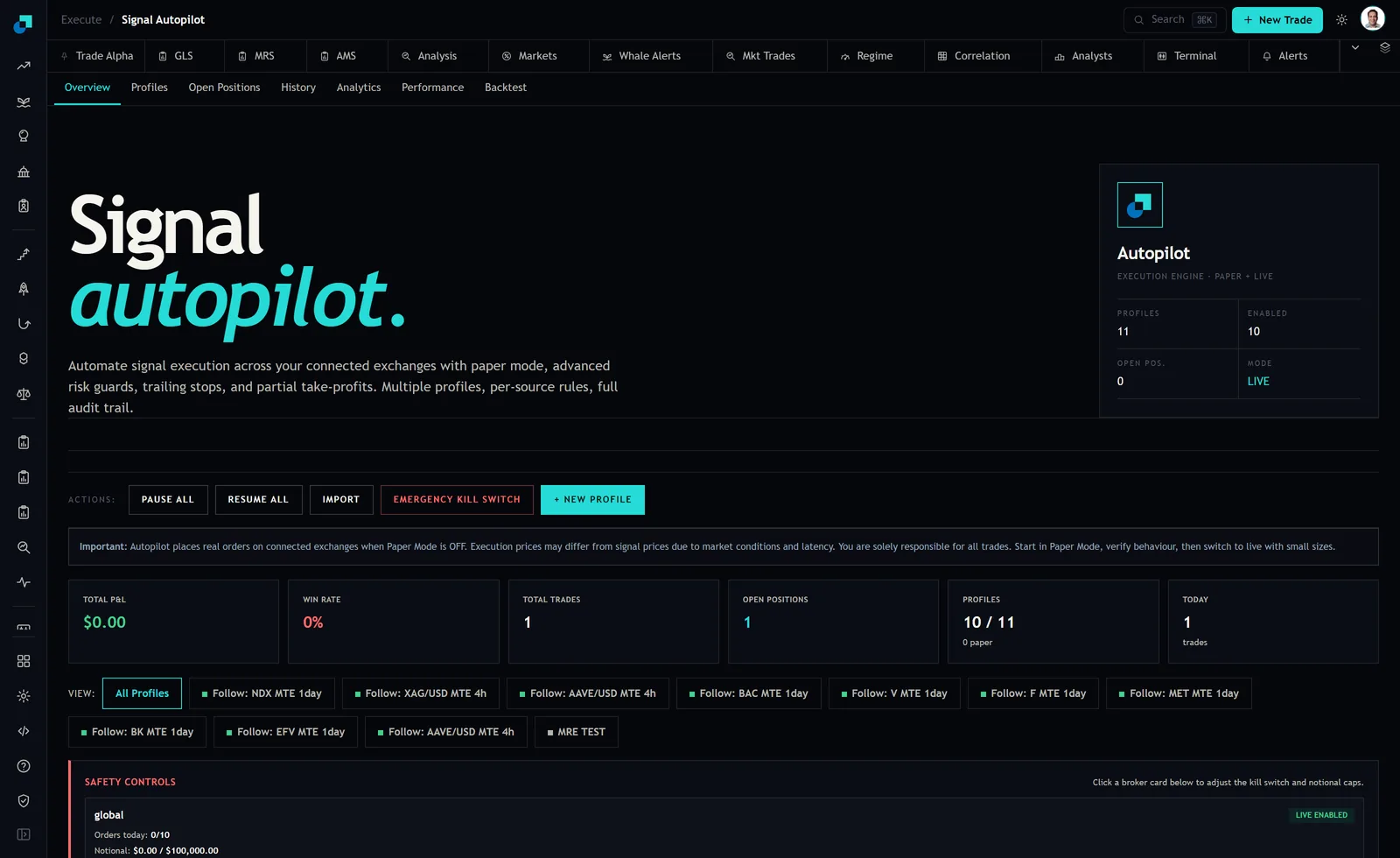
That is the correct behaviour and it is still worth anticipating, because it changes what you should expect to see. A cap that binds is a cap that is working. If you have never once seen the profile decline a signal for exposure reasons, either your cap is loose enough to be decorative or the profile has barely traded. At the time of writing my own overview showed TOTAL TRADES 1 and TODAY 1, which is an engine that has done almost nothing, and a cap that has never been tested by a busy week is an untested cap regardless of how carefully you derived it.
Four things a cap does not protect you from
Caps are a ceiling on committed capital. They are not a risk model, and the gap between those two ideas is where people get surprised.
Correlation. Five positions at eight hundred dollars each in the same sector, or five altcoins that all trade off the same beta, is one four thousand dollar position wearing a disguise. A notional cap counts it as diversified. Your account will experience it as concentrated. If your signal source has a habit of surfacing the same theme repeatedly, the cap needs to be lower than the arithmetic suggests, or you need a rule about how many names from one theme you will hold.
Gaps. A cap governs how much you commit, not how much you can lose. Anything that trades through a weekend or an earnings release can reopen well below where the stop sat. Trailing stops, which the module does offer, are protection against a drift down and not against a hole.
Leverage. If the venue is margined, a cap expressed in position notional is not a cap on money at risk. Four thousand dollars of notional at five times leverage is eight hundred dollars of your money and a much shorter distance to a liquidation. Decide which quantity your cap is denominated in and write it down where you will see it again, because six months from now you will not remember.
Accumulated losses. An exposure cap looks at what is open right now. It does not care that the profile has closed nine losing trades this week, because each one was individually within the ceiling. If you want a stop on the week rather than on the position, that is a separate decision and a separate number, and the place you will see it is the History tab rather than the exposure setting.
The check to run seven days after you switch it on
Put a reminder in your calendar for a week out, because the cap you set from a spreadsheet and the cap you needed are rarely the same number, and the evidence arrives quickly.
Open the Open Positions tab and add up what the profile is holding right now. Compare that to your cap and to what you assumed the typical load would be. Then open the History tab and read the entries in order, looking for two specific things: how close together the entries clustered, and whether the largest simultaneous exposure across the week was near the ceiling or nowhere near it. If it never got above a third of the cap, the guard is not doing anything and your real risk control is the strategy's own selectivity, which is a much less reliable thing to be relying on. If it pinned at the ceiling repeatedly, you are running a smaller strategy than you think you are and the skipped signals are worth counting.
Either way you are adjusting one number with a week of your own data behind it, which puts you well ahead of the version of this where the percentage got typed in on the first evening and never looked at again.