Copy strategies create a specific and slightly awkward best execution problem. The price everybody in the room instinctively reaches for as the benchmark is the price the whale got, and that price is not a benchmark. It is a reference you could not have achieved, because at the moment it printed the signal did not yet exist for you.
Measure against it anyway and you produce a file that reports negative slippage on every trade forever. That file will not survive review, not because the execution was poor but because the benchmark was never attainable, and a control that cannot be passed is not a control.
The benchmark you must not use
Look at what the feed actually gives you and the problem becomes concrete. Each row carries an Entry figure, an Amount, a Platform and a Time, and it is very tempting to treat Entry as the price to beat.
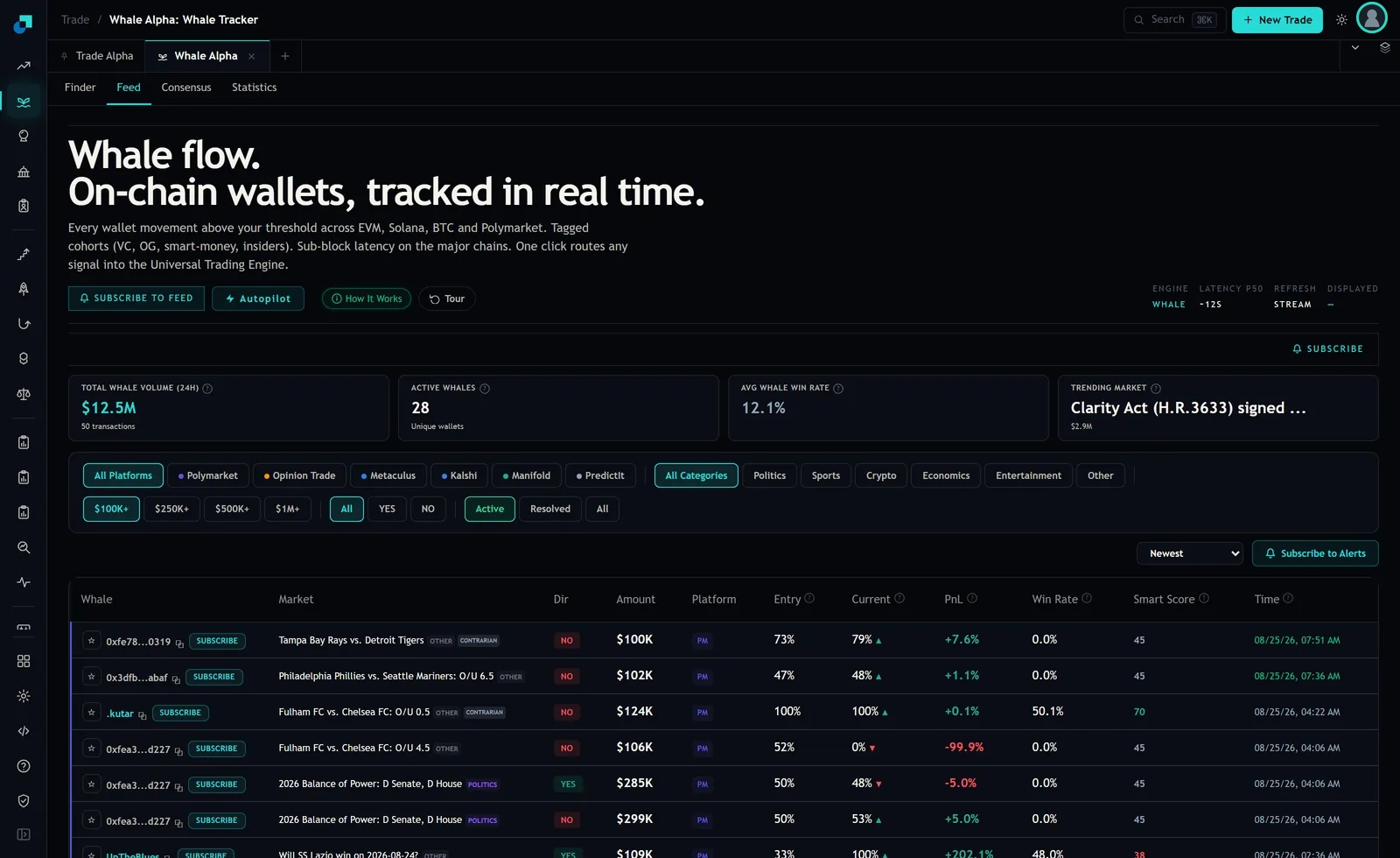
The whale's Entry belongs in the file, but in a clearly labelled compartment. It is an information benchmark, useful for measuring how much of the move happened before you could act, and explicitly marked as unattainable. It is never the primary measure, and the file should say why in one sentence so that nobody re-derives the mistake next quarter.
Anchoring arrival to signal availability
The correct arrival point is the moment the signal became actionable to you. That is a specific timestamp with three components, and each one belongs in the record.
First, the source event time as reported, which on this feed resolves to the minute. Second, the detection and publication offset, for which the platform's own header figure of roughly twelve seconds at P50 is a starting input and not an answer, because a median is not a distribution and your file needs to say what you assumed and how you measured it. Third, your own receipt timestamp, logged by your systems when the record entered them, which is the only one of the three you control and the only one you can defend without relying on a vendor's clock.
Arrival price is then the market mid at your receipt timestamp. Slippage against that number is a fair measure of your execution because it is the first price you could have transacted at. Everything before it is decay, and decay is a strategy question rather than an execution question. Keeping those two separated is most of the value of doing this properly, because it stops a research problem being reported as a trading desk failure and the reverse.
Around that primary measure, carry three more. Interval VWAP over your execution window, which tells you whether the working of the order was reasonable. A decay benchmark at a fixed offset after arrival, five and fifteen minutes say, which evidences whether patience would have been better and turns anecdote into a series. And the whale's Entry, compartmentalised as above.
Probability points are not basis points
On the prediction market rows this feed serves, the Entry column is a probability, not a price in currency. That changes the unit and it changes the size of the numbers, and a file that reports slippage in basis points without saying which basis is inviting a misreading.
The largest ticket in the capture was around $285K at an entry of 50. Paying 51 instead of 50 is one probability point, which sounds trivial and is a two percent worse entry price, roughly $5.7K of position value on that ticket. The same one point difference on a contract trading at 5 is a twenty percent worse entry. The unit is not linear in the way a basis point on an equity is, and the policy has to state the convention: report slippage in probability points and in percent of notional, both, on every row.
Round lot and tick conventions matter here too. If the venue quotes in whole cents, then the achievable price set is coarse and a one point miss may not represent any execution failure at all, merely the absence of an intermediate price. Document the tick, because half the apparent slippage on cheap contracts is the tick.
Size ratio and the same-signal cohort
Two adjustments that turn a naive comparison into an honest one.
The first is size. The tickets visible in the capture ran from roughly $100K to $299K. If the reference participant works a $285K ticket and your fund works a $2M one in the same book, their fill is not a benchmark for yours under any definition, because you are a materially different participant in the same liquidity. Record the ratio of your notional to theirs on every copied trade. A file that shows consistent underperformance against a reference one seventh your size is not reporting bad execution, it is reporting a capacity constraint, and that belongs in a different conversation with different people.
The second is crowding. You are not the only subscriber. By your arrival timestamp the price may already contain the reaction of everyone else who received the same row. Run a same-signal cohort check as standard, meaning look at the price path between the source event time and your arrival, and record whether it moved and by how much. When it moved hard, your arrival price was already the post-signal price and your execution against it can be excellent while the trade is still bad. Both facts should appear, separately, in the same file.
What the file has to contain
The record for each copied entry, at minimum.
- Signal identity, meaning the row as observed, the source venue, the instrument and the direction, captured at receipt rather than reconstructed later.
- Three timestamps, being source event time at its stated resolution, your receipt time, and your first order time, with the clock source named for each.
- The assumed detection offset, its provenance, and whether it was measured by you or taken from a vendor header.
- Arrival mid at receipt, and the tick and unit convention in force.
- Your fills with venue, time, size and price, and the interval VWAP over the working window.
- The four benchmark results, with the reference participant's fill labelled as an information benchmark and excluded from the primary measure.
- The size ratio to the reference ticket and the same-signal cohort price move.
When the honest answer is that no edge was left
Sometimes the file's conclusion will be that the arrival price already sat past the reference fill by more than any plausible edge, on most trades, over a meaningful sample. That is a finding, and it is the most useful thing a best execution process can produce for a copy strategy.
The temptation at that point is to fix it with execution effort, faster infrastructure, tighter routing, more aggressive orders. Occasionally that is right. More often the measurement is telling you that the edge lives before your arrival and therefore is not available to you at all, and no amount of execution quality recovers an edge that has already been consumed. Writing that down clearly, with the decay benchmark series behind it, is a better outcome than a year of well executed trades in a strategy that never had room for you.