Ask anyone who has spent a year watching Form 4 filings and they will tell you the buy feed fills up with tiny drug companies. That impression is worth testing against the panel rather than repeating, because when I opened Sector Flow the picture was not the one the folklore predicts, and the gap between the two is where the useful part of this is.
There is no biotech row, and that is the first problem
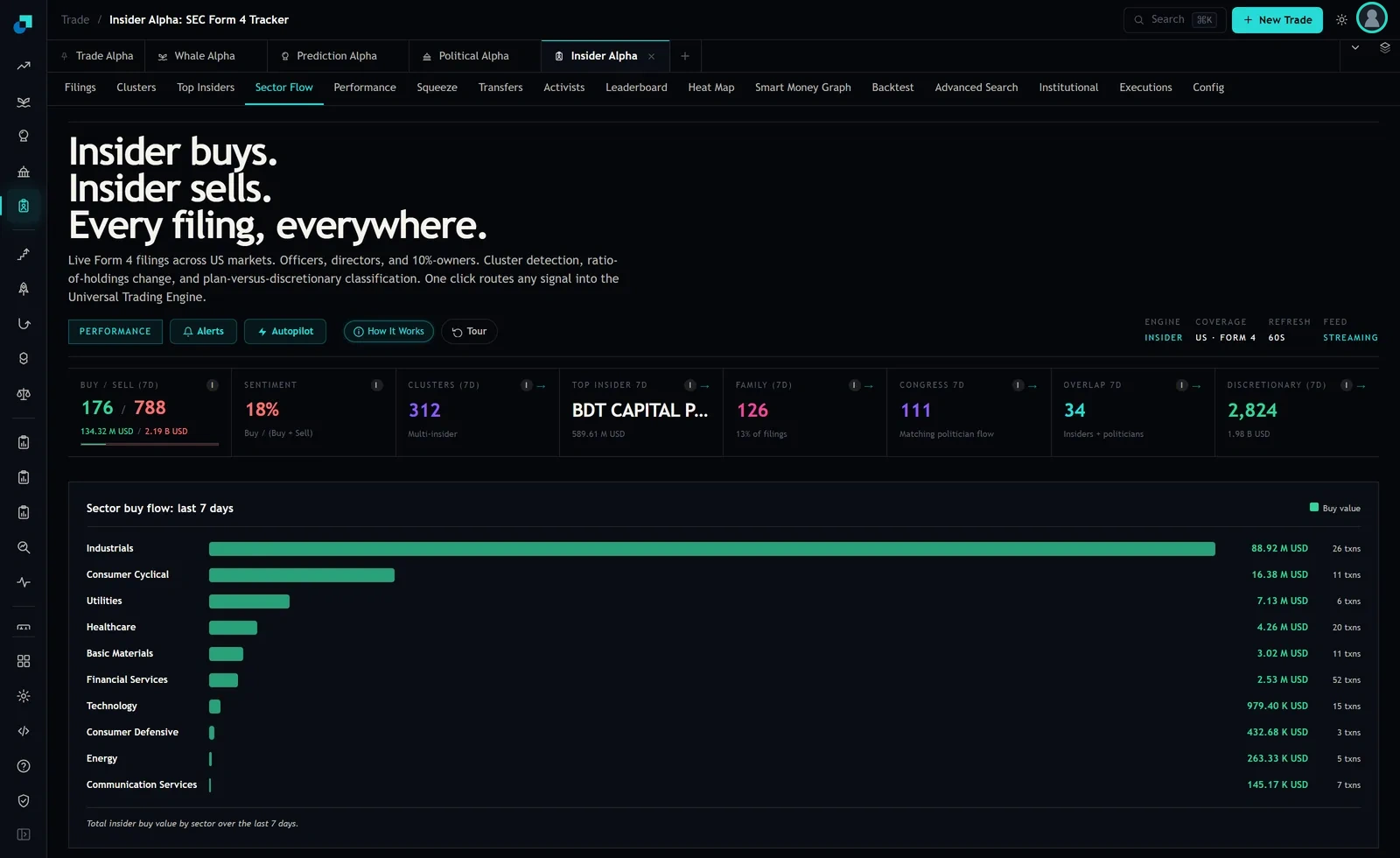
The Sector Flow panel buckets everything into ten sectors, and biotech is not one of them. The closest thing is Healthcare, which on the capture in front of me showed 4.26 M USD of insider buying across 20 transactions over seven days. That is third of ten by transaction count, behind Financial Services at 52 and Industrials at 26, and fourth by dollars, behind Industrials at 88.92 M USD, Consumer Cyclical at 16.38 M USD and Utilities at 7.13 M USD.
So on that particular week, healthcare did not dominate the buy count. It was busy relative to its dollars and unremarkable relative to the whole board. I am flagging this because the claim that biotech floods the insider feed is exactly the kind of thing that gets asserted and never checked, and the panel gives you a way to check it in about ten seconds. Do that before you build a rule around the assumption.
What the numbers do show is the split that matters. Divide dollars by transactions and the average Healthcare purchase was about 213 thousand dollars, against about 3.4 million in Industrials. Healthcare is a bucket where a comparatively large number of people bought comparatively small amounts. That is the shape you would expect from a sector full of small companies, and it is the shape that generates the impression of a flooded feed even when the sector is not actually leading on count.
Where the transaction count comes from, and it is not conviction
A small drug company with no revenue funds itself by selling shares. It does that repeatedly, and the people around the company frequently participate: the venture funds on the register, the officers, the directors who came in with an earlier round. Every one of those participations that touches a Section 16 filer produces a Form 4.
That filing looks like insider buying on any feed that counts filings. It is not the same act as an officer deciding on a Tuesday that the market has the company wrong and buying shares at the market price. In the first case the price was negotiated, the size was allocated, and the decision to participate may have been made for reasons of ownership maintenance rather than valuation. In the second case somebody put their own money in at whatever the screen said.
Form 4 lets you separate these, because every transaction on the form carries a code, and an open-market purchase has a different one from an acquisition from the issuer or an option exercise. Insider Alpha covers open-market buys, open-market sells, option exercises and plan sales, and classifies transactions as plan or discretionary. Use that. A count of Form 4 buys that has not been filtered by code is close to meaningless in this sector, and it will be highest exactly where the financing activity is heaviest.
The calendar is the confounder
Here is the structural reason biotech insider purchases are weaker evidence than they look, and it has nothing to do with anybody behaving badly.
The event that decides a small drug company's value is usually a scheduled one. A trial reads out, a regulator responds, a partner decides. Around those events, the people who know what is coming are restricted from trading, which is the entire purpose of the restriction. So the purchases you can actually see in a filing feed are, by construction, purchases made during the windows when the insider was permitted to trade, which is generally not the period immediately before the thing that matters.
That inverts the naive reading. You are not watching people position ahead of a readout. You are watching people buy in the open periods between readouts, which is a much weaker statement about what they expect. And a buy made four months before a binary event tells you the insider was constructive four months out, not that they know how the data lands.
The one pattern still worth reading
I do not think biotech insider buying is useless. I think it is one narrow configuration and everything else is noise. The configuration is this.
- The filer is an individual with a title, not a fund or a holding entity. On the sector board you cannot see this, so you have to open the filing.
- The transaction code is an open-market purchase, not an award, exercise or issuer transaction.
- The price paid sits inside that day's trading range, which confirms it went through the market rather than at a negotiated price.
- There is no financing announcement within a few days on either side. If there is, you are looking at a participation, not a purchase.
- The size is large relative to what that person is plausibly paid, not large in absolute terms. A chief executive putting several hundred thousand dollars of their own money in is a different signal from a fund putting several million of somebody else's in.
- The stock has already fallen substantially. Buying into strength tells you much less.
Even when all six line up, size the position as though you will be wrong. A clinical-stage company is a binary claim, and a bad readout does not take twenty percent off, it can take most of the value in a single session. If your account is 5,000 dollars, a position in this kind of name is 150 or 250 dollars, an amount you have already written off in your head before you place the order. This is not a strategy that produces a smooth return, and nothing on the Sector Flow panel claims otherwise.
What to check before you place the order
The sector panel is a starting point and it should be used as one. It tells you that healthcare insiders did something twenty times last week for a total of 4.26 million dollars, and that is the end of what it tells you. Everything that determines whether any individual filing is worth acting on lives one level down, in the filing itself.
Open it. Read the code. Read the price against that day's range. Read the footnotes, because in this sector they routinely explain that a purchase was made under a plan adopted months earlier or as part of a subscription agreement. Then check the traded volume in the name, because a company small enough to have this kind of insider activity is frequently small enough that your own order moves the price, and the cheapest way to lose money on a good idea is to pay four percent in spread getting into it.