The reason people break a working strategy is almost never that they were careless. It is that they reached for the wrong knob first, and the wrong knob does not announce itself. Turning it produces a new backtest that looks fine, sometimes better, and the damage is only visible months later when the live results refuse to resemble the numbers on screen.
There is a clean line through the parameter list. On one side are the settings that change how a strategy feels to own without changing which bars it acts on. On the other are the settings that re-select the trade set, which means the published record you were attracted to no longer describes the thing in front of you. Knowing which side a knob is on is most of the skill.
Read the row you are starting from before you change anything
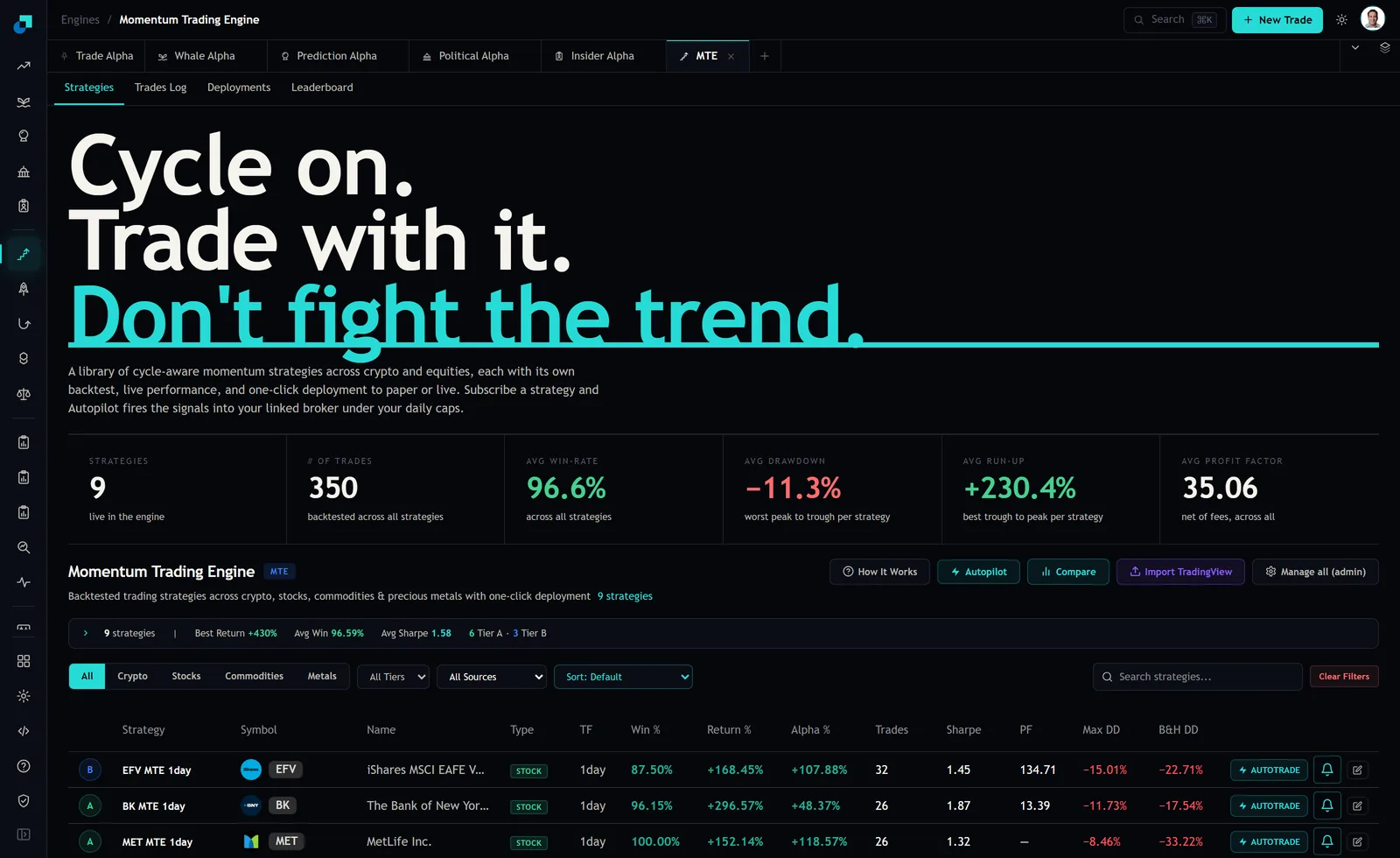
Take a strategy off the engine's Strategies tab and look at the whole row rather than the headline. The columns are Strategy, Symbol, Name, Type, TF, Win %, Return %, Alpha %, Trades, Sharpe, PF, Max DD and B and H DD.
One of those matters more than the rest and it is not the one people read. On the visible rows at capture, an international equity fund strategy on a 1day timeframe showed Win 87.50%, Return +168.45%, Alpha +107.88%, Sharpe 1.45, PF 134.71, Max DD -15.01% and B and H DD -22.71%. Next to all of that: Trades, 32. Two bank strategies on the same timeframe showed 26 trades each, with win rates of 96.15% and 100.00%.
Thirty-two trades. Every number in that row was computed on thirty-two observations, and every judgement you make about a parameter change will be made on a sample of roughly that size too. Hold that in mind through everything below, because it is the reason the advice comes out the way it does.
Knobs that change the ride, not the rules
Three settings belong in this group, and they are the three you should reach for.
Position size is the clean one. Halving your size halves every outcome proportionally and does not touch a single entry decision. It is the only genuinely free adjustment available, and it is the one most people skip because it feels like it is not doing anything clever.
Which instruments you run the strategy on is the second. Running a 1day trend system on two names instead of six does not alter its logic. It alters your concentration, which is a portfolio decision made at your level, not a strategy decision made inside the rule.
Stop distance sits at the edge of this group and deserves a caveat rather than a blanket blessing. Widening or narrowing a stop obviously changes results, sometimes a lot. What it does not change is which bars the strategy calls an entry on. The entry set stays fixed and the exit distribution moves, which is a much smaller and more legible change than the alternatives below. Treat it as adjustable, expect the win rate to move against you as you narrow it, and do not adjust it and the lookback in the same week.
Knobs that quietly destroy the thing you cloned
Now the other side of the line. Lookback length, bar timeframe, the set of timeframes used for confirmation, and swapping the entry rule itself.
The engine documents eleven distinct entry systems spanning momentum, breakout and mean reversion, with multi-timeframe analysis across five synchronised timeframes for trend confirmation. Every one of those is a decision about when the strategy is allowed to act. Change any of them and the strategy fires on a different set of bars, holds different positions, and produces a different trade set. The row you liked was computed on the old trade set. It has no bearing on the new one.
The profit factor column makes this concrete. A profit factor of 134.71 means the gross wins in that sample were more than a hundred times the gross losses, which on 32 trades means the losing trades were tiny and few. Nothing about that property is inherited by a variant. Move the lookback and you get a different set of trades with a different loss profile, and there is no mechanism by which the new set would preserve a ratio that extreme. If the variant still shows a profit factor over a hundred, that is a fact about your new sample and not evidence that the change was harmless.
The arithmetic of tuning on thirty-two trades
Say you try eight lookback values and keep the best one. You have run eight trials against a sample of about thirty. The winner of those eight is the value whose noise was kindest, and on that sample size the noise is comfortably large enough to determine the ranking on its own.
This is not a claim that tuning never helps. It is a claim about what you can learn from a result at this sample size, which is close to nothing when the result is the maximum of several attempts. The practical rule that follows is narrow: change one thing at a time, and require a mechanical reason for the change before you look at what it did. If you cannot say in a sentence why a longer lookback should work better on this instrument, then a backtest showing that it does is not evidence, it is the eight-trials problem wearing a different hat.
The same caution applies to the engine's own summary tiles, which report a 96.6% average win rate and a 35.06 average profit factor. Those are aggregates across nine strategies and 350 backtested trades in total, roughly thirty-nine trades per strategy, and they are computed before your slippage, your delay between signal and order, and your tax. They describe a library, not an outcome, and certainly not a variant you built yesterday.
The change worth making this week
If you are going to touch one thing on a cloned strategy in the next seven days, make it size, and derive it from the drawdown column rather than from what feels comfortable.
Take the international equity strategy above. Max DD of -15.01% against a buy-and-hold drawdown of -22.71% over the same window. On a $10,000 account fully allocated to it, that backtested worst peak-to-trough is $1,500. Ask yourself honestly whether you would still be running it at the bottom of a $1,500 hole after a run of losing weeks, because if the answer is no, then the correct size is smaller and the correct size is knowable today without a single parameter change.
And treat that -15.01% as a floor rather than an expectation. It is the worst drawdown in thirty-two backtested trades. A live account adds slippage on every entry and exit, adds the gap between a signal timestamp and when you actually place the order, and adds the possibility that the next thirty-two trades are worse than the last thirty-two, which is not a pessimistic assumption but simply the coin landing the other way. Size for the version where it does.