The idea of copying congressional disclosures is straightforward until you try to implement it on a real account with real money in it. Then it turns into an operations problem, and the operations problem is the reason most people who start doing this stop within two months.
The choice in front of you is between assembling the copies yourself, one member at a time, and subscribing to an aggregated basket that holds the cohort as a single line. On a five thousand dollar account that is not a close call, and the arithmetic that decides it takes about five minutes to run.
What twelve copies costs a five thousand dollar account
Say you pick twelve members whose filings you find interesting, which is a modest number given the roster runs to 7,083 legislators. Each of them shows up with a handful of names over a quarter. Call it three live positions each, which is conservative. You now hold 36 positions.
Five thousand dollars across 36 positions is 139 dollars a name. If your broker does fractional shares, that works mechanically. If it does not, you cannot buy a single share of half of them and the whole thing falls apart on the first filing. So step one is checking whether your broker supports fractional orders, because it decides whether this approach is possible at all before it decides whether it is wise.
Assume it does. You have now built a portfolio that is, functionally, a very expensive index fund. Thirty-six names at equal weight is diversified past the point where individual selection matters, which means you have taken on all of the administration of stock picking and none of the concentration that would make it pay. Every new filing that arrives is a decision, a trade, and a small drag. The dashboard showed 870 filings in the month at capture and 24 in the week, and while only a fraction touch your twelve members, the queue never empties.
Then the honest question. How many weeks will you actually keep doing this? Not how many you intend to. The failure mode here is not a bad trade, it is abandonment halfway through, which leaves you holding 36 stale positions nobody is maintaining.
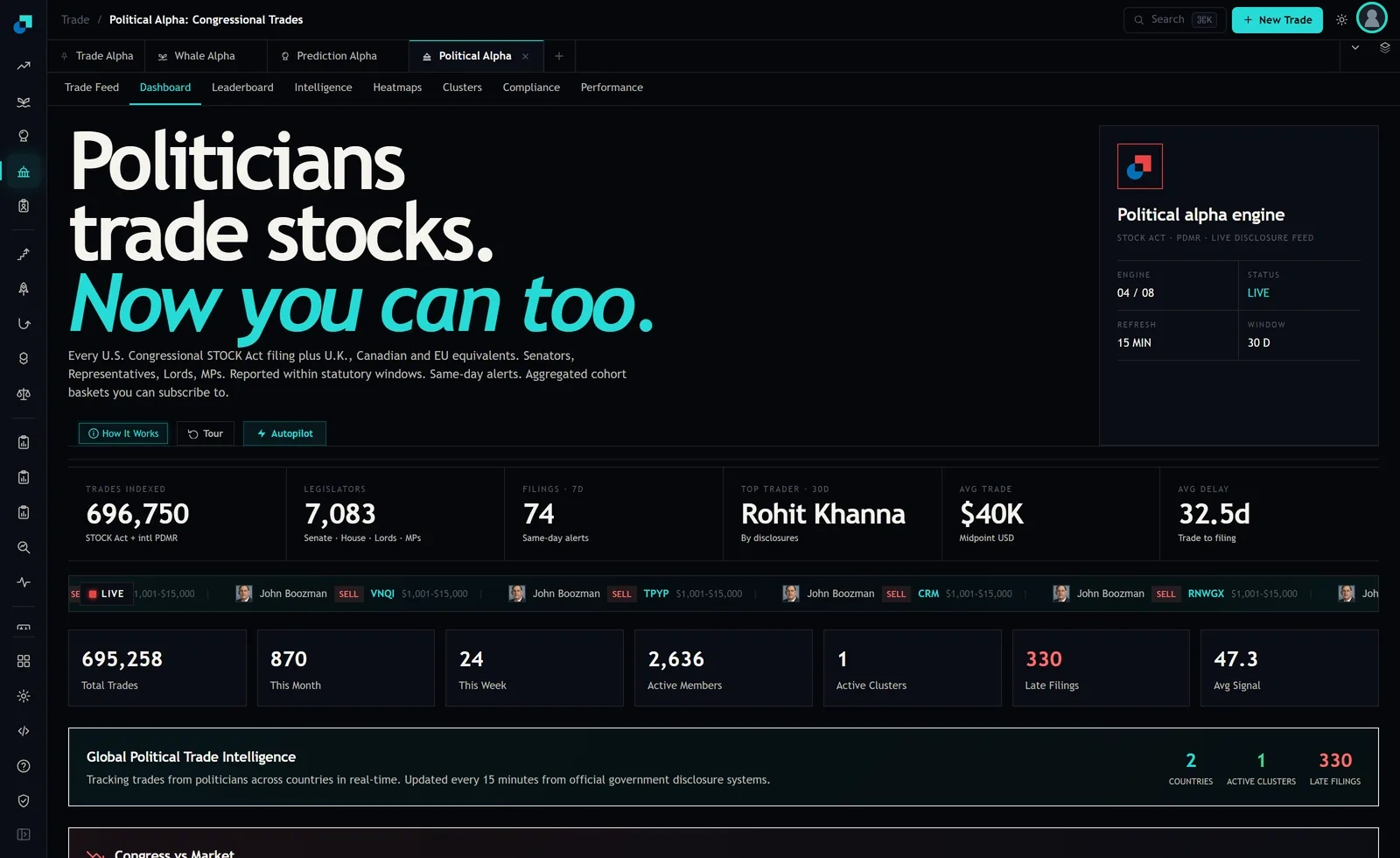
What the dashboard states and what it leaves to you
I want to be precise about what is confirmed on the screen above, because the difference matters when you are handing over a rebalancing decision.
The dashboard copy says the platform covers every US congressional STOCK Act filing plus UK, Canadian and EU equivalents, that filings are reported within statutory windows, that there are same-day alerts, and that there are aggregated cohort baskets you can subscribe to. An Autopilot control sits next to the tour button. The engine panel reports a 15 minute refresh and a 30 day window, and the module's feature list includes cluster detection across politicians, parties and sectors.
What that screen does not tell you is how a basket decides what it holds. That is not a criticism, it is a landing view rather than a basket page. But it means the following four questions are yours to answer before you subscribe to anything, and none of them should be answered by assumption:
- What triggers a rebalance. A new qualifying filing, a fixed calendar, or a drift band. These produce very different turnover and very different tax outcomes in a taxable account.
- How a position leaves. On a disclosed sale, on a time limit, or never. A basket that only adds is not a strategy, it is an accumulation.
- How many names it carries. This is the number that decides whether your account size works, and it is the subject of the next section.
- What it costs, in dollars, per year. Not in percent. On five thousand dollars, percent hides everything.
If a basket page answers those four, you can evaluate it. If it does not, that is your answer.
The three numbers that decide basket against copy
Position count first. Divide your intended sleeve by the number of names the basket holds. If the result is under about 50 dollars a name you are in fractional-share-only territory and any friction, including a minimum ticket at your broker, will hurt. Under about 20 dollars a name and the rounding error starts to be a material share of the position.
Turnover second. Every rebalance is a set of round trips. In a taxable account each one is a taxable event with a short holding period, which is the highest rate available to you. A cohort basket that reconstitutes on every qualifying filing across a dozen members will generate far more turnover than one that reconstitutes monthly, and on a small account the tax and spread drag is the largest identifiable cost in the whole exercise. Ask for the turnover figure and, if you cannot get one, treat the basket as high turnover until proven otherwise.
Cost third, and in dollars. A subscription that costs 240 dollars a year against a five hundred dollar sleeve is a 48 percent annual fee on the capital that is actually doing the work, which no strategy overcomes. The mistake is comparing the subscription to the whole account rather than to the money you have allocated to the idea. If you would only put five hundred dollars behind this, the subscription has to be priced against five hundred dollars.
Where a basket stops being the cohort you picked
Two limits sit underneath every version of this, whether you copy by hand or subscribe, and neither is fixable by better execution.
The lag is the first. The dashboard reported an average of 32.5 days between transaction and filing, with 330 late filings in the compliance tally. Whatever the basket holds, it is holding a decision that was made roughly a month ago, at a price that no longer exists. That is a property of the disclosure regime, not of the product, and it applies identically to the hand-built version. It does mean that arguing about whether your rebalance happens on Tuesday or Friday is arguing about the wrong end of the problem.
The dollar bands are the second, and they are the reason a basket cannot really be a copy. Disclosures report ranges. The rows on the live strip all sat in the 1,001 to 15,000 dollar band, and the dashboard uses a 40,000 dollar midpoint convention for its average trade figure. So nobody, including the basket, knows the member's actual position weight. Any aggregated basket has to impose its own weighting scheme, most likely something close to equal weight, and the result is a portfolio that shares the cohort's names but not their sizing. It is a names-only replication. That is worth knowing and it is not a scandal, but it does mean the honest description is "a systematic strategy that uses disclosures as its universe", not "I hold what they hold".
The decision I would make on this account this week
One basket, not three. Adding a second cohort basket to a five thousand dollar account gets you overlapping holdings and a second subscription, and the overlap means the diversification you think you are buying is mostly imaginary.
Size it as a satellite. My cap for a thematic sleeve like this on a small account is around ten percent, which is five hundred dollars here, and it goes down not up if the subscription cost is fixed. The core of a small account should be the boring thing you already own.
Paper it or watch it before funding it, for one full rebalance cycle. You want to see what the turnover actually looks like in practice rather than in the description, and one cycle tells you more than any amount of reading. Then set a review date at six months and write down in advance what would make you stop, which for me is two things: the sleeve underperforming the boring core by enough to have paid for itself twice over, or a rebalance cadence I find myself ignoring. If you are ignoring it, you have quietly gone back to holding 36 stale positions, which is where this started.