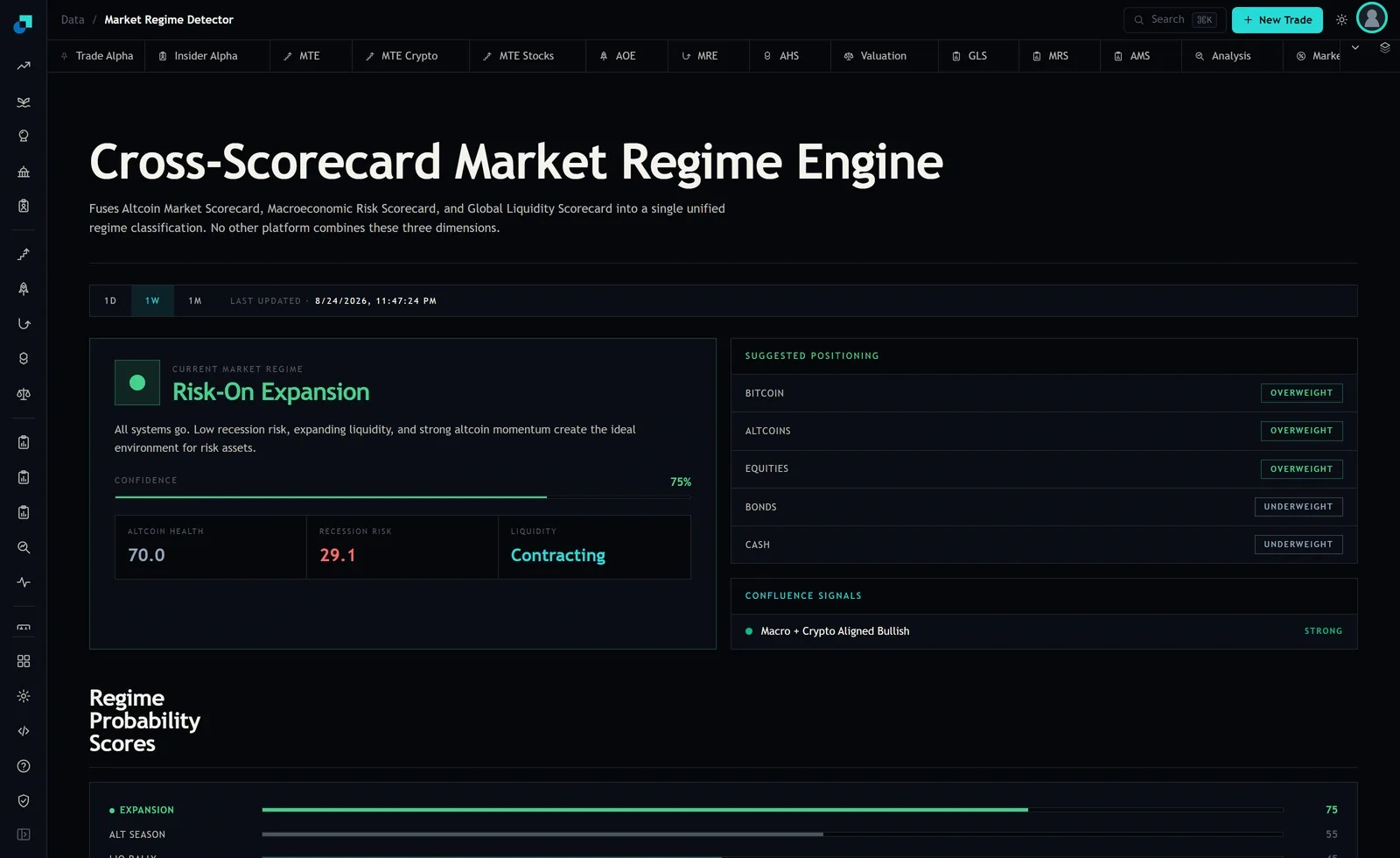
The three little buttons above the regime card look like a display preference, in the same family as choosing a chart colour. They are not. Picking 1D instead of 1M changes how often you will be told the market has changed character, and therefore how often you will trade, and therefore what this tool costs you per year.
That makes it the most consequential choice on the screen and the one people make in half a second without thinking.
What the toggle changes, and what a single capture can prove
Being straight about the evidence. The capture I am working from has the toggle sitting on 1W, stamped 8/24/2026 at 11:47:24 PM, showing Risk-On Expansion at 75 percent confidence. That is one reading on one setting at one moment.
I cannot show you the daily and the monthly disagreeing, because I did not capture them side by side, and I am not going to describe a disagreement I did not see. What I can tell you is what has to be true regardless. A faster reading updates more often. A reading that updates more often changes its mind more often. Those two sentences carry the whole decision.
The screen also does not spell out what the toggle does internally, whether it changes the lookback window, the sampling frequency, or both. So do not build a theory on assumed mechanics. Build on the part that is certain, which is the update rate.
Match the reading to the holding period, not to your curiosity
The rule is simple and almost nobody follows it. A signal you cannot act on is not information, it is stimulation.
Suppose you rebalance every month or two, which describes most self-directed accounts honestly. Between one rebalance and the next, a daily flag produces twenty or more readings. You will act on exactly one of them, whichever happens to be showing when you sit down, and which one that is has more to do with your calendar than with the market. You have added noise to your decision and called it timeliness.
Now suppose you hold for weeks and you read the monthly flag. Between rebalances you get one or two readings. Every one of them is potentially actionable, and when the flag changes it is because something persistent changed rather than because the last few sessions were rough.
The frequency of the reading should be at most the frequency at which you are genuinely willing to trade. Faster than that is not caution, it is a subscription to be alarmed on a schedule you cannot respond to.
Put a price on the switches before you choose
The way to make this concrete is to price the switching, using your own numbers rather than mine.
Start with what a regime change costs you when you act on it. If your tilt moves ten percentage points of the portfolio, then on a 40,000 dollar account each switch turns over 4,000 dollars. At a half percent round trip across spreads and fees, that is roughly 20 dollars per switch. Your figures will differ, particularly if you hold anything with a wide spread, so work them out once and write them down.
Then estimate switches per year on each toggle. I do not have measured counts for this module and I am not going to invent any, so put placeholders in and replace them with your own measurements next quarter. Say the daily flag changes thirty times a year, the weekly eight, the monthly three. On the numbers above those become roughly 600, 160 and 60 dollars annually, which on a 40,000 dollar account is about 1.5 percent, 0.4 percent and 0.15 percent.
A one and a half percent annual drag is an enormous hurdle for a macro overlay to clear before it has helped anybody. That gap is the argument for the slower reading, and it does not depend on the daily flag being wrong. It only depends on it being frequent.
Two costs sit on top of that and neither shows up in a commission statement. In a taxable account, faster switching converts long-held positions into short-term gains. And a flag that flips constantly trains you to stop believing it, which means you will be ignoring it on the one turn that actually mattered. That second cost is the expensive one and it is invisible until afterwards.
The twelve-week test that answers it for your market
All of this becomes concrete with a log that takes under a minute a week.
Once a week, at roughly the same time, open the screen and click through all three toggles. Write down the regime name and the confidence figure for each, plus the date. Three lines a week for twelve weeks.
At the end you can count directly how many times each reading changed its label over the quarter, annualise it, and multiply by your cost per switch. That gives you the real annual price of each toggle for your account, in dollars, measured rather than assumed. It also shows you something the arithmetic cannot, which is how often the fast reading changed and then changed straight back, and that pattern is usually more persuasive than any cost figure.
One discipline makes or breaks the log. Record which toggle each reading came from, every time. A row that says Risk-On Expansion with no toggle noted is unusable, because you will have no idea three months later whether the label changed or you simply clicked a different button.
When the daily reading earns its place
There are two honest uses for the fastest setting and neither is allocation.
The first is if you genuinely hold for days. If your positions turn over inside a week, a monthly regime reading is describing an environment your trades will never live to see, and the daily flag is the one that matches your horizon. That is a small minority of self-directed accounts and it is worth being truthful with yourself about whether you are in it.
The second is as a check rather than a trigger. Run your allocation off the slower reading, and look at the daily only when you have already decided to place a trade for other reasons. Used that way it can talk you out of a purchase on a bad day without ever being allowed to talk you into one.
What you must not do is keep all three open and read whichever agrees with you. Three toggles and a preference is not analysis, it is a machine for confirming a decision you already made, and it will produce a confident-looking answer every single time you ask it. Pick one before you have a position, write down which one you picked, and change it only for a reason you could explain to somebody else.