Two columns on the far right of the Whale Finder get almost no attention because they are dates rather than dollars. Tenure says how long the tracker has been watching a wallet. Last says when it last did anything. Between them they contain a fact about every wallet on the table that none of the dollar columns can tell you.
Subtract Last from today and you have a dormancy gap. Subtract the gap from Tenure and you have the wallet's actual active window, which is the denominator that every per-day figure should have been using all along.
The subtraction, run on three real rows
At capture, with the screen dated 25 August 2026, the three top rows read as follows.
The Ethereum row showed 2,050 trades, tenure of 432 days, and a Last date of 26 August 2025. That is a dormancy gap of about 364 days. The naive reading is 2,050 trades over 432 days, or 4.7 a day. The corrected reading subtracts the gap: this wallet was active for roughly 68 days and did 2,050 trades in that window, which is about 30 trades a day. Then it stopped, and it has been silent for a year.
The Base row showed 50 trades, tenure of 40 days, and a Last date of 23 July 2026, so a gap of about 33 days. Active window of roughly 7 days, 50 trades, or about 7 a day. A wallet that appeared, traded hard for a week, and went quiet for a month.
The BSC row showed 55 trades, tenure of 426 days, and a Last date of 8 January 2026, a gap of about 229 days. Active window of roughly 197 days at 0.28 trades a day. Genuinely occasional, then dormant since January.
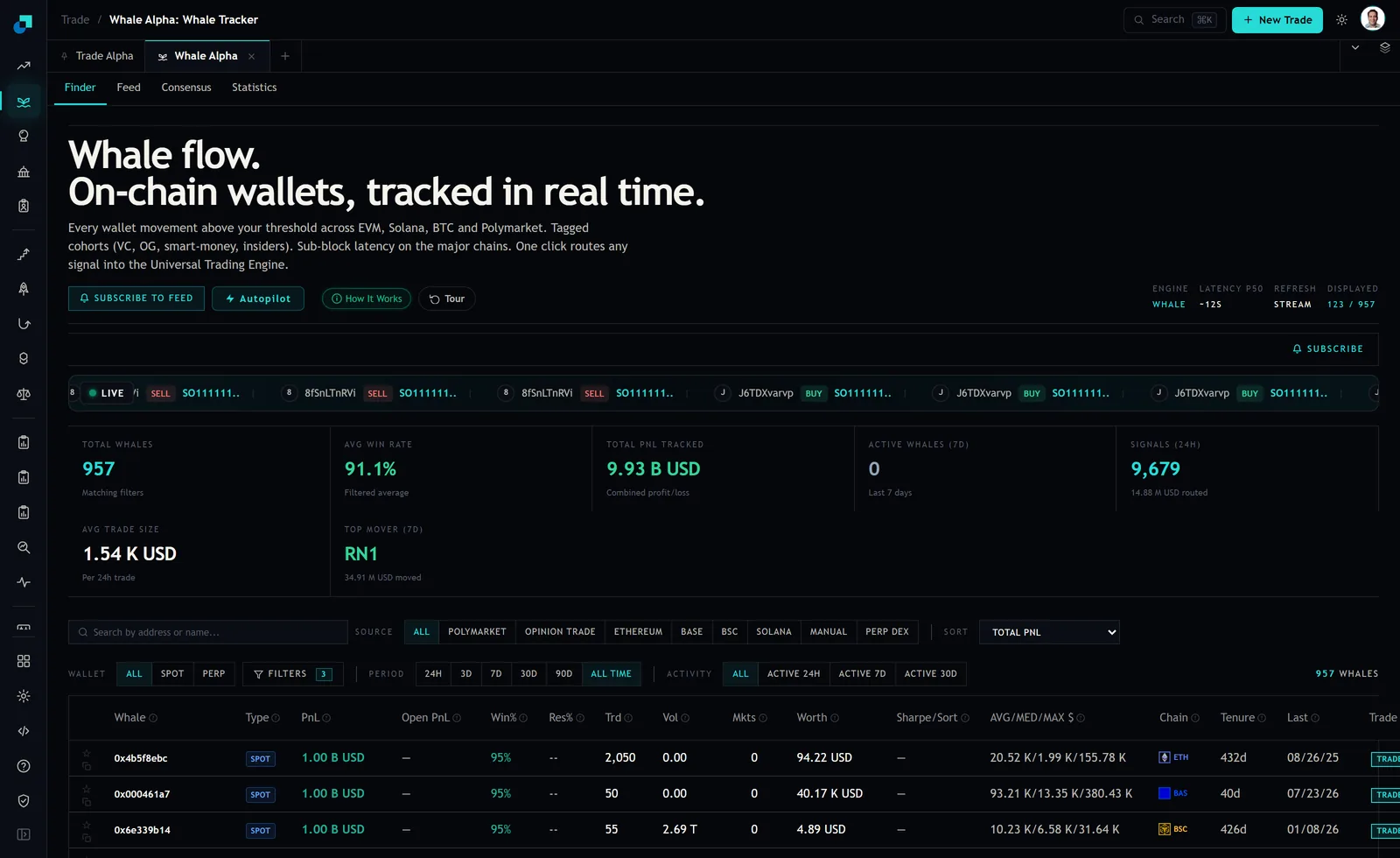
Three wallets that look broadly comparable on the dollar columns turn out to be a burst trader who quit, a one-week sprinter, and a slow accumulator who stopped in January. None of them traded this week.
The tile that tells you to check your filters
Above the table, the Active Whales 7D tile read zero while the header reported 957 whales matching filters. Take that at face value and none of the 957 traded in the last seven days, which is possible but would be remarkable.
The more likely reading is that the tile and the table are counting different things, or that the tile is not populating. Either way the lesson for your routine is the same: do not trust a summary tile to tell you a wallet is live. Check the Last column on the specific row, because that is the field attached to the wallet you are about to copy.
Why a wake-up carries more than a debut
Now the actual argument. A wallet appearing for the first time and a long-tenured wallet returning after months are both new activity on your screen and they are not the same information.
A brand new wallet gives you nothing to condition on. Its win rate is computed over a handful of trades, its median clip is one observation wide, and you have no idea whether the operator has been trading for a decade under different keys or started yesterday. Every statistic on the row is an estimate from a sample too small to constrain it. That is the sample-size problem in its purest form and no amount of staring at the row fixes it.
A dormant wallet returning gives you a prior. You know its historical clip size, its typical frequency, its chain, and how it behaved the last time it was active. When it starts trading again you can compare the new behaviour against the old, and that comparison is the actual signal. Something changed for an operator whose normal you can describe.
There is also a plainer point about why wallets go quiet. Somebody who traded 30 times a day for ten weeks and then stopped for a year did not run out of interest in the market. They stopped because the conditions they trade stopped being present, or because they moved capital elsewhere. A return means their conditions came back, and that is a piece of information about the market and not just about the wallet.
The check that separates a wake-up from a handover
Here is the failure mode. A dormant wallet reactivating might not be the same operator. Keys get sold, lost, moved between people, or drained. If you treat the returning wallet as the historical one and it is not, you have copied a stranger while believing you had a track record behind you.
The comparison that catches most of these is size. Read AVG/MED/MAX from the row and compare the returning trades against the historical median. The Base row's median was 13.35 thousand against a maximum of 380.43 thousand, so a returning trade anywhere in that band is consistent with the same hand. A wallet whose historical median was 2 thousand coming back with 200 thousand dollar clips is not obviously the same operator, and the burden of proof should sit on the side of assuming it is not.
Two supporting checks. Same chain, because an operator returning on a different network is a weaker claim than one returning where it always traded. And same market type, because the module separates spot and perp wallets in the Type column, and a wallet that was spot-only coming back in perps has changed something fundamental about how it takes risk.
The routine, which is two filters and a column
You can run this in under five minutes and it is the same three steps every time.
- Set the activity filter to ACTIVE 24H. That is the entire population of wallets that did something yesterday, and it is the only list where the wake-up question is live.
- Sort or scan by Tenure, and look for the high numbers. High tenure inside an ACTIVE 24H list is the definition of a wake-up: a wallet the tracker has watched for a long time that has just done something. Low tenure in that same list is a debut, and debuts go on a watch list rather than into a position.
- For each wake-up, read AVG/MED/MAX and check the returning size against the historical median. Matching size, same chain, same type, and the wallet is worth an hour of your evening. Mismatched size and you are looking at a different operator holding an old key.
The reason this is worth building into a routine rather than doing occasionally is that dormancy is the normal state. Three of the three top rows at capture were dormant, one of them for nearly a year, and every one of them was sitting near the top of a table sorted by total PnL. Rank sorts by what a wallet did. Only the Last column tells you whether it is still doing it.