A squeeze position is unusual among equity trades because the thing that makes it work is the same thing that makes it impossible to leave. Elevated short interest in a thin float is a statement that a large number of shares have to be bought back eventually and that the market for them is small. If you are long, your exit and the shorts' exit compete for the same book, and the moment your thesis is validated is the moment everyone else's exit competes with yours too.
The exit is priced at entry whether or not you price it
The discipline is to write the exit plan before the position exists, and to write it in units of participation rather than in adjectives. Everything else follows from that one habit. A desk that decides at entry that liquidation is a five day exercise at eight percent of volume has implicitly capped the position, and the cap is a number rather than a feeling.
The asymmetry to model is not subtle. Entry happens into a name that insiders have just bid for, often with the filing already public and buyers present. Exit happens for one of two reasons and both are bad for you. Either the thesis broke and you are selling into weakness alongside everyone running the same screen, or the thesis worked and you are selling into a spike whose depth is an illusion created by the very short covering you were positioned for. In the first case the book is empty. In the second, the book is full of people who will not be there in twenty minutes.
What the screen tells you about the exit, and what it does not
The Squeeze view pairs insider transactions with the bi monthly short interest report and, at capture, carried a table header of Ticker, Company, Insider, Filed, Trade value, SI percent of float sorted descending, DTC and Signal. The line beneath the title read FINRA short interest as of 2026-03-30, with 26,353 tickers covered, and the footer noted that short interest is published twice per month on the fifteenth and the last business day.
Of those columns, exactly one speaks to your exit, and it is not the one people quote. SI percent of float is a crowding measure. DTC is days to cover, shares short divided by average daily volume, and it is the closest thing on the screen to a liquidation clock. It is measuring the shorts' clock rather than yours, but the denominator is shared, and any number of days to cover above a handful is telling you that the name cannot absorb a coordinated exit at normal volume.
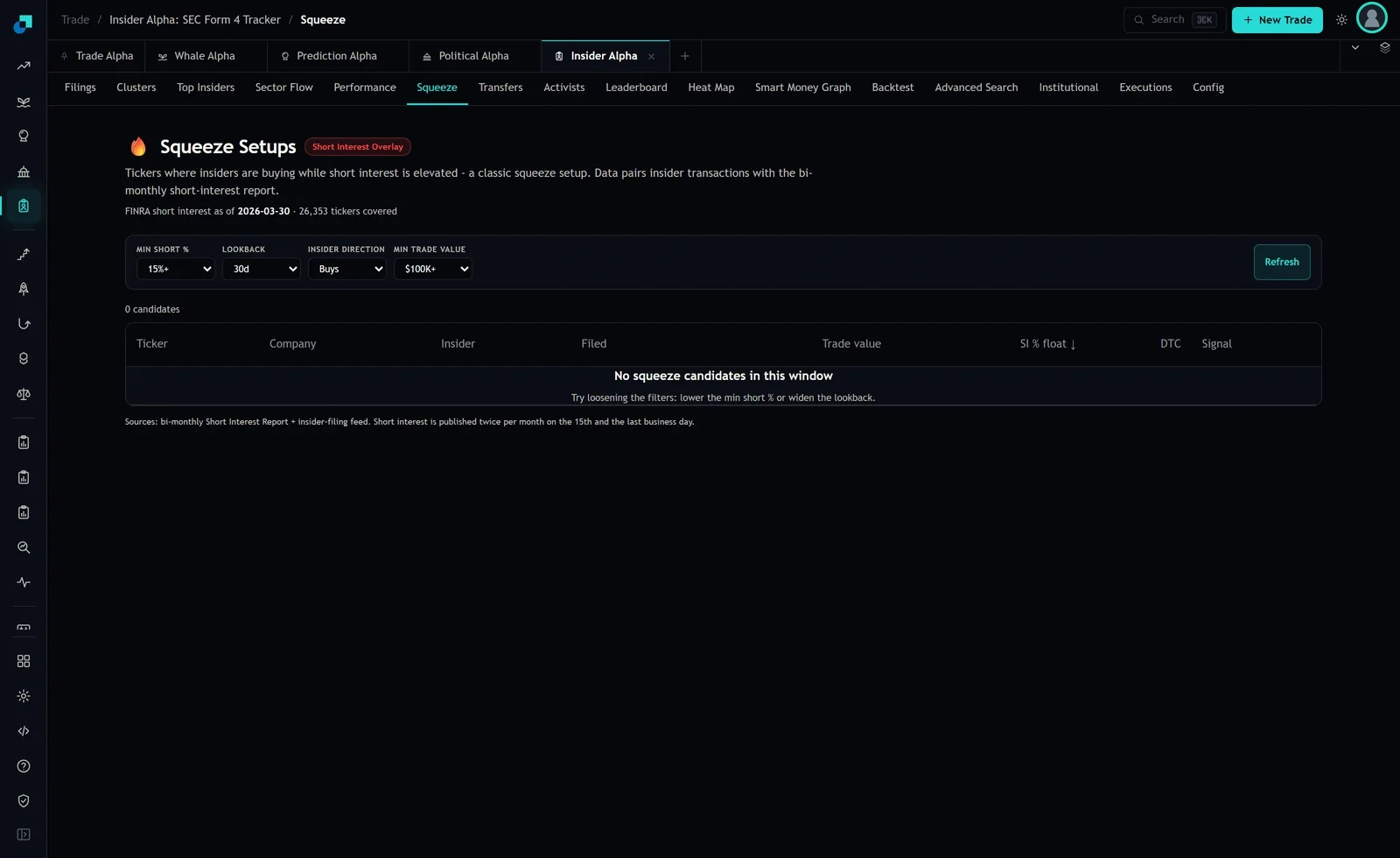
What is absent matters as much. There is no average daily volume column, no free float, no borrow fee, no utilisation and no option open interest. Every input to a liquidation model has to be joined in from your own security master and your prime broker. The screen is a candidate generator and treating it as a position sizing tool is the specific error this piece exists to prevent.
Participation on the way out is not the participation you used on the way in
Run the arithmetic twice with different assumptions, because entry and exit are different problems. A reasonable entry model allows a longer completion window, since you are buying into a signal that is not yet consensus and you can be patient. A liquidation model has to assume a shorter window and a lower participation rate, because forced selling in a thin name at high participation is how you print the tape yourself.
| Name ADV | Entry at 12 percent over 5 days | Exit at 6 percent over 3 days | Binding constraint |
|---|---|---|---|
| 500k USD | 300k USD | 90k USD | Exit, by a factor of 3.3 |
| 2m USD | 1.2m USD | 360k USD | Exit, by a factor of 3.3 |
| 10m USD | 6m USD | 1.8m USD | Exit, by a factor of 3.3 |
| 50m USD | 30m USD | 9m USD | Exit, by a factor of 3.3 |
The ratio is constant because the assumptions are, which is the point. Whatever entry number your model produces, the exit constraint under a stressed assumption is roughly a third of it, so the maximum position is the exit number and the entry number is irrelevant except as a schedule. Desks that size on entry capacity and then discover the exit constraint during liquidation have not made an execution error. They made a sizing error months earlier and only found out when it was expensive.
Then stress the denominator itself. Average daily volume in these names is not stationary, and the ADV you sized on was measured during the period when the name was interesting. If the thesis fails quietly and attention moves on, volume can fall well below the level your model assumed, and your three day exit becomes a two week one at the same participation rate. Recompute the liquidation estimate on current ADV monthly, not on the ADV you used at entry.
Option depth is derived from stock depth and inherits its problems
The listed option chain looks like a second exit channel and sometimes is one, but the mechanism deserves stating because it determines when it helps. A market maker taking the other side of your option trade hedges the delta in the underlying. The stock they hedge in is the same thin stock you are trying to leave. Option liquidity in a small float is therefore not independent liquidity, it is the same liquidity intermediated, priced with a spread that widens as the underlying gets harder to hedge.
Three practical consequences. First, in a squeeze specifically, implied volatility and option spreads widen at exactly the moment you want to use them, so an option exit that looked cheap when you modelled it at entry will not be cheap when you need it. Second, open interest at a given strike is not the same as available depth, and a chain with respectable total open interest can have almost nothing quoted at the strike and expiry you need. Third, exercise and assignment mechanics can convert your neat hedge into a delivery obligation in a stock with no borrow, which is a different and worse problem than the one you were solving.
The honest use of the chain is at entry rather than exit. Defining risk with a long option structure at the start caps the loss without requiring you to find a bid later. Planning to hedge your way out of an illiquid squeeze position after it moves against you is a plan that depends on a counterparty who will be repricing precisely because you need them.
The observable that says the thesis has become consensus
The moment to reduce is the moment the trade stops being a variant view, and there is a reasonably clean tell available in the same data the screen is built on.
Track the sequence of published short interest prints for the name rather than the level. A falling short interest percentage of float across consecutive fortnightly reports means shorts are leaving, which is the event you were positioned for. It is also the exhaustion of the fuel. Once the short base has been substantially reduced, the mechanical support for the thesis is gone and what remains is a directional equity position in a company you probably would not have bought on its fundamentals. Many desks hold through that transition without noticing it occurred, because the price action is still favourable while it happens.
Pair that with the financing signal from your stock loan desk. A borrow fee that collapses back toward general collateral levels is telling you lendable supply has been restored and scarcity is over, usually before the next short interest print confirms it. Two consecutive fortnightly declines in short interest, or a decisive normalisation in borrow, should trigger a scheduled reduction rather than a discussion about whether to reduce.
Write both triggers into the position record at entry with the sizes attached, and write the third one too, the boring one: a maximum holding period after which the position is cut regardless of price. Squeeze theses have a shelf life defined by the short base, and a position that is still open long after the crowding has cleared is no longer the trade that was approved. When it is reviewed, the defensible answer is that the exit conditions were written down in advance and executed. There is no defensible version of discovering the exit conditions during the exit.