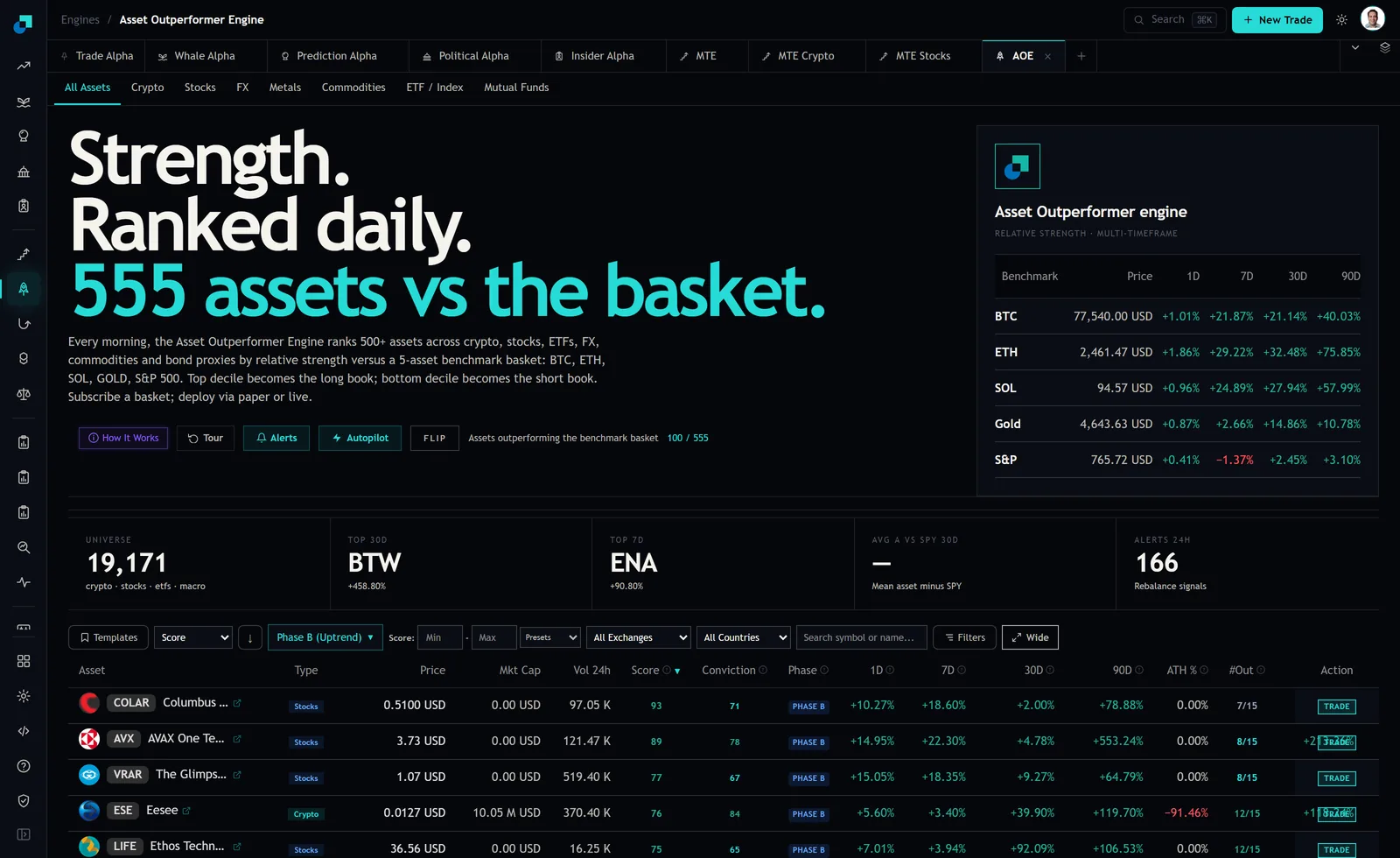
The hero line on the Asset Outperformer board reads 555 assets versus the basket. The page copy underneath describes the top decile as the long book. Do the division and the long book is roughly fifty-five names, which is a perfectly sensible construction for a fund and a completely unusable one for a five thousand dollar account. Fifty-five positions out of five thousand dollars is ninety-one dollars each. At that size, a two percent spread on a thin name is under two dollars, which sounds harmless until you multiply it by fifty-five entries and fifty-five exits, and until you notice that a ninety-one dollar position cannot move your account no matter how right it is.
So the decile is a research list. Turning it into a book means throwing away roughly nine out of every ten names on it, and the useful question is which nine. What follows is the order of cuts I run, which matters, because the cheap cuts should happen before the ones that need judgement.
Fifty-five names and ninety-one dollars each
Start by fixing the destination. Six positions at five thousand dollars is a little over eight hundred dollars each. That is large enough that a fifty percent move on one name is a four percent move on the account, which is the level where a position is worth the attention it costs. It is also small enough that six of them still diversify something. Five is defensible, eight is the most I would attempt, and the number matters less than committing to it before you look at the list, because deciding how many to hold while reading a ranking is how people end up with nineteen positions.
Fixing the number first also converts every subsequent step into a comparison rather than an evaluation. You are not asking whether a name is good. You are asking whether it is one of the six best on this list for a specific slot, which is a much easier question and a much harder one to talk yourself out of.
Cut one: dedupe by driver, not by ticker
The first pass removes duplicates, and duplicates on a ranking board are rarely the same ticker twice. They are different tickers expressing the same trade. The ETF tab makes this vivid: on the capture, Direxion Daily Gold Miners Index Bull 2X scores 67 with a 30-day move of +82.05 percent, Direxion Daily Junior Gold Miners Index Bull 2X scores 65 with +81.35 percent, and Global X Gold Explorers scores 61. Three rows, three tickers, three separate lines in a top decile. One trade. If gold miners roll over, all three go together, and an account holding all three is not holding three positions, it is holding one position at triple weight while believing it is diversified.
The same tab carried two separate rows both named Ether Tracker One in euros, one scored at 59 and one unscored. Whatever the reason for two listings, they are not two ideas. Leverage is its own driver too: three leveraged products in a decile is one decision about whether you want leveraged exposure this month, not three stock picks.
Run this pass by writing a one-word driver next to each name. Gold. Ether. Small-cap biotech. AI. When two names carry the same word, keep the one with the better evidence and delete the other. On most captures of this board this single pass removes a third of the list, and it costs nothing but a few minutes.
Cut two: the volume floor, and the unit the column does not state
The next pass is the one that saves real money, and it uses the Vol 24h column rather than the score. On the capture, Ethos Technologies scores 75 with volume reading 16.25 K. Columbus Acquisition, sitting at the very top with a score of 93, reads 97.05 K. The Glimpse Group reads 519.40 K and Eesee reads 370.40 K.
Be careful with the unit. The column header is simply Vol 24h with K and M suffixes and no currency or share label on the screen I am working from, so I would not build arithmetic on the assumption that it is dollars. Treat it as a comparison between rows, and confirm the actual dollar volume in your broker or on the exchange before you size anything. What the comparison tells you is unambiguous regardless of unit: the top-ranked name trades at roughly one fifth the activity of a name twenty points below it, and Ethos trades at a fraction of that again.
My floor is a ratio rather than a level. An eight hundred dollar position wants at least a hundred times that in daily turnover, so eighty thousand dollars a day, and I would rather have five hundred times. Under that ratio you are a visible share of the day's trade in a name you cannot exit on a bad afternoon. Note also that the market cap column reads 0.00 USD for every equity and ETF row on this capture, so it cannot do this job for you. Crypto rows do carry a market cap, and Eesee showing 10.05 million tells you something the equity rows will not.
Cut three: one name per asset class, and one tiebreak
The third pass caps concentration by type. The Type column labels each row Stocks, Crypto or etf_index, and the rule is one name per label in the final six. That cap is not a diversification theory, it is a defence against what the ranking does in a strong tape: when one asset class is running, it fills the top decile, and a naive top six can easily be six crypto tokens on a good week for crypto. You would then own one bet in six wrappers, which is the exact mistake cut one was designed to prevent, arriving through a different door.
With a cap in place you will usually have two or three candidates fighting for one slot, and this is where the narrow columns finally earn their place. Columbus Acquisition scores 93 but its #Out reads 7 of 15, meaning it beat seven of the fifteen benchmark-and-timeframe contests. Eesee scores 76 with a #Out of 12 of 15. The higher score is winning by a bigger margin somewhere; the lower score is winning more broadly. For a six-name book that I want to leave alone for weeks, I take breadth over margin, because a name beating twelve of fifteen comparisons is less dependent on one benchmark continuing to behave.
The other tiebreak is the 30-day cell against the 1D cell. Columbus shows +10.27 percent on the day and +2.00 percent over the month. That is a rank built out of one session, and one session is not a holding period.
What six positions cost to run, and what to do when only four survive
Six positions at eight hundred dollars is manageable in a way that fifty-five is not. Six entries and six exits at, say, a one percent round-trip cost is about a hundred dollars of friction on a five thousand dollar account, or two percent, which you need to earn back before anything counts as profit. Add a rebalance every month and you are paying that twice more a year. This is the honest argument for a small book that is left alone rather than a large one that is constantly tuned.
The cuts will sometimes leave you with four names instead of six, most often after the volume floor eats a chunk of the list. Hold four and leave the rest in cash. The temptation is to reach back into the decile and promote the best of the names you already rejected, which throws away the entire reason you rejected them, and the reason is usually that you could not get out of them. A four-name book with two thousand dollars idle is a worse-looking portfolio and a better one.
The failure mode of this whole procedure is worth naming: it is systematically biased toward liquid, large, boring names, and the enormous moves at the top of this board tend to happen in exactly the illiquid ones you are cutting. You will watch names you deleted print triple-digit months. That is the trade you are making, and on a five thousand dollar account, where one position you cannot exit can take a year to work off, it is the right side of it.