The Stocks tab ranked 522 assets at capture. Your brokerage account reaches some subset of those, and if you have one account in one market that subset is a lot smaller than 522. The order in which you apply that fact determines whether the screen saves you time or wastes it.
Most people rank first and check access later. That produces a shortlist you fall in love with and then cannot execute, which is the worst of both, because now you are looking for a workaround for a position you had no particular reason to want an hour ago.
Your real universe is your broker's list
Before you touch the board, write down what your account can actually do. Four lines is enough and you only do it once.
- Which exchanges you can place an order on directly, as opposed to which you can see quotes for.
- Which currencies your account holds, and what the conversion costs each way.
- Whether you can buy fractional shares, because that decides how coarse your position sizing is.
- Whether the account permits sub-dollar listings and over-the-counter lines at all, since some do not and the board carries several.
That list is your universe. Everything else on the board is information rather than opportunity, and treating the two the same is what fills a watchlist with names that will never become positions.
Running the two selectors as an access check
The toolbar carries an exchange selector and a country selector, sitting together to the right of the score range boxes. At capture both read All, meaning neither was filtering anything, which is the state the board starts in.
Open each one and see what it offers, then set them to match the list you just wrote down. Do this at the start of the session, before you look at a single score, and check two behaviours while you are there: whether the setting survives moving between the Crypto and Stocks tabs, and whether it survives a page reload. If it does not, then engaging the filters is a step you repeat every session, and it is worth building the habit deliberately because the board will not remind you.
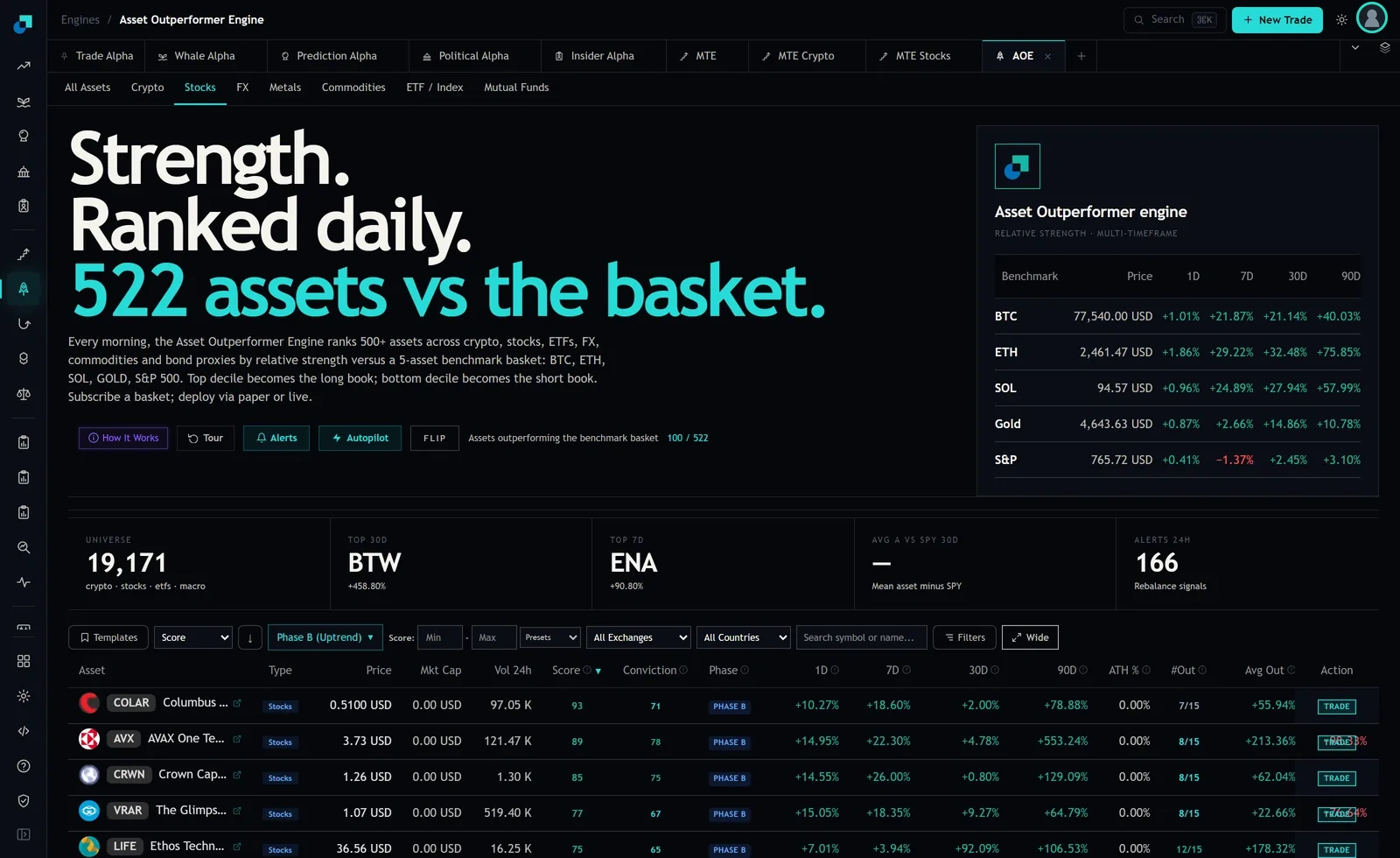
There is one thing the board cannot help you with. There is no exchange column on the row, so you cannot look across a name and read where it trades. The selectors are the only venue handles in the interface, which makes engaging them more important rather than less.
What a cross-border position actually costs on 500 dollars
The reason access matters more for retail than for anyone else is that the costs are fixed and your positions are small, so the percentages are brutal.
Work it with your own broker's numbers rather than mine, because they vary enormously. The shape of the arithmetic is what matters. Say you buy 500 dollars of a foreign-listed name. If your broker's currency conversion costs half a percent each way, that is five dollars round trip. If the foreign market ticket carries a fixed commission, say eight dollars each side, that is another sixteen. Twenty one dollars of friction on a 500 dollar position is 4.2 percent, which the stock has to make back before you are level.
Run the same numbers on a 2,000 dollar position and the friction falls to about 1.05 percent, which is survivable. That is the real lesson: cross-border access is not binary, it is a minimum size question. Below some position size, a foreign listing is not worth owning at any rank, and the size where that flips is a number specific to your account that you can calculate once this week and reuse forever.
Add one more line if your broker charges for real-time data or FX on dividends, and note that the same friction applies again on the way out. Costs you can compute in advance are the easiest money you will ever save.
The price column decides your position sizing
Two rows on the board show the opposite ends of a problem that only affects small accounts.
Tribhovandas Bhimji Zaveri was quoted at 286.20 dollars. If your account does not do fractional shares and your intended position is 500 dollars, your choices are one share at 286.20 or two at 572.40. Neither is 500. You are either 43 percent under your intended size or 15 percent over it, and repeated across a portfolio that is how position sizing quietly stops meaning anything.
At the other end, Rising Dragon Acquisition was quoted at 0.0852 dollars. A 500 dollar position is nearly six thousand shares, and before you place that order you want to know whether your account permits sub-dollar listings, what the spread looks like in percentage terms rather than in cents, and whether the order will route somewhere you expected.
Check the Vol 24h cell on the same row while you are there. Crown Capital showed 1.30 K at a price of 1.26 dollars. Whether that column is counting shares or dollars, at that price both readings describe a stock turning over a low four-figure amount in a day, and a 500 dollar order against that is a large share of the session. Ethos Technologies at 16.25 K is not much better. High score, real company, and an order book that your own order would dominate.
What to do with the names you cannot reach
The honest answer most of the time is nothing. A high-ranked name on an exchange your account does not reach is not a problem to be solved, it is a name for somebody else.
Two responses are worth having anyway. The first is a separate watchlist, kept deliberately apart from your actionable one, for names you would buy if access changed. It costs nothing and it stops the inaccessible names cluttering the list you actually work from. The second is to check whether a fund you can buy already holds the exposure. If the attraction is a sector or a country rather than one specific company, an accessible fund often gets you most of the way there without any of the friction above.
The response to avoid is reaching for a synthetic route because the direct one is blocked. Getting exposure through a leveraged product, a contract for difference or an unfamiliar wrapper in order to own a name you liked on a screener means you have swapped a well-understood risk, the company, for a poorly understood one, the instrument. The rank on the board said nothing about the wrapper.
The five-minute version
Open the Stocks tab. Set the country selector to your market and the exchange selector to the venues your account reaches. Only then sort by Score. Read across each surviving row to the Price and Vol 24h cells and delete anything you cannot size properly or cannot trade without becoming most of the day's volume. What is left is short, probably shorter than you expected, and every name on it is one you could buy this afternoon.
That last property is the whole point. A shortlist you can execute against is worth more than a longer one that reads better, because the second kind produces research you never act on and a slow accumulation of the belief that the screen does not work. It works fine. It was answering a bigger question than the one your account can afford to ask.