An unfiltered insider feed is not a research tool. It is a firehose that produces the feeling of being informed while consuming the twenty minutes you had before the open. I have watched people scroll it every morning for months and never once take a position from it, which is a worse outcome than not looking at all, because it costs the same time and produces the same nothing.
What follows is the stack of cuts I apply, in order. The order matters. Each one is chosen to remove as much of the feed as possible for as little judgement as possible, so that the expensive human attention lands only on rows that survived the cheap machine filters. The target is about ten rows a morning, which is roughly what one person can genuinely think about before nine thirty.
Cut one, the transaction code, which does most of the work
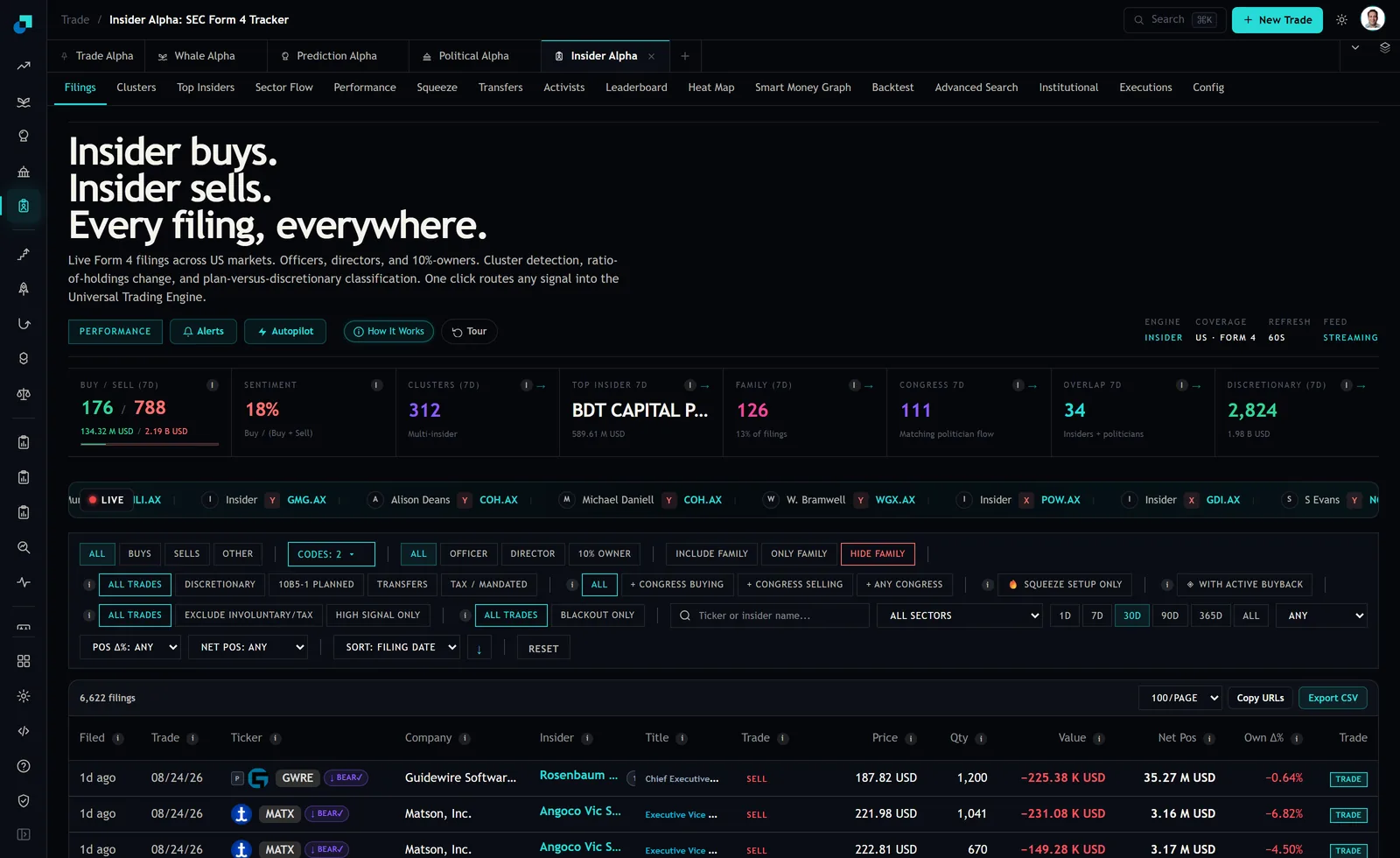
Insider Alpha's coverage line tells you what is in the pipe: open-market buys, open-market sells, option exercises and 10b5-1 plan sales, all in one stream. Restrict to code P, open-market purchases, and the feed collapses immediately. Grants, vesting, tax withholding and exercise-and-sell pairs all disappear, and those are the bulk of Form 4 volume in any period you care to look at.
This one cut is worth more than every clever filter that follows it. It is also the one people skip, usually because a dollar-sorted feed looks impressive and the largest rows in it are almost always compensation events rather than decisions.
Cut two, the size floor, scaled to what you actually trade
The module exposes size buckets at $25K, $100K, $500K and $1M in its filter panels, and those are sensible rungs. Which one you pick should depend on the market cap you trade rather than on your own account size. On a large cap, a fifty thousand dollar purchase by an executive earning several million a year is a rounding error and probably a formality. On a two hundred million dollar company, the same fifty thousand from a director is a real commitment.
My default is $100K on anything above a couple of billion in market cap and $25K below that. If you only run one setting, run $100K and accept that you are giving up the small-cap tail, which is where a lot of the interesting filings live but also where most of the illiquidity that will hurt you lives.
Cut three, who filed it
The form tells you whether the reporting person is an officer, a director, a ten percent owner, or some combination. Keep officers and directors. Treat ten percent owner filings as a separate, lower priority stream.
The reason is that a ten percent owner is frequently a fund, and a fund buying more of a position it already holds is running its own book for its own reasons. It is not the same act as a chief financial officer, who knows exactly what the quarter looks like, choosing to add. Officers and directors are also the ones with the sharpest legal exposure for trading around information, which is a constraint that makes their purchases more considered rather than less.
Cut four, freshness and price sanity
Two quick numeric cuts. First, drop anything where the gap between the transaction date and the acceptance date is more than about five business days. Section 16 gives insiders two business days, so a wide gap means either a late filer or a plan transaction, and in both cases the information has had time to travel before it reached you.
Second, apply a price and liquidity floor that reflects what you can actually execute. I do not take insider signals on anything under a dollar, and I want enough average daily volume that my intended position is a small fraction of a day. That has nothing to do with the quality of the insider signal and everything to do with the fact that a good signal in a stock you cannot get out of is not a trade, it is a subscription.
What each cut costs you, stated honestly
Every filter above throws away real information as well as noise, and you should know which.
- Code P only discards genuine code J and code K filings, which are rare but occasionally the most interesting thing in a week. It also discards discretionary plan transactions under code I.
- A dollar floor systematically discriminates against directors of small companies, whose entire annual retainer might be less than your floor. This is the cut I am least comfortable with, and the workaround is to look at the purchase relative to the shares the person already held rather than in absolute dollars.
- An officer and director filter throws away the case where a well-informed outside holder is quietly building. Some of those are the best setups on the board.
- A freshness cut throws away accurate late disclosures from companies with a thin back office, which is most micro caps.
I accept all four costs because the alternative is a feed I do not read. A filter you actually run beats a comprehensive one you abandon in three weeks.
The ten-line format and the morning pass
What survives goes into a fixed shape, one line per filing, and the shape is fixed so that comparison is fast. Ticker. Code. Role, meaning officer, director or owner. Dollars. Business days between transaction and filing. Transaction price against the current price. Whether more than one insider appears at the same company in the last quarter, which is the Clusters view's whole job. That is seven fields and it fits on one line.
The morning pass takes about fifteen minutes. Read the ten lines. For any row where the current price is close to the transaction price and more than one insider has bought recently, open the actual filing and check one number, the shares owned following the transaction, to confirm the person's holding actually went up. Everything else gets deleted. On a normal day nothing survives to a position, and that is the expected outcome rather than a failure of the process.
The one adjustment worth making after a month is to your own thresholds, not to the structure. If you are consistently getting thirty rows, raise the dollar floor a rung. If you are getting two, drop it. Change one dial at a time and keep the list of what you would have acted on, because the only way to know whether your filter is any good is to be able to look back at what it showed you and what happened next. The module keeps a Backtest tab for the same reason. Whichever tool you use, the discipline is the same one, which is to write down the rule before you look at the outcome.