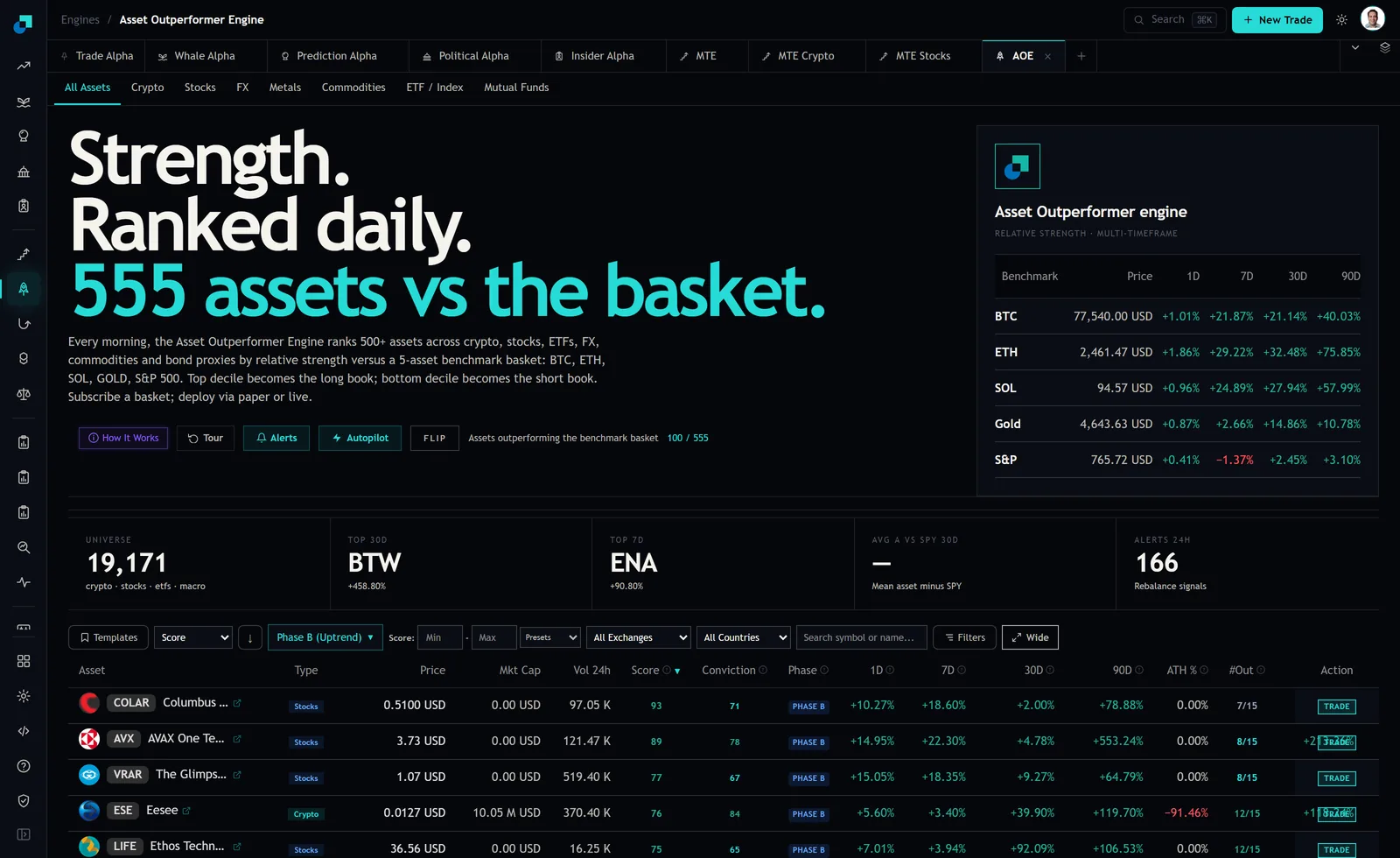
There is a small control sitting directly above the Asset Outperformer board, next to the line that reads "Assets outperforming the benchmark basket". It is labelled FLIP, and it is the least used genuinely useful thing on the page. The default board answers one question: what is beating BTC, ETH, SOL, Gold and the S&P 500 right now. FLIP asks the other one. The module's own description of the design is explicit about why both halves exist, since the top decile becomes the long book and the bottom decile becomes the short book.
One control, two boards
Most screening tools are built around finding things to buy, and that framing quietly assumes you start from cash. You do not. If you have been investing for any length of time you start from a portfolio, and the more valuable question on any given morning is not what to add but what to stop holding. The default view cannot answer that, because anything you own that is doing badly is by definition not on a list of outperformers. It has simply vanished from your screen, which feels like nothing happening.
That is the gap FLIP closes. Same universe, same five benchmarks, same composite score built from momentum over 1, 3 and 7 days, trend over 30 and 90, strength over 180 and 365, and consistency of outperformance. The difference is which end of the resulting distribution you are looking at. Nothing about the calculation changes. Your position in it does.
Why the bottom half is the more useful half for a retail account
The asymmetry is practical rather than philosophical. Buying is a decision you make deliberately, usually after reading something, and it gets your full attention. Selling is a decision you avoid, and the avoidance is invisible, so nothing prompts you to revisit it. A holding that has quietly lost to every benchmark for four months generates no alert, no email and no feeling. It just sits there.
There is also a real opportunity cost that the default view hides completely. The comparison is against a basket that includes assets you could have owned instead with a single order. If something in your account is losing to all five benchmarks across all three timeframes the engine checks, the question is not whether it might recover. The question is why that money is not in one of the five things it is losing to, which is a much harder question to wave away.
The bottom of the board answers that in a form you cannot argue with, because it is arithmetic rather than opinion, and because you did not have to go looking for it.
Pruning with it, in order
The routine takes ten minutes and I run it monthly rather than daily, because the engine rescans every six hours and reacting to that cadence with a retail account is a way to pay a lot of spreads for nothing.
Flip the board, then set the type tab to match what you actually own, crypto or stocks or ETF and index, rather than working from All Assets. The combined view mixes populations in a way that makes the ordering less meaningful, and it also renders a lot of rows, at capture a universe count of 19,171 across crypto, stocks, ETFs and macro.
Then look for your own holdings in the list. That is the entire trick. Not the worst names on the board, which are mostly assets you have never heard of, but yours. If a holding appears, open its row and read three cells before you do anything. The score, which tells you how comprehensively it is lagging. The 30-day figure, which tells you whether the lag is recent or long-standing. And the market cap and volume cells, because if it is thin then the exit needs planning rather than a market order.
A holding that shows up in the bottom half once is information. A holding that shows up three months running while you told yourself a story about it each time is a decision you have already made and not executed.
Why shorting the bottom is the wrong retail trade
The obvious next thought is that if the top decile is a long book then the bottom is a short book, and the module's design says exactly that. For an institutional desk that is a legitimate reading. For a retail account it is usually a bad idea, and the reasons are structural rather than a matter of skill.
Borrow is the first. Shorting equities requires locating stock, and the small caps that populate the bottom of a relative strength ranking are the hardest and most expensive to borrow, with rates that can move against you while the position is open. In crypto you are typically using perpetuals instead, which means funding payments and a liquidation price, both of which turn a correct thesis into a closed position at the wrong moment.
The second is the shape of the loss. A long position can lose what you put in. A short can lose several times that, and the assets at the bottom of this board are precisely the ones capable of moving violently. The captured stocks tab had 0GQU showing a 30-day figure of +9,122.97%, and MF at +187.37%, both scored at 70. Those are top-half readings, but they are the same population of small, thin names that fills the bottom half, and they show what the tails look like in both directions.
The third is simply that you do not need it. The pruning use is free, requires no margin account, carries no borrow cost and no liquidation risk, and improves your returns by removing drag rather than by adding exposure. That is a smaller edge than a successful short and it is one you can actually collect.
Turning it into a habit that survives
The reason this does not become routine for most people is that it is unpleasant. The flipped board is a list of your mistakes, presented without commentary, and there is no version of looking at it that feels good. So make it mechanical and take the judgement out.
Same day each month. Flip, filter to your type tab, find your holdings, note which appear and how they scored. Keep the list somewhere you can compare against next month rather than trusting yourself to remember. And set the rule in advance rather than in the moment, something as blunt as a holding appearing in the bottom half on three consecutive checks gets closed regardless of the story attached to it. Written before you are attached to a specific position, that rule is easy. Written while looking at one, it is impossible, which is exactly why the habit has to come before the situation.