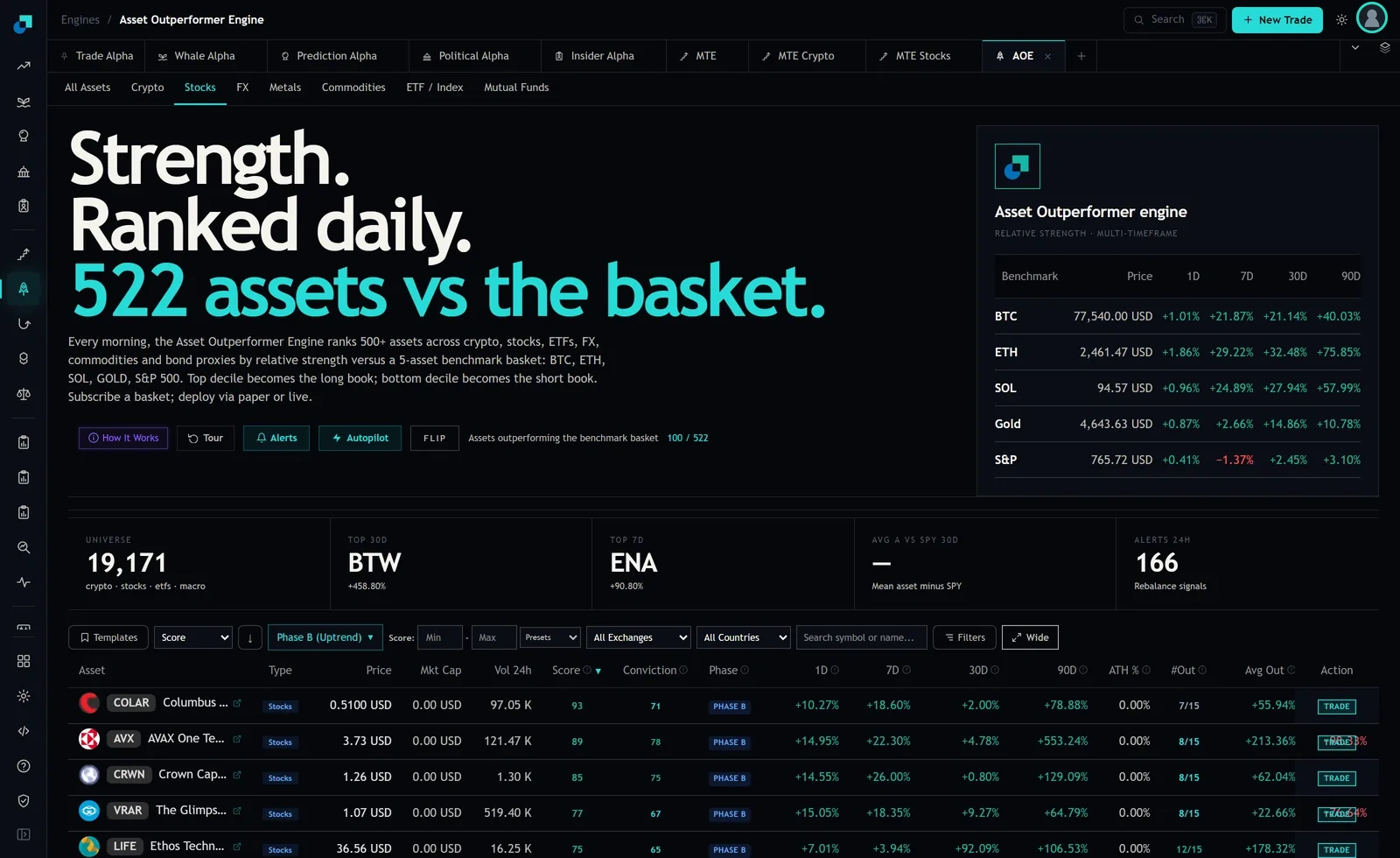
The Stocks tab of the Asset Outperformer Engine ranked 522 assets at capture, with 100 of them shown as outperforming the benchmark basket. Read down the scored rows and a handful of them are not US companies at all. Medivir AB and Active Biotech AB are Swedish. Tribhovandas Bhimji Zaveri Limited is Indian, and it was quoted at 286.20 dollars. All three were carried with a US stocks type.
This is not a reason to distrust the board. It is a reason to spend ten seconds per row before you act on one, because the difference between a company and the particular quote you are looking at is where retail money quietly goes missing.
The name is the first tell and it costs nothing to read
Company suffixes are jurisdictional and they are printed right there in the Asset column. AB is a Swedish limited company. Tbk marks an Indonesian public company, which is how Verona Indah Pictures Tbk and Superior Prima Sukses Tbk PT appear on the all-assets board. Limited and Ltd turn up everywhere but are far more common outside the United States than Inc or Corp.
Then there is the price. A stock you have never heard of quoted in three figures is worth a pause, because US small caps are rarely there. Tribhovandas Bhimji Zaveri at 286.20 dollars is the example on this board, and once you notice the price you notice the name, and once you notice the name you know to check where it actually trades.
None of this means the row is wrong or the company is bad. A company listed primarily abroad often does have a US-accessible quote, an ADR or an over-the-counter line, and that quote is a real instrument you may well be able to buy. What it is not is the same instrument as the home listing. The hours are different, the depth is usually a fraction, the spread is wider, and the price you see may be a stale reflection of a market that closed hours ago.
Tickers that are not shaped like tickers
The second tell is the symbol itself. US tickers are one to five letters. When you see a four character code that starts with a digit, you are looking at a vendor identifier rather than a US listing symbol.
Medivir carried 0GP7 at capture and Active Biotech carried 0GQU. The same pattern appears on the all-assets board attached to a Vanguard total world equity fund as 0V1N and to a leveraged financials fund as 0KQK, so it is not specific to foreign operating companies. What the pattern reliably means is that the row is being identified by something other than a US ticker, and that is your cue to find out what it is before you type it into a broker.
The practical failure here is nastier than it sounds. Type a code like that into a retail brokerage search box and you will usually get no result, or worse, a partial match on a completely unrelated ticker. Then you are one confirmation click from owning something you never researched.
Two tells that do not work on this tab
I was taught to treat a blank market cap as a sign of a badly typed row, and on this tab that check simply does not fire. Every visible row on the stocks board showed 0.00 USD in the Mkt Cap column, from Columbus Acquisition at the top through to Ethos Technologies, whether the company was American or not. A field that reads the same on every row cannot separate anything.
Curiously it inverts one tab over. On the all-assets board, the rows explicitly typed as international stocks were the ones carrying real market caps, 66.23 million and 104.48 million dollars, while the US stock rows sat at 0.00. So blank market cap on the all-assets tab is weak evidence that a row is domestic, and blank market cap on the stocks tab is evidence of nothing at all. Know which board you are on before you lean on the field.
The other check that is not available is the exchange. There is no exchange column on the row. You cannot look across and read where a name trades, which means the venue question has to be answered from the toolbar or from your broker, not from the board. That is worth knowing before you build a habit around a column that is not there.
The return that cannot be a return
The strongest single tell is a number that is not physically plausible. Active Biotech showed a thirty day move of plus 9,122.97 percent on the stocks board at capture, sitting on a score of 70 at a price of 5.46 dollars.
Take that at face value and it says a listed pharmaceutical company multiplied ninety times in a month. Treat it instead as what an anomalous figure usually is on any screener, which is a price series problem: a currency change, a corporate action, a share consolidation, a switch between two quotes of the same company, or a single bad print. I do not know which of those it was and neither will you from the board.
The rule that follows is simple and it applies far beyond this module. A return figure that would be historic if true is a reason to distrust the row, not a reason to buy it. Cross-check the price against an independent source before the row goes anywhere near a shortlist, and if the two sources disagree, the row is out.
What to set before you scan, not after
The toolbar carries a country selector sitting immediately right of the exchange selector, and at capture it read All Countries, which is its unfiltered state. That is the control to engage first, before you have seen a single score, because filtering after you have found something you like is how you end up arguing yourself into an exception.
Open it and see what it offers. If it lets you restrict the board to your own market, do that at the start of every session and treat the resulting list as the only one you are allowed to act on. The board is then answering the question you can actually execute against, rather than the more interesting question of which companies anywhere in the world are strongest.
Do the same with the exchange selector next to it, for the same reason. Between them, those two dropdowns are the difference between a shortlist and a wishlist.
Keep one habit for the rows that still get through, because filters are never complete. Before any name reaches a buy decision, put the ticker into your own broker's search and confirm three things: that the symbol resolves to the company you think it is, that the venue is one your account can reach, and that the quoted price is in the currency you are holding. Those three checks take under a minute and they catch every failure mode described above, including the ones the board has no column for.