You are down eleven percent on a position. You open the analysis page for reassurance, and the composite reads bullish. Now you have a problem that feels like a contradiction and is actually a category error, and the way most people resolve it is by choosing whichever of the two inputs supports doing nothing.
The panel and your profit and loss are answering different questions. Sorting out which question each one answered is the whole job here, and it takes about five minutes. What it produces is not a prediction. It is a decision about whether this position stays on at this size.
The panel does not know anything about your position
Start with the thing that resolves most of these conflicts on its own. A market composite describes a market. It does not know your entry price, your size, how long you have held, what you were thinking when you bought, or that you are down eleven percent. It cannot be talking about your position because it has never seen it.
That sounds obvious written down and it is routinely ignored in the moment, because a bullish reading feels like a second opinion on your trade. It is not a second opinion on your trade. It is a first opinion on something adjacent to your trade, and the distance between the two is exactly what you need to measure.
There are three ways that distance shows up. Wrong horizon: the reading covers a period longer or shorter than your holding period. Wrong scope: the reading covers a basket or a market condition and you own one asset. Wrong vintage: the reading is older than you think. Any of the three can produce a bullish panel above a red position with nothing being contradictory at all.
Read the column that matches how long you intend to hold
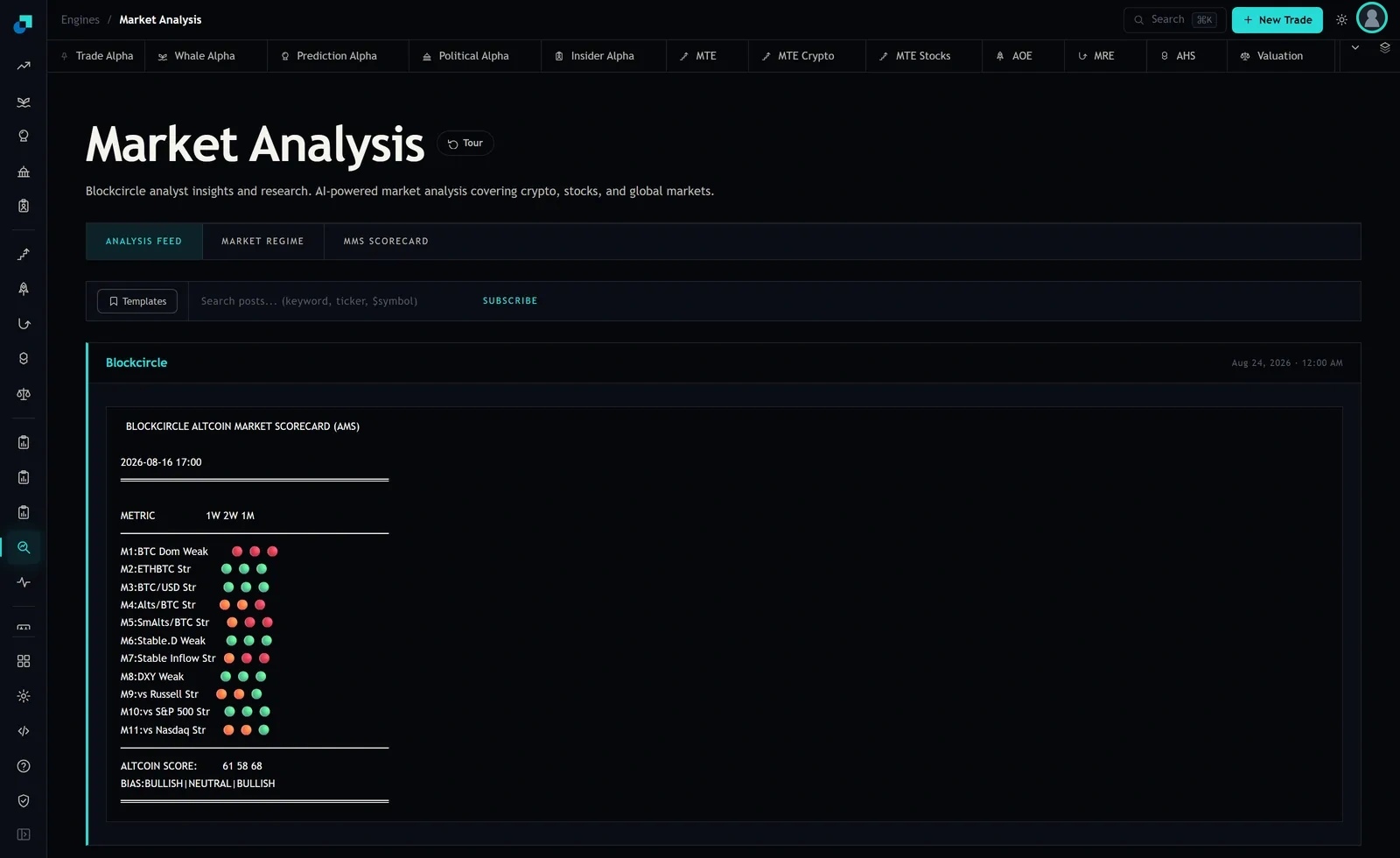
The capture makes the point better than an argument does. The bias line reads bullish, neutral, bullish across the one week, two week and one month columns. There is no single answer on this card. There are three, and two of them disagree with the third.
So before anything else, pick your column. If you bought intending to hold for a couple of weeks, the middle column is yours, and the middle column reads neutral. The bullish reading you came for belongs to a one week trader and a one month trader, neither of whom is you. A large share of the conflicts I have watched people agonise over dissolve at this step, and the remainder get much clearer because you now have one reading instead of a blur.
Scope is the second cut, and it is sharper. Look at what those rows actually measure: bitcoin dominance, ether against bitcoin, alts against bitcoin, small alts against bitcoin, stablecoin dominance, the dollar index, crypto against three equity indices. Not one of them is about the specific token you hold. A composite can read 68 while the row closest to your asset, the small alt line at amber, red, red in this capture, is telling you that your part of the market is the part that is not working.
Rank the evidence before you weigh it
Once horizon and scope are matched, you may still have a genuine disagreement. Not all disagreement carries the same weight, and the ranking is what stops you from folding on noise or holding through a real break.
The strongest evidence is that the specific claim you entered on has flipped. You bought because ether was outperforming bitcoin and that row has turned. This is not a mood, it is your own stated reason ceasing to be true, and it should carry more weight than any composite. If you cannot name the claim you entered on, that is a finding in itself and the position is smaller than you thought it was.
The middle tier is structural: the level that defined your risk has broken, or the thing you expected to happen by a certain date has not happened by that date. Neither invalidates the idea outright, and both are legitimate reasons to reduce.
The weakest tier, and the one that generates the most action, is a composite disagreeing with you while your own thesis row still holds. That is a reason to check your work, not a reason to trade. Composites are built from many inputs and can move because of components that have nothing to do with your position.
The practical rule that falls out of this: fold on tier one, halve on tier two, do nothing on tier three alone.
Write the fold rule before the trade, in dollars
None of the above works if you decide it while looking at a red number, so it has to be written at entry. Three lines in whatever you keep your notes in, taking about ninety seconds.
Line one: the claim. "Ether outperforms bitcoin over the next month." Line two: the flip condition, stated so a stranger could check it. "The ETHBTC row turns amber or red on the one month column." Line three: the action and the amount. "Sell half. If it turns on two horizons, sell all of it."
Make the amounts dollars rather than percentages, because dollars are what you actually feel. On a $3,000 position, half is $1,500 out and $1,500 left working. Writing it that way at entry, when you are calm, is what makes it executable later, when you are not.
One more line worth adding: the date you will next check. A thesis with no review date turns into a holding by default, and the default is where positions go to quietly become long-term investments.
Check the vintage before you act on either side
Before you fold or hold on the basis of a panel, confirm the panel is describing now. On the card in the capture, the feed header stamps the post Aug 24, 2026 while the scorecard printed inside it carries a stamp of 2026-08-16 17:00. That is eight days between the post and the data, and eight days is enough for a bias line to change.
This cuts both ways and that is why it is worth the ten seconds. A stale bullish reading talks you into holding something that has already turned. A stale bearish reading talks you out of a position that recovered while you were not looking. If the data stamp is older than the horizon you are trading, you do not have a current reading, you have a historical one, and the honest move is to go and check the underlying yourself before you touch the position.
The trap of waiting for the panel to catch up
The most common resolution of this conflict is the one that feels most patient: hold, and wait for the market to come round to the reading. It deserves a name because it is not patience.
A composite built from one week, two week and one month lookbacks is a description of what has already happened. It does not catch up to anything. If your position is falling while the composite is high, the composite will eventually reflect the fall, at which point you will have the confirmation you were waiting for and a considerably worse price. Waiting for a backward-looking measure to agree with a forward-looking hope is a structure that only resolves one way.
The other version of the trap is upgrading your timeframe when the number goes red. You bought for a week, the week went badly, and now you are a one month holder because the one month column looks better. That is not analysis, that is a horizon chosen to avoid a decision. If you genuinely want to hold for a month, the size, the stop and the review date all have to be rebuilt for a month, and if you would not have taken the trade at that size for that period, you are not holding it, you are stuck in it.