The seductive version of this research goes like this. You see a disclosed purchase in a defence name, you go looking, you find that an appropriations measure moved through committee a few weeks later, and you feel like you have found something. You almost certainly have not. Legislatures consider thousands of measures a year across every sector of the economy, and if you go looking for a bill that touches a given industry within a two month window of any date you choose, you will find one. Every time. That is not a discovery, it is the birthday problem with a suit on.
The routine below is the one I use to stop that happening. It is four steps, and the fourth is the only one that separates a real timeline from a story you told yourself.
Step one, recover the trade date and throw away the filing date
The single most common error is anchoring on the wrong date. The date you notice is the date the disclosure appeared. The date that matters for any legislative timeline is the date the transaction happened, and those are far apart.
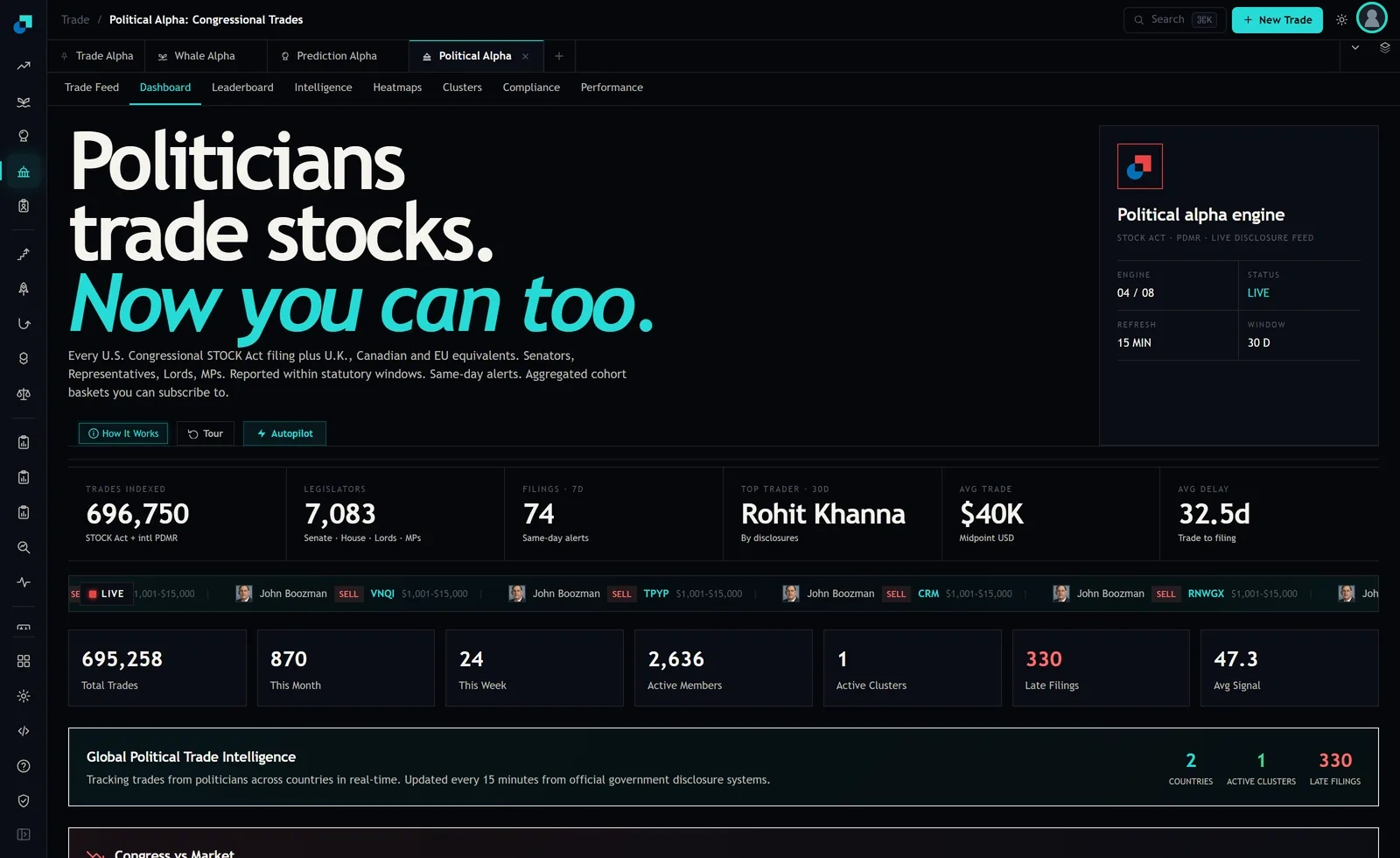
Look at the AVG DELAY tile on the Political Alpha dashboard. It reads 32.5d, subtitled "Trade to filing". The average gap between transaction and disclosure is just over a month, and with 330 late filings showing on the same screen the distribution clearly has a long right tail, so individual rows can be much staler than that.
So before anything else, write down two dates: the transaction date and the disclosure date. You will use both, for different things. The transaction date defines the window in which you look for legislative activity. The disclosure date defines the window in which the market could first have reacted to the information becoming public, which is a completely different question and one most people collapse into the first by accident.
Step two, establish the committee relationship before you look at any bill
This step exists to constrain your search, and constraint is the whole game. Pull the member's committee and subcommittee assignments from the official source, which publishes them, and write them down. Do this before you look at a single piece of legislation.
The reason for the ordering is simple. If you look at bills first, you will find one that fits and then reverse-engineer a reason why the member would have known about it. If you fix the committee relationship first, you have a testable predicate. Either the traded company operates in a sector that falls under a committee the member sits on, or it does not. If it does not, you are finished, and finishing early is the point of the step.
Political Alpha carries a Committee Correlation view inside its Heatmaps tab and its documented per-trade signal score weights committee fit as one of its inputs, so the platform clearly treats this relationship as a first-class variable. For a single trade you are examining by hand, though, the assignment list from the official source is what you want, because you need the specific subcommittee rather than an aggregate correlation.
Step three, draw the window and search the calendar inside it
Now you go to the legislative calendar, and you go with a window you fixed in advance rather than one you widen until you find something. My default is thirty days either side of the transaction date. The forward half is where a scheduled markup, hearing or floor action could plausibly have been visible to a committee member in advance. The backward half catches the case where the member was reacting to something that had already happened in committee but had not yet been noticed by the market.
Inside that window, you are looking for activity that touches the traded company's sector and that passed through a body the member actually sits on. Not activity anywhere in the legislature. Not activity in a committee the member has no relationship with. The two filters together, sector plus committee, cut the candidate set by an enormous factor, and that reduction is what makes the exercise worth anything.
Record what you find in a fixed format: the date of the legislative action, the body it happened in, the sector it touches, and the number of days between it and the transaction. Fixed format matters because you are about to compare this record against other records, and free-text notes cannot be compared.
Step four, the falsification test that most people skip
Here is the step that decides whether anything you just did was real. Take three other disclosed trades from roughly the same period, chosen by a rule that has nothing to do with your hypothesis. The simplest rule is to take the three rows immediately above and below your trade in the feed. Then run the exact same procedure on them: fix the transaction date, list the committee assignments, draw the same thirty day window, search for sector-relevant legislative activity.
If you find an equally convincing bill for all three, your method has a false positive rate near one and the match you found on your original trade carries no information. This happens far more often than people expect, and the reason is the base rate. Sector-relevant legislative activity within sixty days of an arbitrary date is close to a certainty for large sectors like health care, financials and technology, which is where most disclosed trading lives anyway.
The test has a useful second output. If your control trades come back empty and your candidate comes back with a specific committee action in a narrow window, you have something worth ten more minutes. Not a trade. Ten more minutes.
What a surviving match is actually worth
Suppose the match survives. What have you got?
You have a plausible information path, not a signal. The trade is already about a month old by the time you see it. The legislative action may already have occurred and been priced. And the size on the filing is a bracket rather than a number, which is why the dashboard reports average trade as $40K under the subtitle "Midpoint USD" and why the ticker rows so often read $1,001 to $15,000. You cannot tell conviction from a bracket.
So the honest use of a surviving match is as a research prompt with a deadline attached. Pull the chart across the transaction and disclosure dates and check whether the move already happened. If the price is unchanged across both, you have a question worth researching on the fundamentals. If the price already moved, the interesting question is whether the underlying thesis is still live at today's price, which is a normal investment question that the disclosure has now merely pointed you toward.
And keep the falsification records. After you have run this fifteen or twenty times you will have your own measurement of how often the control trades produce a match, which is the only way to know whether your window and your committee filter are tight enough to mean anything. Nobody publishes that number for you. You build it yourself, four columns in a spreadsheet, one row per attempt.