Two wallets can show the same profit over the same six months and be completely different animals. One took ninety positions, none of them wildly bigger than the others, and ground out the number. The other took eleven positions, ten of which were noise, and one of which was a swing so large that it is the entire record. Copying the first is a strategy. Copying the second is standing next to somebody at a roulette table and hoping the ball goes where it went last time.
You cannot tell these two apart from a profit figure, a win rate, or a volume tile. You can tell them apart in about fifteen seconds from three numbers you can get on any wallet you are considering: the average size of its trades, the median size, and the largest single one. The average is the least useful of the three, and it is the one everybody looks at.
Why the average is the number that lies
An average is a total divided by a count, and totals are dominated by their biggest element. Take the Whale Alpha Feed reading from capture: 12.5 million dollars of whale volume across 50 transactions in twenty four hours. The average print is 250,000 dollars. That number is true and it may also describe nothing that happened. If one of those fifty prints was six million dollars and the other forty nine were roughly a hundred and thirty thousand each, the arithmetic still lands on 250,000 while the typical trade was half that. The average has been dragged to a place where no actual trade lives.
The median does not have this problem, because it does not care about magnitude, only order. Sort the fills by size and take the middle one. One monstrous trade moves the median by one position. It moves the average by however many dollars it was worth divided by fifty. That single property is why the median is the number that describes the wallet's habit and the average is the number that describes its biggest day.
Reading a wallet as a distribution rather than a total
The Statistics tab is worth a visit purely as a cautionary example here. At capture it carried a tile labelled average bet size reading zero dollars, sitting on a platform tracking 26,687 whales with a best performing wallet at a billion dollars. A tile can be empty, or broken, or computed over a scope you did not expect, and if you take one summary statistic as gospel you will occasionally build a decision on a zero. Distributions are harder to break silently, because a distribution with a hole in it looks wrong to the eye immediately.
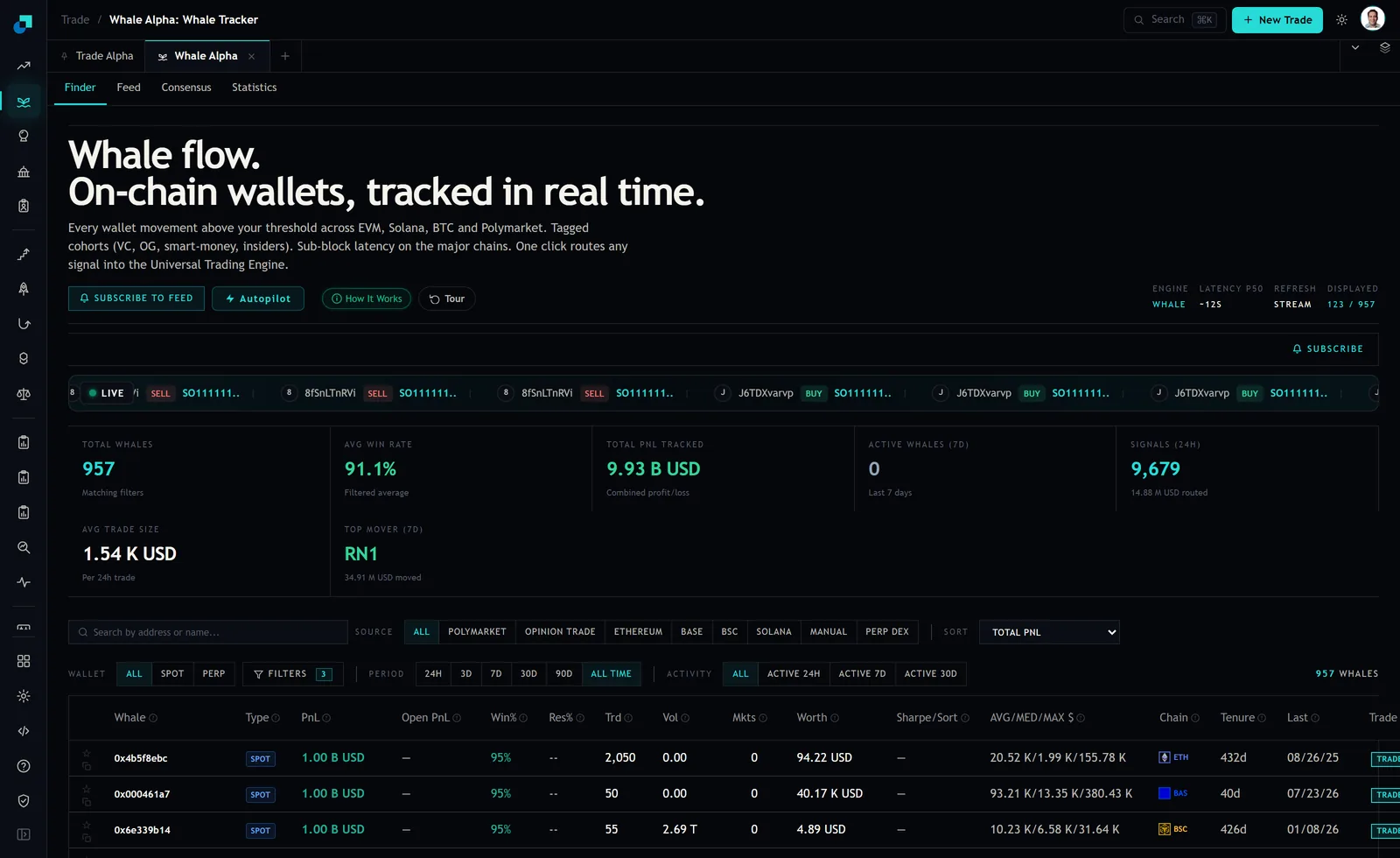
Notice what the module puts in its own ranking metrics: realised PnL, win rate and average return per trade, risk classification for concentration and leverage and drawdown, and holding period distribution and trade frequency. Three of those five are shape measurements. The platform is telling you, in its own documentation, that a wallet is not adequately described by its total.
The ratio I actually compute
Divide the largest trade by the median trade. That single ratio does most of the work.
- Under about three, you are looking at a consistent sizer. This wallet has a position sizing rule and follows it. Its results, good or bad, are repeatable in the sense that the same process produced all of them. This is the profile worth studying, because there is something to learn.
- Between three and ten, you have a wallet that scales up on conviction. That is a legitimate style, and it is the most common profile among people who are actually good, but it means the record is unevenly weighted and you need to check whether the big trades were the winners or the losers.
- Above ten, and especially above twenty, the record is one event. Everything else is noise around it. Before you draw any conclusion, find that one trade and ask what it was. Sometimes it is genuine, a wallet that saw one thing clearly and pressed. Often it is a token that went vertical while the wallet happened to be holding, which is a story about the token and not about the wallet.
The second thing to check is where the maximum sits in time. A wallet whose largest trade was fourteen months ago and whose median has been drifting down ever since is a wallet whose capital is shrinking, whether or not the headline PnL still looks impressive. A wallet whose largest trade was last month and whose median has been rising is either compounding or getting reckless, and the risk classification for leverage will usually tell you which.
What this changes when you have a few thousand dollars
Here is the practical part, because none of this matters unless it changes what you do on Monday.
If you have found a consistent sizer, you can scale it down honestly. A wallet whose median trade is two percent of its book and whose maximum is five percent gives you a rule you can apply to your own account at any size. Two percent of five thousand dollars is a hundred dollars. The proportions survive the translation, and so does the risk profile. You are running the same shape with less money in it.
If you have found a one trade wonder, the scaling does not work at all, and this is the failure mode I want you to avoid. The wallet made its money by having enough capital to survive ten losers before the eleventh paid for everything. On a small account you do not get ten losers. You get three or four before the position sizes you would need are larger than what you have left, and you stop, and the eleventh trade happens without you. Copying a lottery style with insufficient capital is not the same strategy at lower stakes. It is a strictly worse strategy, because the payoff structure requires a bankroll you do not have.
There is also a plain liquidity point. A wallet whose median trade is a quarter of a million dollars is trading in venues and sizes where a hundred dollar order is invisible, which is fine. But it may also be trading things where a hundred dollar order is not economical after fees, or where the wallet's own entry moved the price to somewhere you cannot get in at. The size distribution tells you whether the strategy is one you can physically participate in before you spend an evening reading its history.
The version of this check that takes thirty seconds
Open the wallet. Get its trade count and its total volume, and divide for the average. Get its largest single trade. If the largest trade is a big fraction of the total volume, you already have your answer and you can stop, because a wallet where one fill is a quarter of everything it has ever done is a wallet with one idea in it. If it is not, then go find the median properly and run the ratio.
Most candidates die at that first division. The ones that survive it are worth the hour it takes to read their actual history, and that is the point of the check: not to find the right wallet, but to stop spending evenings on the wrong ones.