Someone forwards you a screenshot of a listing announcement from a mid-tier venue and the implied argument is always the same. It got listed, so it is on the way up, and the top-tier listing is next. That argument is doing an enormous amount of work off a single row of data, and most of the work is invented.
A listing is an operational fact. A venue has decided to run a book in this token, with a particular quote asset, in a particular market type. That is genuinely useful information. It is also much narrower than the story people build on top of it, and the gap between the two is where money gets lost.
What the Exchange chip actually contains
Start with the column itself, because reading it precisely removes half the confusion. On my capture of the listings ledger, the Exchange chips read Kraken, Hyperliquid Spot, Coinbase Pro (GDAX), Asterdex Futures and MEXC Futures. Notice that the chip carries two facts fused together. The venue, and in several cases the market type.
That second half matters more than the first. Two of the rows in view, TWSTSTOCK and MNSTSTOCK, carried MEXC Futures chips. Those are futures listings. A futures listing is a contract you can trade at that venue. It is not a token you can buy, withdraw and hold, and it does not mean the venue has opened a spot book. If your mental model is "it is now buyable on MEXC", a futures row does not support that.
The second thing worth knowing is what the ledger does not do. There is no tier column. Nothing on the row ranks Kraken above MEXC or sorts venues into first and second division. The sort options are newest, market cap, volume and confidence. The tiering you are applying is your own judgement layered on top of a venue name, which is fine as long as you know that is what you are doing and do not mistake it for something the data told you.
The three things a mid-tier listing does tell you
Being narrow is not the same as being worthless. There is real content in the row.
First, a book now exists with a specific quote asset. The Pair column tells you which. On the capture, FOLD/USD and TMX/USD were on Kraken, ONE/USDC was on Hyperliquid Spot, BASECAT/USD and DRB/USD were on Coinbase Pro, and ATH/USDT was on Asterdex Futures. The quote asset determines what you actually hold after a sale and whether you need a second trade to get back to the currency you think in.
Second, the venue accepted the token operationally. Somebody at that venue confirmed a contract address, wired up deposits and withdrawals for that chain, and agreed to run the book. That is a low bar, but it is not zero, and it is more than an unlisted token has cleared.
Third, you now have a second price. A centralised book alongside an on-chain pool gives you a comparison, and disagreement between the two is information about where the real liquidity sits.
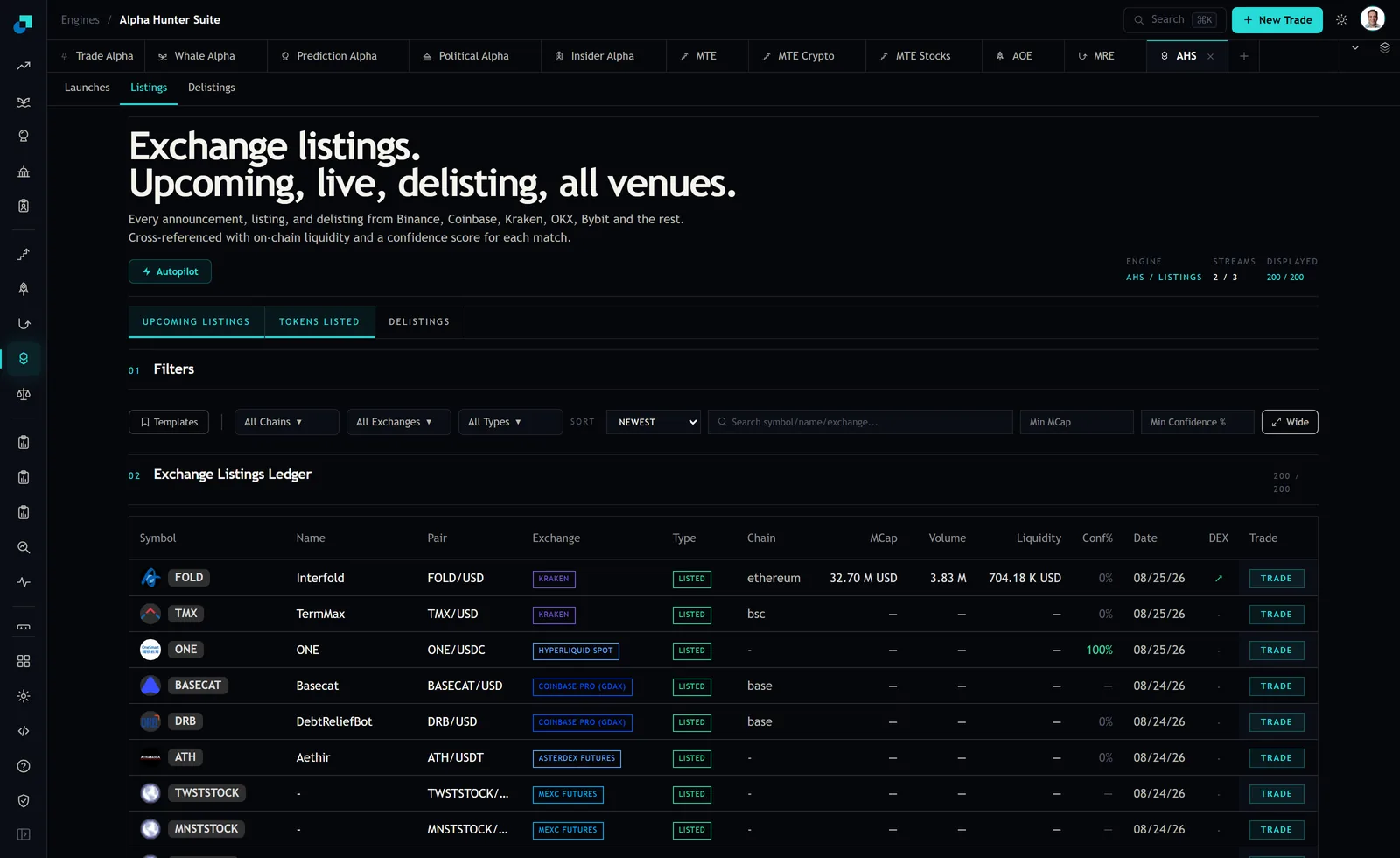
That screenshot also makes the fourth point on its own. Look at the two MEXC Futures rows. The Name column is empty, the chain shows a dash, and MCap, Volume and Liquidity are all dashes. The listing exists and almost nothing else about it is populated. Whatever you decide, you are deciding on very little.
The thing it does not tell you
It does not tell you a top-tier listing is coming.
The ladder story sounds mechanical, as though venues promote tokens up a hierarchy on merit. They do not share a queue. Each venue applies its own listing standards, its own legal review, its own view on the token's jurisdiction and its own commercial interest, and those criteria are not nested. A token can satisfy a mid-tier venue's requirements for years while failing a top-tier venue's on a point that has nothing to do with price.
The base rate argument is the one that should settle it for you. Mid-tier venues list a great many names. Top-tier venues list comparatively few. So most mid-tier listings are not followed by a top-tier listing, whatever the individual case looks like. That is arithmetic about the size of the two populations, not a judgement about any particular token.
And the ledger publishes no conversion figure. There is no column, no panel and no statistic in the module saying that a listing on one venue leads to a listing on another at any rate. If someone quotes you such a number, ask where it was measured, over what universe, and with what treatment of the tokens that died in between. Usually the answer is that it was not measured at all.
Access and cost decide more of this than the signal does
Here is where the retail version of this question actually gets decided, and it has nothing to do with tiers.
Can you use the venue at all from where you live, with the account you have? If not, the listing changes nothing for you and the analysis stops.
Is the new book deeper than whatever you are using now? A thin centralised book is not an improvement on a decent on-chain pool, and the Volume and Liquidity fields being empty on a fresh row means you have to check that at the venue rather than infer it. Pull up the actual order book and look at what sits within one and two percent of the mid price.
What does the round trip cost? Taker fee in and out, the spread, the withdrawal fee if you plan to move the token, and the second trade if the quote asset is not what you want to end in. On small positions these costs are frequently larger than the edge anyone is claiming from the listing itself.
The check to run before you act on a listing row
This takes about five minutes and it is the same five minutes every time.
- Read the chip for market type. Spot or futures. If it says futures, stop treating it as a buyable token and price the funding cost instead.
- Read the Pair column for the quote asset, and decide whether you are willing to hold that asset after the trade.
- Open the venue's own book and measure depth within one percent of mid, then compare it against your intended size. If your position is a meaningful fraction of what sits there, the listing has not solved your exit problem.
- Confirm deposits and withdrawals are actually open for that token on that chain at that venue. Listed and withdrawable are separate states and the row does not distinguish them.
- Write down what you would need to see to change your mind, before you enter rather than after.
None of that tells you whether the token is worth owning, and neither does the listing. The row establishes that a market exists at a venue. Whether that market is deep enough for your size, cheap enough for your horizon, and reachable from your account is a separate set of questions, and those are the ones with answers you can actually check today.