There is a category of research finding that is analytically correct and commercially useless, and listed mining equities produce it more reliably than almost anything else. The valuation work is tractable. Hash rate, fleet efficiency, all-in power cost, hosting arrangements and coin price give you a defensible fair value with fewer moving parts than most industrials require. The gap between that fair value and the quoted price is often large and occasionally obvious.
Then you try to put money into it at size and discover that the position you can actually build over a horizon shorter than the mispricing is a fraction of what the conviction justified. The edge was real. It was simply not harvestable at your assets under management, and nothing in the valuation work told you that, because capacity is a separate calculation that most research processes never run.
The edge and the harvest are different questions
Analysts are trained to answer the first and rarely asked to answer the second, and the two have almost no inputs in common. Fair value depends on operating economics and the coin price. Harvestable size depends on tradable float, average daily volume, your own participation limit, the disclosure thresholds you would cross, the half-life of the mispricing, and the correlation of the name with everything else in the sleeve.
The uncomfortable consequence is that capacity has to be computed before the research is commissioned, not after it is finished. A three week analytical exercise on a name that can absorb thirty basis points of the book is a poor allocation of the team, however good the answer turns out to be.
The size column on the board is market capitalisation
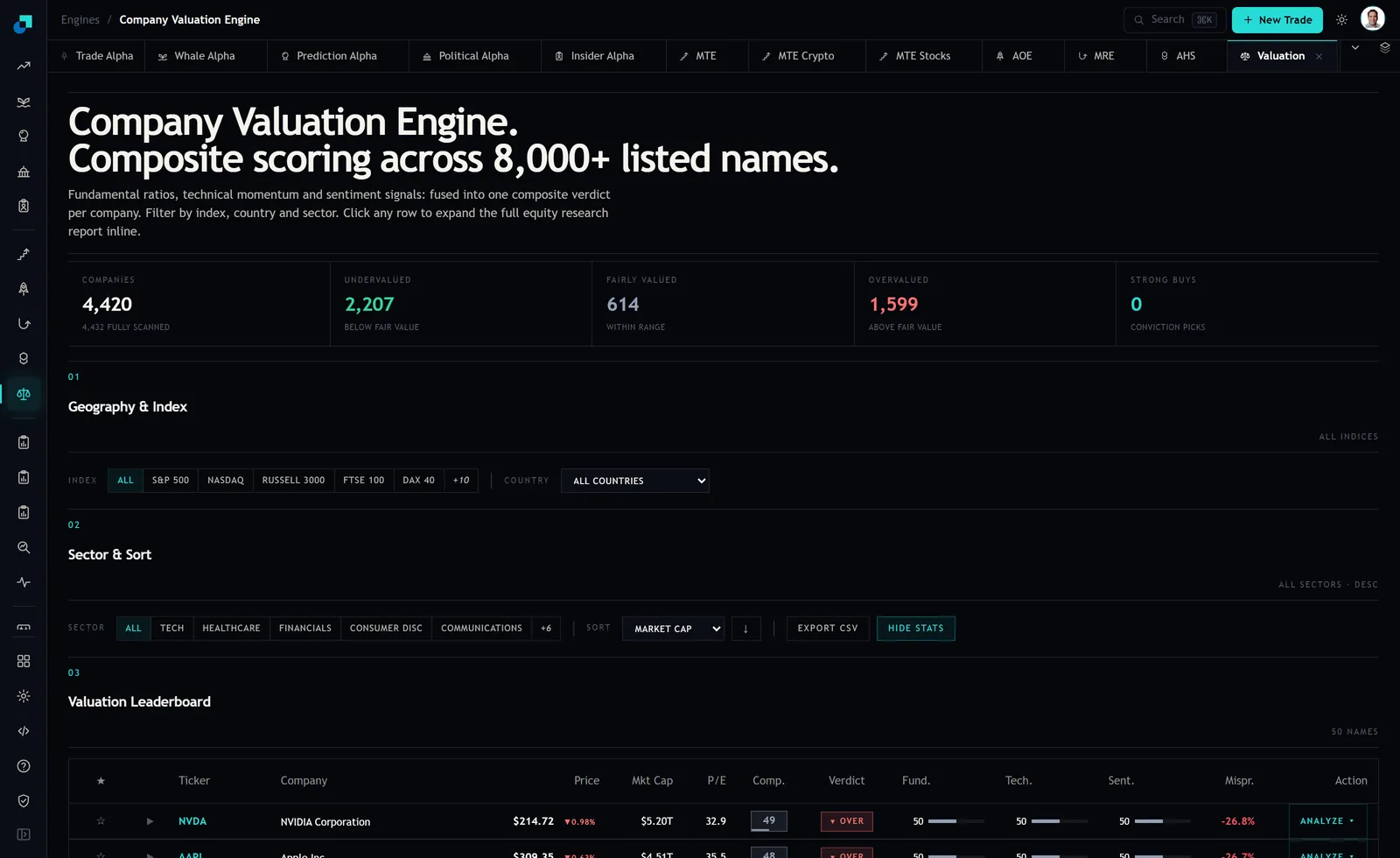
The distinction has practical force in this sector specifically. Mining companies fund themselves through equity issuance, so share counts move fast, and founders and early backers frequently retain large stakes. A ranking by market capitalisation will therefore put names near the top of a list whose genuinely tradable size is a small multiple of what a mid-sized mandate needs in a week.
Use the platform for what it is good at, which is defining a consistent scored universe across index, country and sector and exporting it as a candidate list. The counters at capture read 4,420 companies with 4,432 fully scanned. Then attach the capacity fields from your execution data before any analyst opens a model.
From market capitalisation down to a tradable number
The ladder has four rungs and each one removes something that was never available.
Start with market capitalisation. Subtract insider and strategic holdings from the ownership disclosure, which for this sector is frequently between fifteen and thirty percent. What remains is free float.
Subtract the portion of float held by index-tracking vehicles, which does not trade on your timescale and does not respond to valuation at all. In a name with meaningful index membership this is another large slice.
What is left is the contestable float, and it is the correct denominator for any ownership threshold thinking. It is routinely half of market capitalisation or less.
Then move from stock to flow, because ownership is not the binding constraint, turnover is. Take average daily traded value over a trailing window, and take it over a window that includes a quiet period rather than the last month if the last month contained a coin price move, since volume in this sector expands and contracts with the underlying asset in a way that will flatter any recent measurement.
Participation, build time, and the decay you build into
Fix a participation rate as house policy and apply it uniformly. Fifteen percent of average daily volume is a common ceiling for a discretionary book that does not want to be the print. Then the arithmetic is direct.
Round figures. A miner with a two billion market capitalisation, twenty two percent held by insiders and strategics and another eighteen percent of the float indexed, has a contestable float somewhere around one and a quarter billion. Average daily traded value is forty five million. At fifteen percent participation you can transact under seven million a day.
A five billion book wanting a three percent position needs one hundred and fifty million of stock, which is twenty two trading days of building. Now compare that against the half-life of the mispricing you identified. If the valuation gap on this name has historically closed over roughly thirty trading days, you are spending three quarters of the opportunity accumulating into your own thesis, and your average entry sits materially above where the analysis said it should.
Then run the exit, which is the calculation people skip and the one that hurts. Volume in a stressed tape does not stay at forty five million. Assume it halves, hold participation constant, and the same position takes forty four days to unwind, in conditions where you want out. A position whose exit takes two months is not a three percent position regardless of what the conviction says.
Add the disclosure thresholds. Crossing a substantial holding threshold turns a quiet accumulation into a public statement, invites front-running of the remainder, and in some jurisdictions constrains what you may do next. On a contestable float of one and a quarter billion, a five percent threshold is sixty two and a half million, which the example above crosses less than halfway through the build.
Power contracts collapse the sleeve into one exposure
There is a second capacity constraint in this sector that has nothing to do with liquidity, and it binds tighter than the trading arithmetic at most institutional sizes.
A miner's cost structure rests on a small number of power arrangements at a small number of sites. Two miners with different listings can depend on the same regional grid, the same wholesale market design, the same curtailment programme and occasionally the same counterparty. A book holding five miners for diversification may be holding one exposure to a regulatory decision in one jurisdiction.
Map it explicitly before sizing. For each name, list the sites, the grid or balancing authority, the contract type meaning fixed price, indexed or hosted, the contract expiry, and whether curtailment revenue is a material contributor. Then aggregate the book by grid rather than by ticker.
Where the aggregate exposure to a single grid exceeds what you would tolerate as a single-name position, the sleeve is oversized whatever the per-name liquidity permits. This also compounds the trading problem, because a shock to a shared driver moves all the affected names at once, and the liquidity you modelled independently disappears in all of them simultaneously.
Writing the capacity number into the mandate
The output of this exercise is a stated maximum for the sleeve, computed and documented before positions exist, with three components on record.
Per-name maximum, from participation rate, build window and the exit test under halved volume. Sleeve maximum, from the grid and counterparty aggregation, which is usually the binding one. And a review trigger tied to assets under management, so that growth in the fund automatically reopens the question rather than silently pushing participation rates up.
Attach the action for breaching it in advance, because the decision is much harder once the fund has grown and the analyst still likes the name. The options are a smaller weight, expressing the sector view through the underlying asset or listed futures where the mandate permits, or declining the exposure. What should not be on the list is raising the participation rate, which does not create capacity, it converts a liquidity constraint into an execution cost and moves it somewhere the attribution will not find it.