The month end problem on event contracts arrives in a specific and unhelpful form. It is the last business day, the position is open, the contract does not resolve for another eleven weeks, and the venue's last print is from Tuesday. Somebody has to put a number in the file tonight, and whatever they put decides the NAV, the management fee accrual, the subscription and redemption prices, and whether the desk is inside its risk limits.
On most instruments a marking error is a few basis points of a line. On a binary the line can be worth a dollar or nothing, so the plausible range of a defensible mark is frequently a large fraction of the position's entire value. That is why this needs a written policy rather than a convention, and why the policy has to be written before the month end that tests it.
Write the ladder, and make every rung state its condition
A marking policy for this asset class is a hierarchy in which each level applies only when the level above it fails a stated test. The tests are the policy. The ordering is the easy part.
- Venue last trade, if the print is inside the staleness window and the size traded is above a stated minimum. A single one-lot print is a rumour, not a price.
- Mid of a two-sided book, if both sides are quoted and the spread is inside a stated cap. Record the bid, the ask and the size at each.
- A depth-adjusted mark, applied when the position is large relative to the resting book, using the price at which the line could actually be exited rather than the top of it.
- The price of a matched question on another approved venue, permitted only where a documented match record exists confirming that the two contracts share a resolution source, a cutoff and a settlement date.
- Manual override, with a written rationale, a named approver who is not the portfolio manager, and automatic escalation to the valuation committee.
The value of the ladder is not that level one is more accurate than level four. It is that every mark in the file carries a label saying which level produced it, so the exceptions report writes itself and nobody has to reconstruct the reasoning in March.
Staleness is a number of hours, and there are two ways to fail it
Replace every use of the word recent in your policy with a figure. Twenty four hours, or forty eight, or whatever your fund can defend, and it can differ by category as long as the differences are written down. An undefined staleness threshold is the single most common finding in a valuation review of an illiquid book, because it lets the same desk mark to the tape when the tape is favourable and to the mid when it is not.
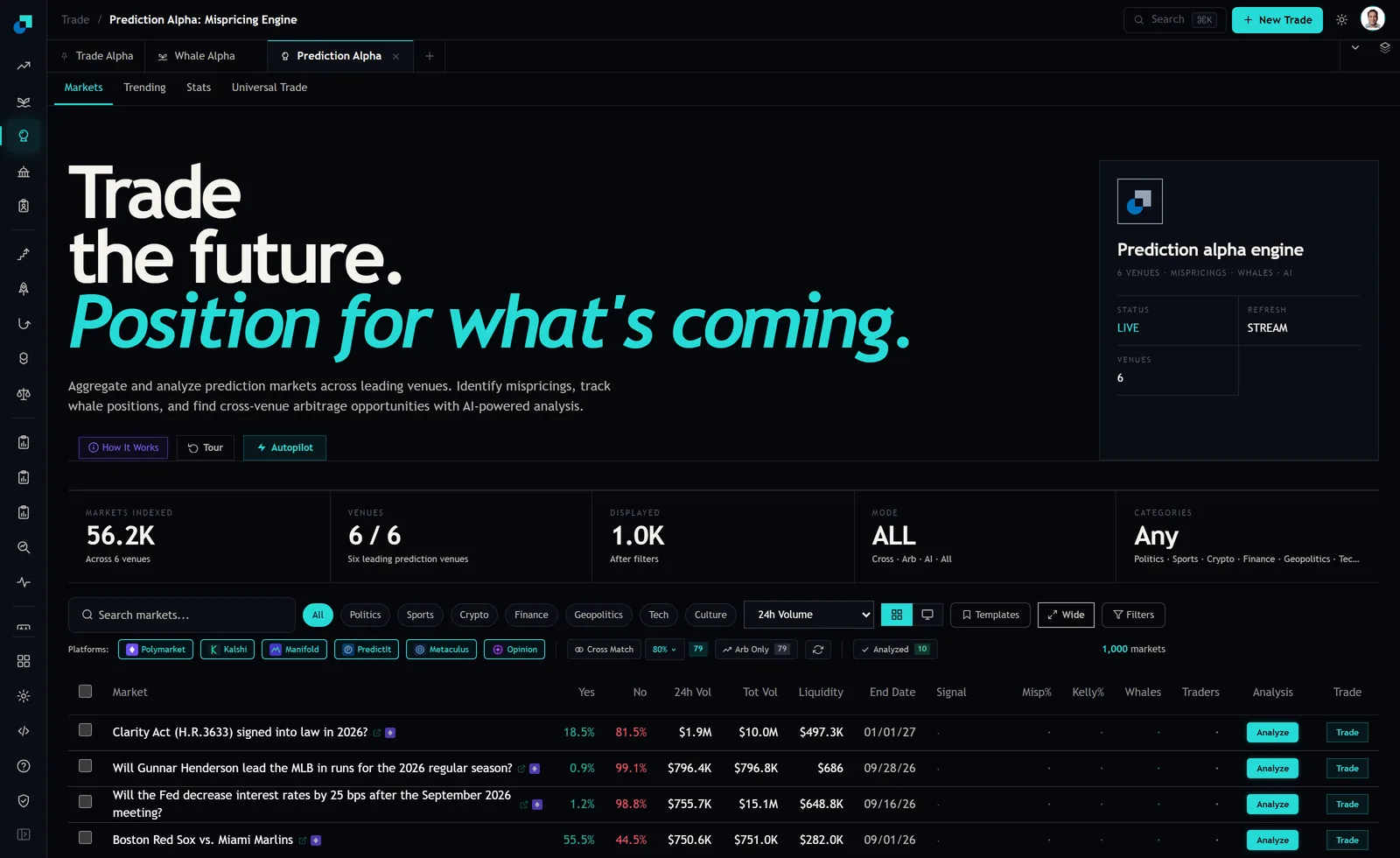
Then recognise that a market can be unmarkable in two opposite ways and that they need different responses. The markets table shows the first case plainly, on a row carrying $796.4K of 24-hour volume against $686 of liquidity. There is no shortage of prints there. There is no book behind them. A last-trade mark passes the staleness test comfortably and is still not a price at which anything could be liquidated. This is the case where level three has to be mandatory rather than optional, and where the trigger should be the ratio between your position size and the resting depth, not the age of the print.
The inverse case is quieter. A contract with a tight two-sided quote and no print for a fortnight, usually a long-dated question where makers are happy to quote and nobody has a reason to trade. There the mid is a perfectly good mark and the staleness test on last trade would have failed it. The ladder handles this correctly only if the levels are genuinely conditional rather than sequential by habit.
The spread looks tiny and is not
Binaries break the intuition that a one cent spread is immaterial, and the break is severe at the ends of the price range. A contract quoted 0.9 bid against 1.9 offered has a mid of 1.4 and a spread of one cent. In absolute terms that is nothing. In relative terms the mark is uncertain by more than a third of the line's entire value, and choosing bid, mid or last on that line moves it by over fifty percent.
So mark uncertainty has to be captured twice. Per line in relative terms, because that is where the error lives, and at fund level in absolute terms, because that is what determines materiality. A policy that sets a single materiality threshold in dollars will wave through a book of near-zero contracts whose collective mark is close to arbitrary, and a policy that sets it only in percentages will drown the committee in lines worth forty dollars.
Tenor belongs in the same calculation. The End Date column on the markets tab shows contracts ending 09/01/26, 09/16/26, 09/28/26 and 01/01/27 sitting in adjacent rows. A mark on the first of those, days from settlement, converges to a known answer almost immediately and any error self corrects. A mark on the last carries for four more month ends and compounds into four sets of fee accruals.
Not every venue is allowed to be a price
This module aggregates six venues and the coverage description makes clear that they are different animals. Among them are play-money community markets and a forecasting community with calibrated probabilities. Neither of those produces a price at which anything can be transacted, and neither may appear anywhere in a marking ladder. A calibrated crowd forecast is a useful input to your fair value work and it is not a valuation source. Write the whitelist of permitted mark venues into the policy by name and require a committee decision to change it.
Then add the consistency rule for paired positions. If a position is a matched pair held across two venues, both legs are marked from sources at the same level of the ladder, struck at the same time. Marking one leg from a fresh print and the other from a stale mid manufactures P&L out of nothing, and it manufactures it in the direction that makes the hedge look like it is working.
Decided but not yet settled
The case that generates the audit finding is the contract whose underlying event has already happened. The match finished, the vote was held, the number was published, and the contract simply has not been settled by the venue yet. The last print may sit at 96 or at 4 because the final trades occurred while the outcome was still uncertain, and the book may be empty because nobody wants the last four cents.
Marking that line to the tape books a P&L movement that is pure artefact, and it will be corrected at settlement in a way that looks like a loss on a position that never lost anything. The policy answer is to mark to expected settlement once the event has occurred and the outcome is determinable under the contract's own resolution criteria, with two conditions attached. Somebody other than the trader confirms the determination against the written criteria, and the mark reverts to the ladder if the venue has flagged a dispute or a review, because a disputed outcome is genuinely uncertain again.
Behind all of it, run a stale mark register. Every line marked at level three or below, with the age of its last observable price, the level used, the approver, and the number of consecutive month ends it has been on the list. That last column is the one the valuation committee should read first, because a position that has been manually marked for four months in a row is not a valuation problem any more. It is a position the fund cannot exit and has not yet admitted to.