The monthly macro meeting is the least defensible hour in most investment processes. It runs long, the loudest person sets the tone, the minute records that the committee discussed the outlook, and three months later nobody can reconstruct what the house view was in April or what would have had to happen to change it. When a position goes wrong and a client asks what your macro view was at the time, "we discussed it" is not an answer.
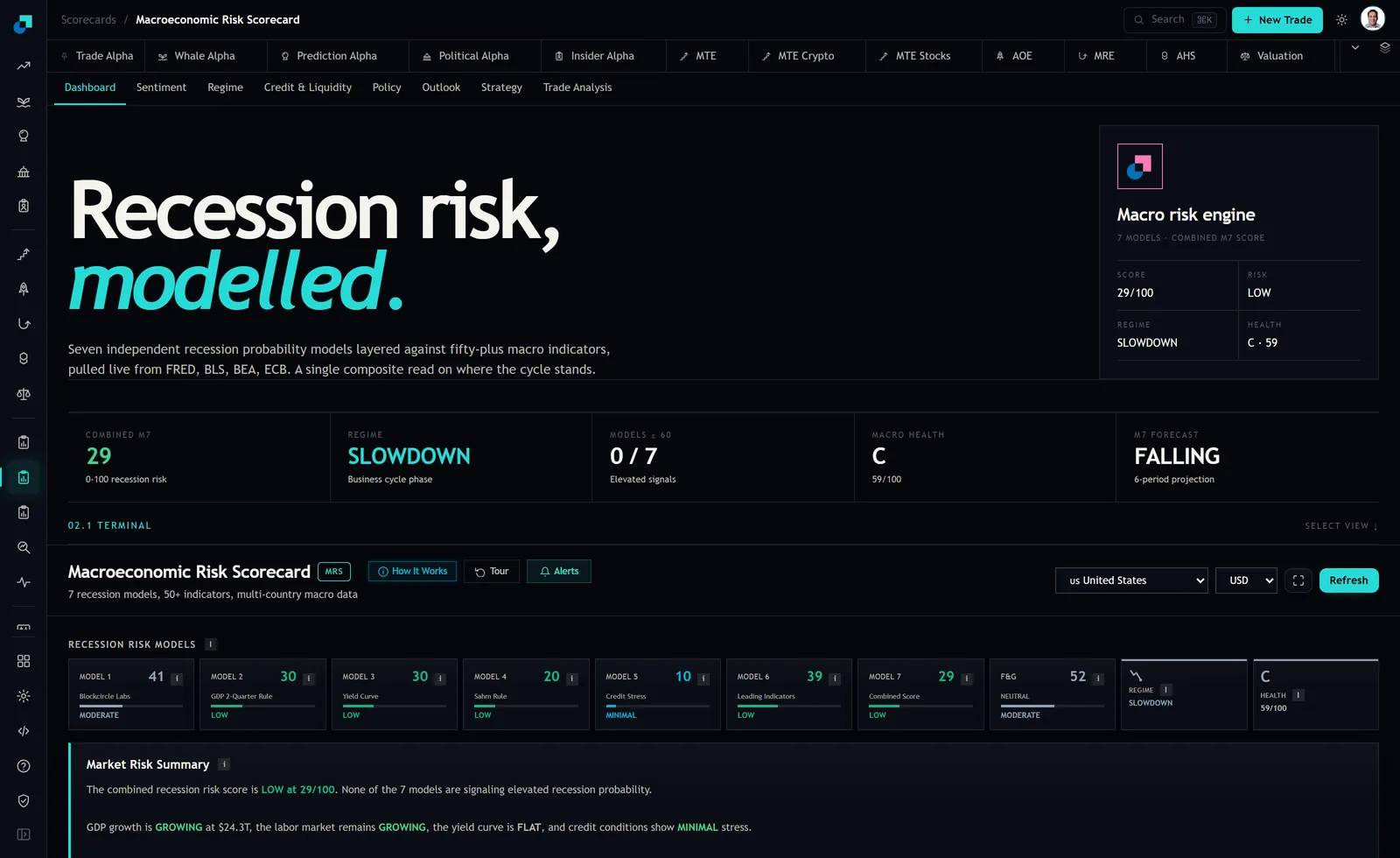
The fix is structural and boring. Stop treating the meeting as a discussion and start treating it as a form that has to be filled in. The Macroeconomic Risk Scorecard is convenient for this because its tab order already imposes a sequence: Dashboard, Sentiment, Regime, Credit and Liquidity, Policy, Outlook, Strategy, Trade Analysis. Eight tabs, eight agenda items, and nobody has to remember what comes next.
One tab, one item, one owner, one question
The rule that makes this work is that each item has a single named owner who has already looked before the meeting starts, and each item exists to answer one pre-written question. Not to present. To answer.
Owners rotate quarterly, not monthly. Quarterly is long enough that the owner builds a sense of what normal looks like on their tab and can say "this is the biggest move I have seen on this in three months", which is the single most valuable sentence anyone says in these meetings. Monthly rotation gives you eight people who each see a snapshot and none who see a series.
The sixty minute agenda
Five minutes of overrun per item is how an hour becomes ninety minutes, so the time box is enforced by the chair and an item that runs out of time is carried to a separate research session rather than allowed to eat the next item.
| Item | The question it must answer | Minutes |
|---|---|---|
| Dashboard | What are the four headline readings, and how have they changed since last month? | 5 |
| Sentiment | Is positioning and sentiment confirming the score, or is it the outlier this month? | 5 |
| Regime | Has the business cycle phase designation changed, and if not, how long has it been where it is? | 8 |
| Credit and Liquidity | Are credit default swap and high yield spread conditions tightening, and at what pace? | 10 |
| Policy | What has changed in the policy path and the yield curve since last month? | 8 |
| Outlook | What does the forward view imply that our current positioning does not reflect? | 7 |
| Strategy | Given all of the above, does the exposure policy change, and by how much? | 7 |
| Trade Analysis | What did last month's macro instruction actually do to the book? | 5 |
| The minute | Write it in the room, before anyone leaves | 5 |
Two things about that ordering. Credit and liquidity gets the largest box because it is where cycle turns tend to show up as a change in conditions rather than as a change in an estimate, and because spread data moves faster than the official series so it is the item most likely to contain something new. And Trade Analysis sits last deliberately, because reviewing what your previous macro call did to the book before you make the next one produces a meeting where people quietly anchor on defending the old call.
The artefact, and why it has to be written in the room
The meeting output is one page with five fields. If it is not written before people stand up, it does not get written, and the entire exercise reverts to a mood.
- The readings, dated. Combined score, risk label, regime label, health grade, count of models at or above 60, and the observation date. Macro data revises. Your record of what the screen said on the day is the only version that will still be true next year.
- The view, in one sentence. Not a paragraph. If the committee cannot compress the view into one sentence, the committee does not have a view, it has a set of observations.
- What it authorises. Explicitly: no change, a research task, or a specific exposure adjustment with a size. Most months this reads "no change", and a process where most months read "no change" is a working process rather than a lazy one.
- What would falsify it. Pre-registered, before the next meeting. Two or three specific readings that would mean the view was wrong. This is the field everybody skips and it is the one that turns the document from a record into a control.
- Dissent. Named. If one member thought the credit picture was worse than the committee concluded, that goes in the minute with their name on it. When the dissent turns out to be right, you want a process that surfaced it, not one that averaged it away.
The falsification field is doing the heaviest lifting. It converts next month's meeting from an open-ended re-argument into a check: did any of the three things we said would change our mind happen. That check takes four minutes. Re-litigating the view from scratch takes forty, and produces a view that drifts with whoever is in the room.
Three ways this meeting degrades, and the counter to each
The first is the single presenter. One person, usually the strategist, ends up walking through all eight tabs while everybody else listens. The meeting is now a briefing, and briefings do not produce committed decisions because nobody in the room owns anything. The counter is mechanical: the chair does not present any item, and no person owns more than two.
The second is the dead tab. Some item reports "no material change" for nine consecutive months, and the owner stops looking properly because the expected answer is known before they open it. This is genuinely dangerous, because the item most likely to be a dead tab through an expansion is exactly the one that matters at the turn. The counter is to require a number rather than a judgement. An owner who has to read out a value cannot report no change without having looked.
The third is scope creep into security selection. Someone raises a name, the discussion follows it, and twenty minutes of the macro hour is spent on a single position. The counter is the chair ruling it out of scope on sight. This meeting produces one thing: a dated house view on the cycle and what it authorises at the exposure level. Everything else has its own meeting.
What you get after four or five cycles of this is not better macro forecasting. Nobody's meeting structure improves their forecasts. What you get is a dated, minuted, falsifiable series of views with named owners and recorded dissent, which is the thing you actually need when a position goes wrong and somebody senior asks what you thought at the time and why.