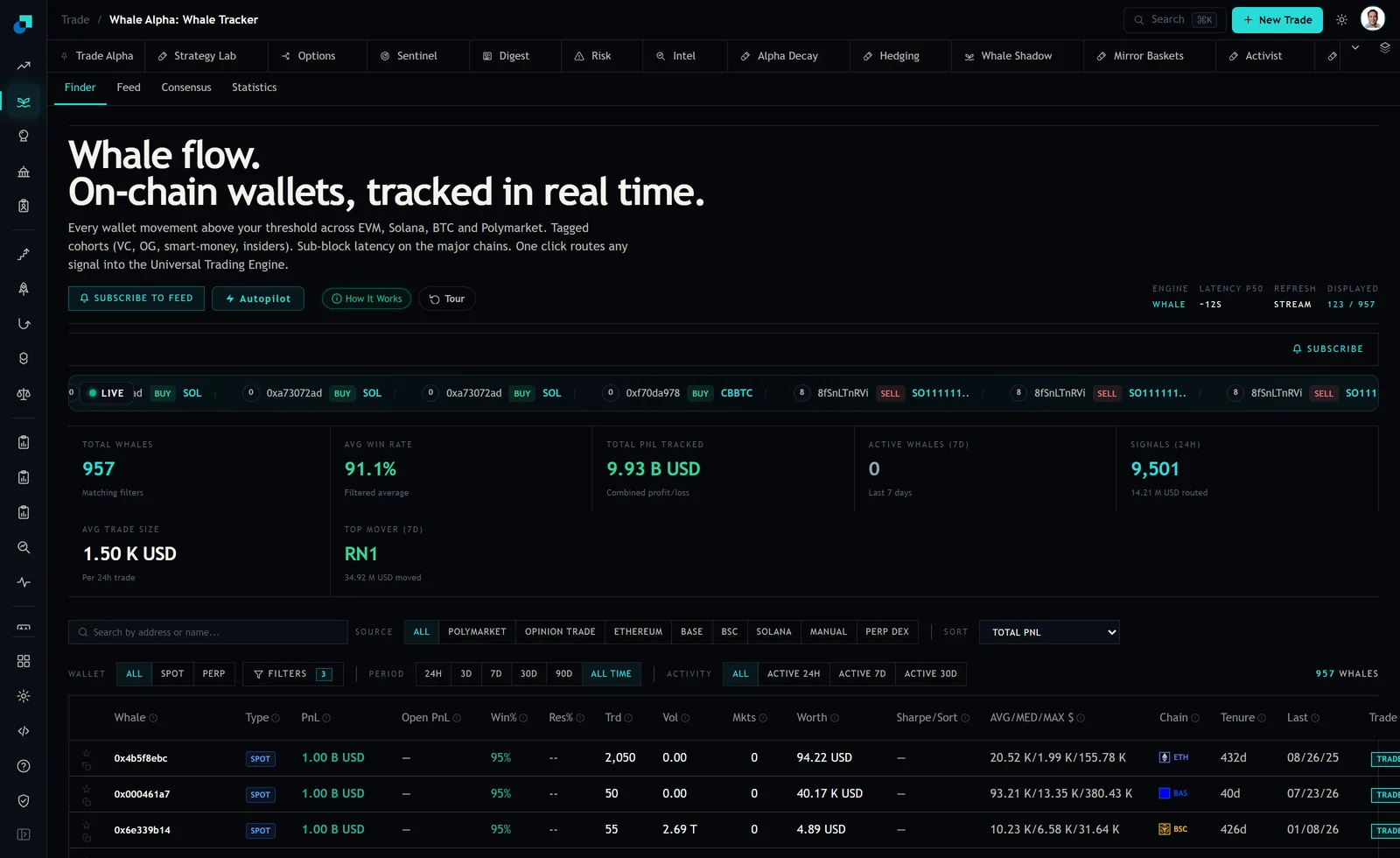
The Whale Finder at capture reported 957 wallets matching the current filters and was displaying 123 of them. Nobody follows 957 wallets. Nobody usefully follows twenty. The number of whales you can actually pay attention to, check periodically and act on is about five, and getting from 957 to five is a filtering problem where the order of the filters matters more than which filters you use.
The order matters because each filter changes what the later numbers mean. Apply them in the wrong sequence and you spend your time comparing statistics that were never comparable, then pick the wallet with the biggest number, which is exactly the failure this whole exercise is meant to prevent.
Source first, because it decides what a row means
The Source row runs All, Polymarket, Opinion Trade, Ethereum, Base, BSC, Solana, Manual and Perp DEX. Pick one and stay there for the whole session.
This goes first because it is the only filter that changes the kind of thing a row is. A Polymarket wallet trades binary contracts that resolve to zero or one. A perp DEX wallet trades leverage with liquidation risk. Their win rates are not the same quantity, their PnL figures are not the same quantity, and their average trade sizes are not comparable. Leaving Source on All and then sorting by PnL is ranking apples against a different fruit entirely and calling the winner the best apple.
Wallet type second, at a finer grain
Next is the Wallet row, which offers All, Spot and Perp. Same logic as Source, one level down. Spot profit and leveraged profit are different achievements and they carry different risk of ruin, and a spot wallet compounding steadily and a perp wallet that survived three near liquidations can print similar looking numbers.
All three wallets visible on the capture were marked Spot. Pick the type you can actually trade yourself. Following a perp whale when you have no intention of using leverage produces a watchlist you cannot act on, which is a pleasant hobby and not a process.
Period is where most watchlists go wrong
The Period row offers 24H, 3D, 7D, 30D, 90D and All Time, and it was sitting on All Time at capture. All Time is the worst possible default for building a follow list and it is the one you get handed.
The reason is visible in the table itself. The Last column on the top row read 08/26/25, which on a page captured in August 2026 is a wallet that had not traded in about a year, sitting at the top of an All Time profit sort. All Time rewards wallets that made their money in a market regime that has since ended. You are not looking for who was good once. You are looking for who is good now, and you cannot see that through a window that stretches back to whenever the tracking began.
Set it to 30D or 90D. Ninety days is my default because it is long enough to hold enough trades to mean something and short enough that it is mostly the current regime. Then look at the Tenure column, which on the capture read 432d, 40d and 426d across the three rows. Tenure and period together are the useful pair. A long tenure with strong recent period performance is a wallet that has adapted. A long tenure with nothing recent is a wallet that is finished, and a 40 day tenure with a spectacular number is a wallet with a lucky month.
Activity last, and the empty list that looks like a bug
The Activity row offers All, Active 24H, Active 7D and Active 30D. This one goes last because it is the harshest cut and you want it landing on a set that is already comparable.
There is a trap here and the capture hands it to you directly. The header tile reading Active Whales 7D showed 0. If you jump straight to Active 7D you will get an empty table and conclude that the tool is broken or that no whales are trading, when what has actually happened is that you asked for the intersection of several filters and one of them is currently empty.
So work inward rather than starting at the tightest setting. Begin at Active 30D. If that leaves too many, step to Active 7D and see whether anything survives. If a step empties the list, go back one. And always check the count on the right of the filter row after every click, because that number moving is the only feedback telling you whether the filter did anything at all.
The two columns that make the final cut by hand
After source, type, ninety days and Active 30D, you should be looking at a short list rather than 957 rows. The last cut is manual and it uses two columns that have nothing to do with performance.
The first is AVG / MED / MAX $, the average, median and largest trade size. On the capture those read 20.52K, 1.99K and 155.78K for the first row and 10.23K, 6.58K and 31.64K for the third. Ask whether you can take a position at that wallet's median size. If its median trade is 6.58K and you trade in units of 500, you cannot follow it in any meaningful sense, because the trades it makes at its normal size will move markets you then have to enter at a worse price. Follow wallets whose median clip is within an order of magnitude of yours.
The second is the trade count column, which read 2,050 for the first row and 50 and 55 for the other two. A 95 percent win rate over 2,050 trades and a 95 percent win rate over 50 trades are not the same claim, and the second one is well within what luck produces. Set a floor, a hundred trades or so, and reject anything under it regardless of how good the headline looks.
The pegged column at the top of the sort
One last thing, and it is the reason none of this should end with sorting by profit and taking the top five. On the capture, three different wallets on three different chains all displayed a PnL of exactly 1.00 B USD and a win rate of exactly 95 percent, while their Worth column read 94.22 USD, 40.17 K USD and 4.89 USD respectively.
Three unrelated wallets do not land on the same figure to the penny. That is a ceiling in the display, not a ranking, and the top of a sort on a pegged column is not telling you who is best, it is telling you who hit the cap. Which is a good general habit anywhere: when several rows share an identical round number, stop sorting on that column and find one that still discriminates.
Write your five down with one line each saying why they are on the list and what would take them off, and put a date on it. Re-run the same four filters in the same order once a month. The Last column moves, tenure accumulates, and a wallet that stops trading should leave your list because it stopped, not because you eventually noticed.