Every news-driven event study on your shared drive has a t-zero in it, and in most cases that t-zero is whatever timestamp field came attached to the record. That choice is rarely discussed in the writeup, it is almost never defended in the appendix, and it is usually the single largest determinant of the abnormal return the study reports.
The problem is not that publish time is a bad field. It is that a news record carries several clocks, they can sit days apart, and the one you can trade on is never the earliest of them. A study anchored on the earliest clock books returns that accrued before your desk had the information, and it books them as alpha.
Three clocks in one row, and a fourth you have to derive
Pull any news or research record apart and you will find at least three distinct moments compressed into what a downstream table treats as one date.
The first is observation time: the moment the underlying inputs were sampled. For a computed product this is a model run time. For a filing it is the period end or the transaction date. This is the clock that describes the world the content is about.
The second is publication time: when the item was released by its source. This is the field most vendors expose and the one most studies use, because it is the one that is populated.
The third is arrival time: when the item landed in your systems, in your timezone, in a form a person or a process could read. Vendor latency, queue depth, parser failures and reprocessing all live in the gap between the second clock and the third, and none of them are visible in the record itself.
The fourth clock is not in the row at all and you have to construct it. Tradable time is the first moment at which your desk could have transacted at a price you would accept, given your own reaction latency, your venue access and the liquidity available in that instrument at that hour. Everything before tradable time is someone else's return.
Two stamps, eight days apart, on the same card
This is not a subtle effect that only shows up in microstructure work. It is visible on the face of a feed.
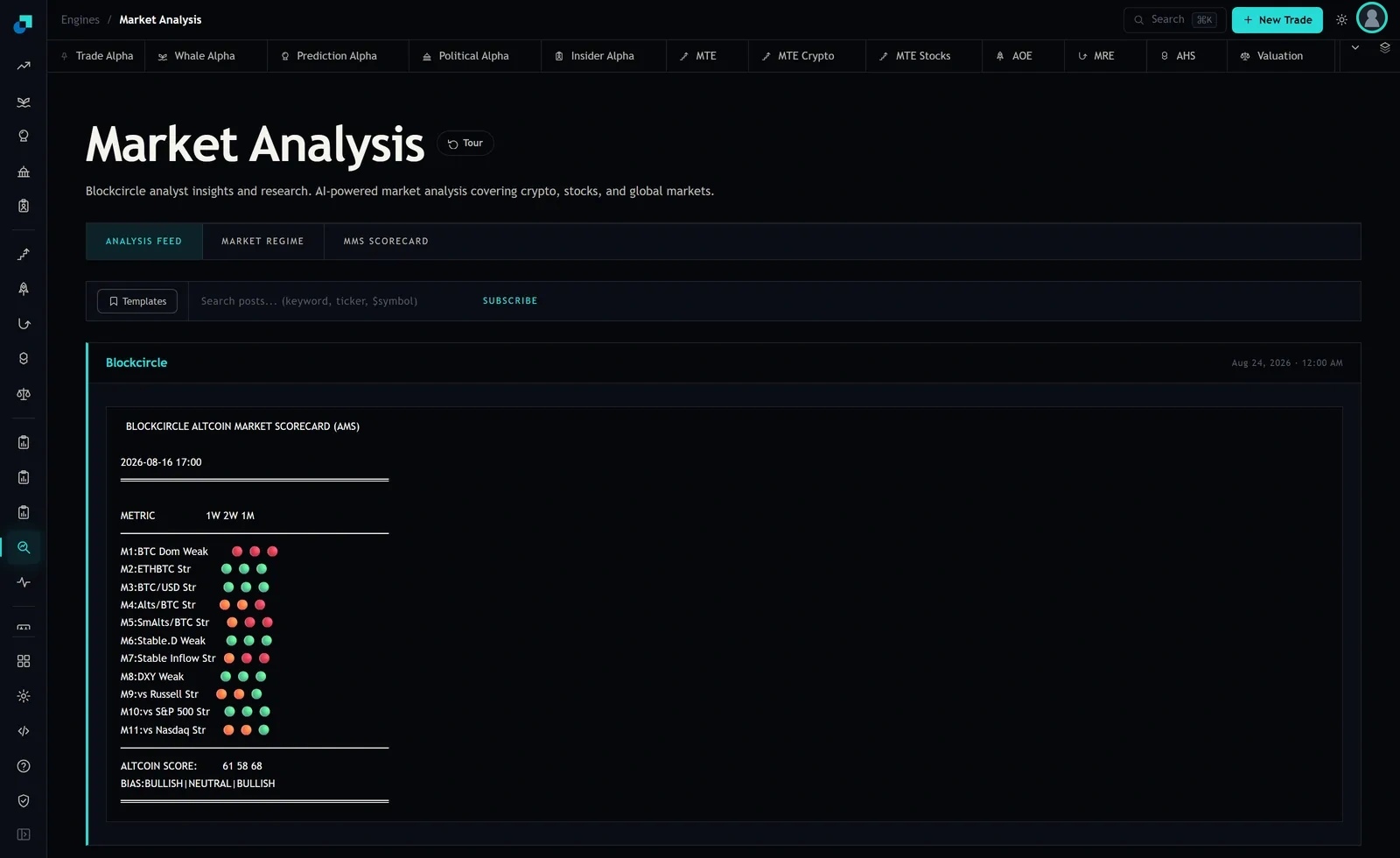
Whichever of those two stamps describes the moment the eleven metrics were computed, the other one does not. An analyst who joins this content to a returns panel on the header date is aligning a reading of one market state with the price action of a market state eight days later. An analyst who joins on the embedded stamp is closer to the observation clock but is now assuming the content was available to be acted on at the moment it was computed, which the card itself gives no reason to believe.
The midnight stamp deserves its own note, because it recurs everywhere. A timestamp of exactly 12:00 AM is usually a date that was widened into a datetime somewhere in the pipeline. Treat any bulk of records landing on the stroke of midnight as date-precision data, and do not run an intraday window on it. There is no timezone on the face of either stamp here either, which is a second thing to resolve before either field is used as an anchor.
Where the inflation actually comes from
The mechanism is simple enough to state in a sentence. If a signal's return is concentrated in the minutes or hours after information becomes public, and you set t-zero earlier than the moment your desk could act, the measured cumulative abnormal return includes the fastest and largest part of the move, which is exactly the part you never had.
Two features make this worse than it sounds. First, the effect is largest for the signals you most want to trade, because concentration of return near the event is what makes a signal attractive in the first place. The better the signal looks on publish time, the more of its measured edge is likely to live in the unreachable window. Second, the bias is one-directional. Moving t-zero earlier can only add the pre-arrival move to your measured result, so this error never happens to work against you, which is why it survives internal review so easily.
The size of the inflation is not something anyone can quote at you from a paper, and you should be suspicious of a number offered without your data attached. It is, however, directly measurable on your own history, and that measurement is the deliverable. Re-run the same study three times, changing only t-zero: once on publication time, once on arrival time, once on arrival plus your realistic reaction lag. Report all three cumulative abnormal returns side by side. The spread between the first and the third is the inflation, in basis points, for your desk, in that instrument, over that sample.
Do this once and it changes how the desk reads every external backtest it is shown, because the first question becomes which clock the vendor anchored on.
The record schema that makes the study re-runnable
You cannot recover these clocks after the fact, so the fix is at ingestion and it is a schema decision rather than a research decision.
Store every clock separately and never overwrite one with another. At minimum, each news record wants: observation or as-of time, publication time as stated by the source, arrival time recorded by your own system, the timezone and precision of each of those, a flag for whether the item arrived through the live path or a backfill, a revision identifier and a pointer to the previous version if the item was updated, and the source identity.
Precision is a field, not a footnote. A record whose publication stamp is date-only should carry that fact explicitly, so a downstream researcher cannot silently run an hourly window on it. Backfilled items need the same treatment: a historical load populates publication time perfectly and arrival time not at all, which quietly reintroduces the bias you just removed. If arrival time is unknown for the backfilled portion of your history, that portion cannot support an intraday event study and the appendix has to say so.
Revisions are the case that catches people late. When an item is corrected and the row is updated in place, your study is anchored on a version of the text that did not exist at the time you claim to have traded it. Append rather than update, and let the study choose the version that was current at its own t-zero.
What this changes in a review meeting
The reason to be strict here is not methodological hygiene for its own sake. It is that the number in the deck becomes a number you can defend when the strategy underperforms it.
A live news strategy that returns materially less than its backtest generates one of two conversations. Either the edge decayed, which is a market explanation and leads to sizing and capacity work, or the backtest was never reachable, which is a measurement explanation and leads to a rebuild. Without the three-clock decomposition you cannot tell those apart, and desks reliably choose the first explanation because it is the one that does not implicate the research.
So make the disclosure standard. Any note quoting an event-driven result states the anchor clock, the assumed reaction lag, and the proportion of the sample where arrival time was inferred rather than recorded. One sentence in the methodology block. It costs nothing to write when the study is built and it is close to impossible to reconstruct a year later, which is precisely when somebody will ask.