Trade Alpha describes itself in one sentence at the top of the Signals tab, and the important clause is buried in the middle of it. Every signal from the engines is confidence scored, deduped across sources on a 90 second window, and routed into one queue.
Most people read past that. It is worth stopping on, because it changes what a row in the feed means, and if you carry the wrong mental model of what a row represents you will size positions off a number that is not measuring what you think it is.
What the window is actually protecting you from
Several engines feed the same queue. The panel lists MTE momentum, AOE outperformers, MRE reversals, MRS macro tilts and manual desk entries, and the source filter carries a chip for each of them.
These engines are not independent observers. They are looking at overlapping data, frequently at the same instrument, and often at the same bar close. When something obvious happens to a stock, it is entirely normal for two or three of them to notice within the same minute.
Without a dedup rule, that single event produces three rows, three alerts, and three separate invitations to open a position. The damage that follows is not confusion. It is sizing. If your rule is a thousand dollars a signal and three rows show up on the same name inside a minute, you now hold three thousand dollars of one idea with everything correlated at one. You did not decide to take that position. The interface decided it for you by presenting one event three times.
The 90 second window is the guard against that. It collapses the near simultaneous duplicates into a single row so the queue reflects events rather than engine chatter.
The row you see is a survivor
Once you know the window exists, the feed reads differently.
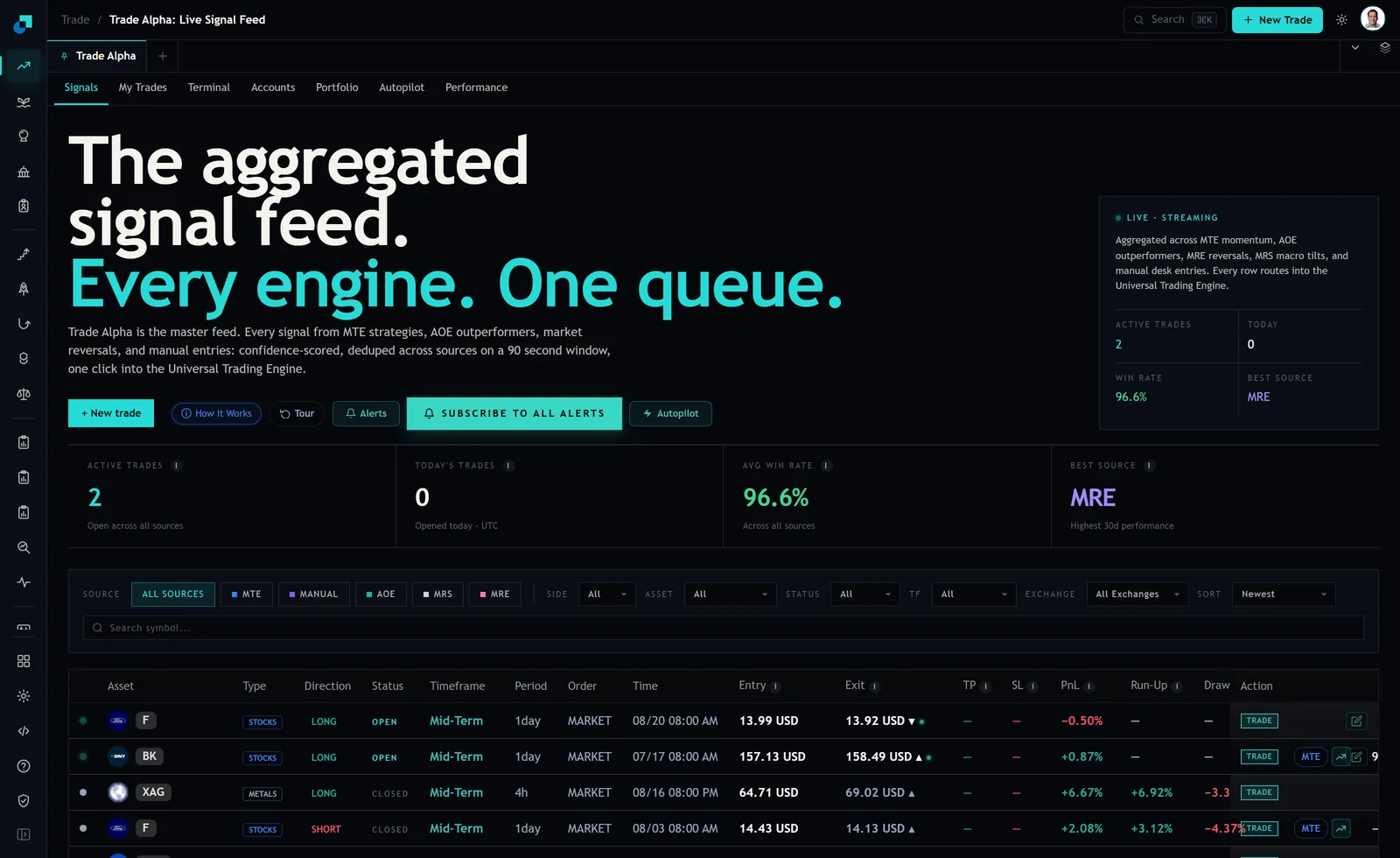
Every row is either a signal that fired alone, or the one that came through a collision with others inside the window. Looking at the table, you cannot tell which, and the distinction is invisible by design.
What the row does carry is its source. In the capture one of the open rows showed an MTE badge in its action area, and the filter chips above the table let you narrow the whole feed to MTE, MANUAL, AOE, MRS or MRE. So the question "which engine produced this row" has an answer sitting on the row itself. Read it rather than infer it.
The question "which engine won the collision, and why" does not have an answer on the page. The interface tells you the window and tells you signals are confidence scored. It does not publish a tie break, and I am not going to guess at one here, because a rule you invented about internal engine precedence is precisely the kind of thing that ends up underneath a position size three months later. If you need to know, treat it as a question for support rather than as something to reverse engineer from four rows.
Row count is not a conviction meter
This is the practical consequence and it cuts in both directions.
You cannot read agreement from the feed by counting. Three engines firing on the same name within ninety seconds produces one row. One engine firing alone also produces one row. The aggregate feed does not distinguish them, so any habit of the form "I size up when multiple engines agree" cannot be executed by looking at the main queue at all.
The reverse misread is more common and more damaging. Seeing a single row and concluding that only one engine liked it, therefore this is a weak signal, therefore take a smaller position. That inference has no support. The single row you are looking at may be the only thing that fired, or it may be the survivor of the strongest consensus the engines produced all week. The feed is deliberately not telling you, and treating a row as weak because it is alone is reading a design decision as information.
Neither should you read the summary tiles as a conviction gauge for an individual row. The panel showed active trades of 2, today's trades of 0, an average win rate of 96.6 percent across all sources and a best source of MRE on a thirty day basis at capture. Those are portfolio and engine level readings taken at one moment. They say nothing about the row you are about to trade, and a headline win rate is never a forecast for the next position.
How to actually check whether engines agree
If cross engine agreement matters to your process, the source chips are the tool, not the aggregate view. Filter to MTE, note what is there for the period you care about, then filter to AOE and do the same. Comparing those views is a real comparison. Counting rows in the combined feed is not.
One honest caveat before you build anything on this. Whether the filtered views expose the full pre dedup population, or the same deduped rows sorted by their surviving label, is not something the page states. That is a five minute check to do on a quiet afternoon with no position on, by watching one busy symbol across two source filters, and it is a bad thing to be uncertain about at the moment you are deciding whether to double your size. Establish it once, then rely on it.
Two habits that follow
The first is to size the symbol rather than the row. Decide before you open the feed what your maximum exposure to any one name is, in dollars, and then let rows compete for that budget rather than adding to it. If you have decided that BTC is worth two thousand dollars of risk to you this week, then the first row spends that budget and the second row does not extend it. This makes you immune to the whole class of problem regardless of how the dedup behaves, and it costs nothing.
The second concerns rows that arrive outside the window. Ninety seconds is short. An engine reacting to the same candle close will land inside it. An engine reacting a full bar later will not, and will produce a genuinely separate row on the same symbol an hour or a day later.
The temptation there is to treat the second row as confirmation and add. Sometimes it is confirmation. It is also, frequently, a second engine noticing the move you are already positioned for, which is not new information about the future, it is old information about the past arriving late. The useful reading of a late second row is as an update on the first trade, worth checking your stop against, rather than as a new trade worth new capital.