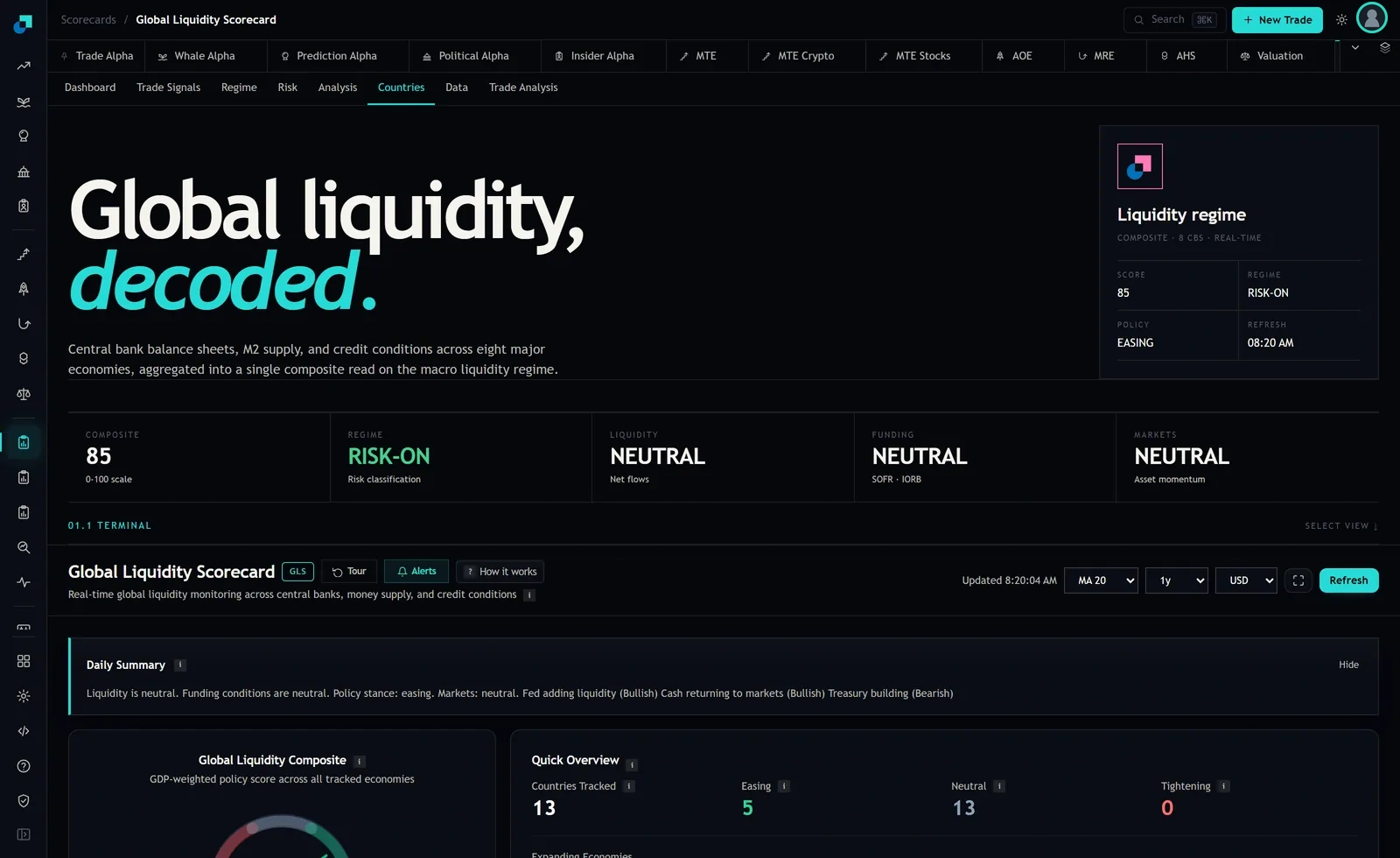
The Global Liquidity Scorecard aggregates eight central bank balance sheets into one number, currently 85, tagged RISK-ON with a policy read of EASING. Seven of those eight balance sheets are not denominated in dollars. Something has to convert them before they can be added, and that something is a set of spot exchange rates that move for reasons entirely unrelated to monetary policy. If your book is funded in euro or sterling, that conversion is not a display detail. It is a term in the signal you are about to allocate against, and it is a term you do not want.
The base currency selector is a modelling assumption
Start with the control, because most desks never touch it. The toolbar above the panel carries a base currency dropdown running from USD through EUR, GBP, JPY, AUD, CAD, CHF, CNY and on into a long tail of emerging market currencies. It is currently set to USD, which is the default rather than a considered choice.
Changing that selector changes the number the composite is built from. It does not change the underlying policy stance of any central bank. Which means the module is quietly offering you a choice about the numeraire of your macro signal, and a numeraire choice is a modelling assumption that belongs in a document, not in a dropdown nobody remembers setting.
Decomposing the aggregate into impulse and translation
The decomposition is a first-order identity and it takes one line. For any non-dollar component, the dollar value is the local currency quantity multiplied by the exchange rate. So the percentage change in the dollar value is approximately the percentage change in the local quantity plus the percentage change in the exchange rate, plus a cross term that is small for small moves and stops being small in a currency crisis.
The first term is the liquidity impulse. It is what the central bank did. The second is translation. It is what the currency market did. They are added together in the number on your screen and they are not remotely the same input.
A worked illustration with round numbers, and these are chosen for arithmetic clarity rather than lifted from any print. Suppose a non-dollar central bank expands its balance sheet by 2 percent in local terms over a quarter while its currency depreciates 6 percent against the dollar. The dollar-denominated contribution falls by roughly 4 percent. Read in dollars, that economy is draining. Read in its own currency, it is easing. A framework that allocates off the first read is short risk assets into a regional easing cycle, which is not an error you can explain away in a review.
The reverse case is worse because it is more comfortable. A flat local balance sheet plus a 5 percent currency appreciation reads as expansion. You add risk into nothing happening.
What follows specifically for a euro or sterling book
The reason this matters more for you than for a dollar fund is that your liabilities are not in dollars.
A dollar fund reading a dollar aggregate has a consistency it did not have to work for. Its numeraire, its benchmark and its signal all sit in the same unit. Your fund does not have that. Your benchmark is in euro or sterling, your redemption obligations are in euro or sterling, and your macro signal has been silently converted to dollars by a dropdown.
Three consequences worth writing down.
- The dollar term in the aggregate is a currency exposure, not a liquidity view. If you take it into the signal untreated you are running an unintended and unbudgeted FX position through the back door of your macro overlay.
- Your own home central bank's contribution is the one you can read cleanly, because setting the base currency to your own removes the translation term for that component and moves it onto all the others.
- There is no setting that removes translation from every component at once. Any common numeraire imposes it somewhere. The choice is where you want the contamination, not whether you have it.
Given that, the defensible default for a euro book is to read the composite in EUR and accept that the dollar and yen components now carry the translation term, on the grounds that the component you care most about interpreting cleanly is the one you are funded in. It is a choice, it is arguable, and the important part is that it is made deliberately and recorded.
Keeping the hedge decision out of the signal
The clean separation is that the composite tells you about liquidity and the hedge ratio is a separate policy that gets set on its own terms and its own review cycle.
Collapsing them is tempting because a dollar-denominated liquidity signal appears to contain a currency view for free. It does not. It contains a currency accident. If your process wants a dollar view, run one deliberately, with its own thesis, its own sizing and its own stop, and let it show up in attribution as an FX decision. What you must not do is allocate to equities on a liquidity signal that was actually a dollar move and then report the outcome under macro.
In practice that means two lines in the monthly attribution rather than one. Liquidity tilt, and currency. If you cannot split them, your reporting is telling the committee a story your process cannot support, and the first quarter where the two terms point in opposite directions will make that obvious in the least convenient way.
The record that answers the review question
The review question, when a liquidity-driven tilt goes wrong, is always some version of what did you know and how did you read it. A dollar-denominated aggregate makes that question harder to answer six months later, because the number you saw is not reproducible unless you recorded the settings alongside it.
So stamp the read. Every time a liquidity reading enters an investment decision, record the composite value, the regime and policy tags, the base currency the panel was set to, the lookback window, the moving average setting, and the refresh timestamp shown in the header. That is six fields and it takes under a minute. Without the base currency field in particular, a future reader cannot tell whether the number in your memo was a policy impulse or a currency print.
The same discipline extends to the country layer. The Countries tab currently shows a GDP-weighted composite gauge reading 70 out of 100 tagged EASING, and a stance count of 13 tracked, 5 easing, 13 neutral and 0 tightening. The stance counts are the one part of this page that is immune to the numeraire problem, because a policy stance does not get converted. When the currency layer is doing something violent and you cannot trust the levels, the counts are still telling you something real about the breadth of global policy, and breadth is often the more durable input anyway.