The cost people quote when they talk about options trading is the commission, usually somewhere around a dollar a contract, and it is close to irrelevant. The cost that actually decides whether a small account makes money is the bid-ask spread, because you pay it going in, you pay it again coming out, and on the kind of contract a retail trader tends to be attracted to it is not a rounding error. It is regularly a fifth of the premium.
Here is the version of this that stings. You buy a call for 1.20 when the market is 1.00 bid and 1.20 offered. You are correct about direction, the underlying moves your way, and a week later the contract is marked 1.30. You are up nothing. The bid is 1.20, and if you want out you sell at 1.20 and you get your money back minus commission. The option had to appreciate a full 20 percent before your position broke even, and none of that requirement came from the market being wrong. It came from the door you walked through.
Write the spread down as a percentage, always
The single habit that changes the most here is refusing to look at a spread in absolute terms. A spread of 0.20 means nothing on its own. Divide it by the mid price and it means everything.
On a contract quoted 1.00 by 1.20, the mid is 1.10 and the spread is 0.20, which is 18 percent of mid. Paying the offer costs you half of that immediately, so you are 9 percent down the moment you fill, and you will hand over roughly the same on exit. Call it 18 percent round trip on a position you have not held for a single minute.
Now put a holding period on it. If you plan to hold that option for two weeks, you have paid 18 percent for 14 days of exposure. Annualised, that is a cost of roughly 470 percent a year on the capital in the trade. Nobody would sign a loan at that rate, and yet this is the ordinary condition of trading weekly options on names where the chain is thin. The number is not there to be dramatic. It is there because it converts an abstraction into a rate you can compare against how often you actually intend to trade.
Read the depth before you read the price
Spreads are wide for a structural reason, and the reason is visible on the chain before you ever place an order. When I open the Options Desk on a name, the two things I look at before the quotes are how many strikes the expiry carries and how much open interest is spread across them.
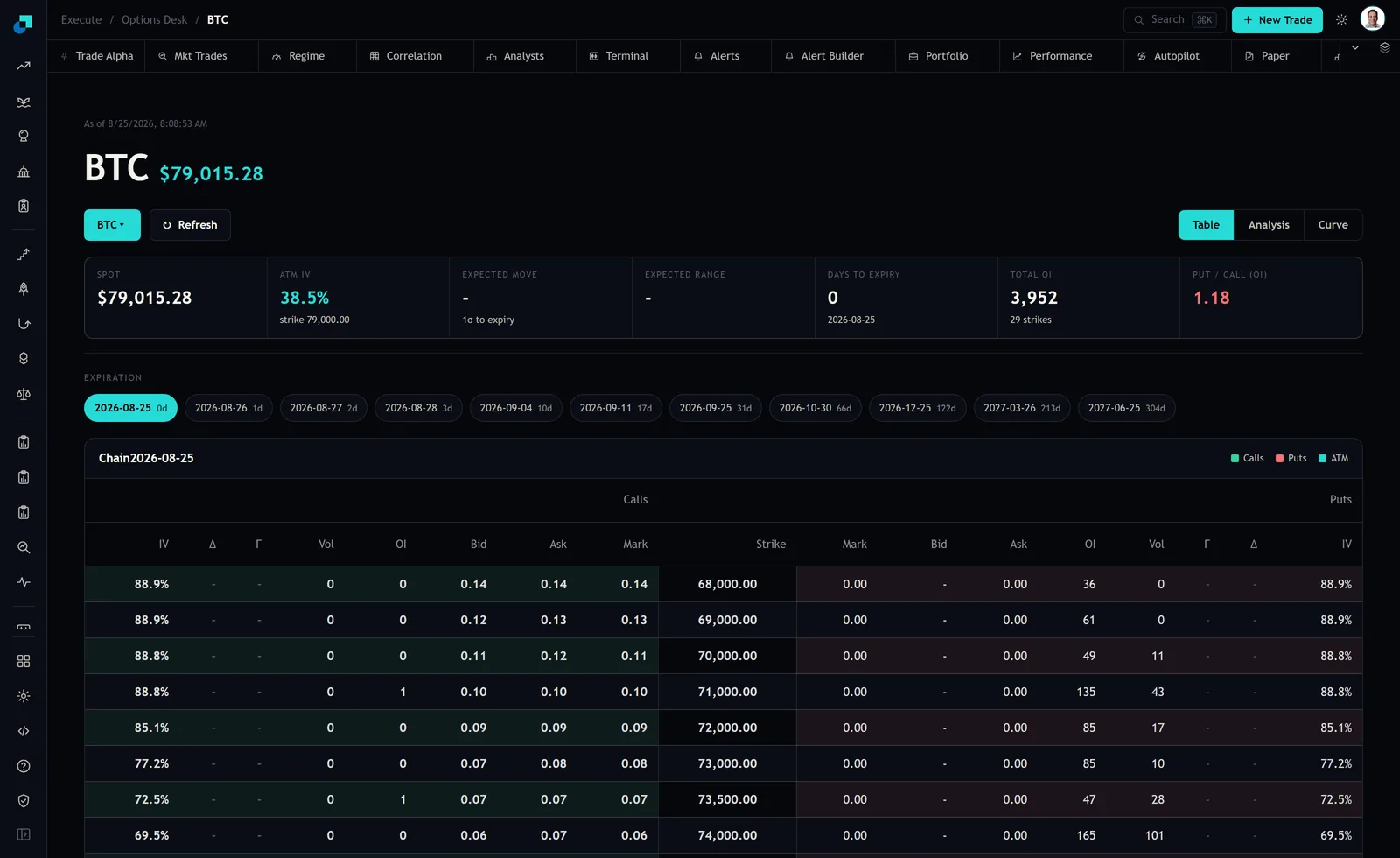
That reading was taken on 25 August 2026 with spot at 79,015.28 and at-the-money implied volatility of 38.5 percent against the 79,000 strike. Total open interest on that expiry was 3,952 contracts across 29 strikes. Average it out and you get about 136 contracts per strike, and averages flatter the tails: the strikes near the money hold far more than that, and the far strikes hold almost nothing. The strike nobody is trading is the one where a market maker quotes defensively, because they have to price the risk of being the only participant on the other side of you.
This is why the cheap-looking option is usually the expensive one. A contract quoted at 0.15 looks like a small bet, and on a 0.10 by 0.20 market you are paying a spread that is two-thirds of mid. You need the option to rise by 100 percent just to get out flat. The lottery ticket is not priced at 15 dollars. It is priced at 15 dollars plus a toll that most of the time exceeds the entire realistic profit.
Four things that cut the bill this week
None of these are clever. They are the difference between a strategy that survives its own costs and one that does not.
- Trade the liquid strikes. Near-the-money strikes on the busiest expiry are where the interest sits, and where the quotes are tightest. Wandering four strikes out to make the premium look affordable is usually buying a wider spread with your savings.
- Use limit orders at the mid, and be willing to sit. On a 1.00 by 1.20 market, place at 1.10 and wait. Sometimes you get filled, sometimes you improve to 1.13, and sometimes nothing happens and you learn the market was never really there. All three outcomes beat lifting the offer reflexively.
- Prefer fewer expiries and longer holds. If the round-trip spread is 18 percent, a two-month hold spreads that cost over eight times as many days as a one-week hold. The spread cost is fixed per trade; the only lever you control is how many trades you make.
- Count the legs. A vertical spread crosses two markets on entry and two on exit. A four-leg structure crosses eight. Every leg on a thin chain is another toll booth, and a strategy that looks elegant on paper can spend its whole expected profit on execution.
The arithmetic that decides whether the trade is worth taking
Before entering, I work out the move the underlying has to make just to cover execution, and I do it in the underlying's terms rather than the option's, because that is the number my thesis is actually about.
Say you are buying a near-the-money call with a delta around 0.50. Round-trip spread cost is 0.20 on the option. Divide by delta and you get 0.40 of underlying movement needed before the position is at break-even on costs alone. With BTC at 79,015, 0.40 is nothing. With a 30 dollar stock, 0.40 is a 1.3 percent move that has to happen before your view starts paying. If your thesis is a 3 percent move, you have just handed over more than a third of it at the door, and that is before time decay takes its cut.
Run this and a lot of trades fail the test on the spot. That is the point of running it. The check takes fifteen seconds and it is the only one I know that rejects bad trades before you have any emotional stake in them.
What this does not protect you from
Tight spreads make an option cheaper to trade. They do not make it a good trade, and they do not make the position safe.
A long option can and frequently does expire worthless, and the maximum loss is the entire premium you paid, spread included. Getting a good fill on a call that finishes out of the money means you lost 100 percent of the position slightly more slowly than the person who paid the offer. Selling options rather than buying them puts you on the other side of the spread, which helps, but a short call without the stock behind it carries a loss that is not capped by anything, and a short put obliges you to buy the underlying at the strike no matter how far it has fallen. Neither of those becomes acceptable because the quote was tight.
The other thing worth saying plainly is that spreads widen exactly when you want to leave. The market that was 1.00 by 1.20 in a quiet tape can be 0.60 by 1.10 in a fast one, and the fast tape is when your stop is hit and your exit is needed. If your plan involves getting out quickly during a violent move, price the exit at the wide spread rather than the calm one, because that is the spread you will actually be offered.
Everything above is why I size options positions against the round-trip cost and not against the premium. If the toll is 18 percent, I need a thesis worth substantially more than 18 percent to bother, and if I cannot state what that thesis is in a sentence, the honest conclusion is that I am about to pay a market maker for the privilege of having an opinion.