The check that has saved me the most money is embarrassingly simple: before sending a market order outside normal hours, look at how much volume the current bar has traded compared to a bar at the same time on a normal day. Most of the overnight fills I used to complain about were not bad luck. They were me sending a noon-sized order into a three in the morning book.
This is a grid, then, keyed to what you can actually see. But I have to start by taking one thing away, because the version of this article I originally wanted to write assumed the Terminal shows you things it does not show you.
One of the three inputs is on this screen, and two are not
The three things that tell you whether a book is thin are traded volume, the quoted spread, and how frequently trades are actually printing. The Terminal gives you the first one cleanly. It does not give you the other two, and any grid that pretends otherwise will send you into the night with false confidence.
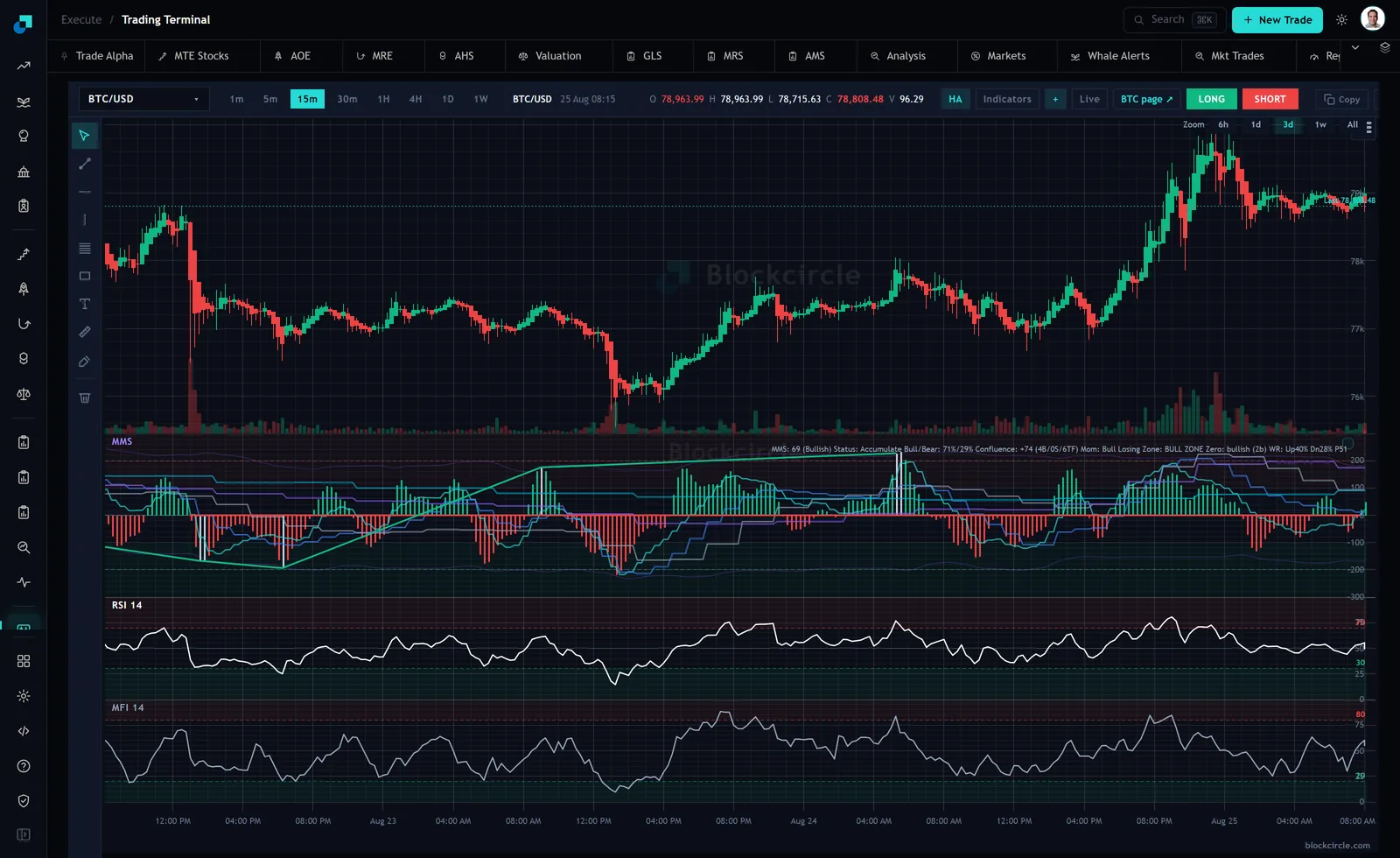
What is there. A timeframe row of 1m, 5m, 15m, 30m, 1H, 4H, 1D and 1W, which fixes the bucket your volume is measured in. An open, high, low, close and volume strip for the selected bar, which at capture read 78,963.99, 78,963.99, 78,715.63 and 78,808.48 with a V of 96.29 on the 15 minute bar at 25 Aug 08:15. A volume histogram sitting directly under the candles, which is the fastest read on this page. Zoom presets of 6h, 1d, 3d, 1w and All. And an MFI 14 pane, which is money flow and therefore carries some volume information rather than pure price.
What is not there. No order book, no depth ladder, no bid and ask spread, and no count of prints per minute. Those live on the ticket at the venue you are about to trade on, and you have to look at them there. This is a two-screen decision and there is no honest way to make it a one-screen decision.
Ten minutes of baseline work, done once
A volume figure means nothing on its own. Ninety six units on a fifteen minute bar is not thin or thick, it is just a number. What makes it usable is a comparison against the same instrument, the same timeframe, and roughly the same time of day.
So do this once, on a quiet evening, for the two or three instruments you actually trade. Set the timeframe you normally trade on. Use the zoom presets to look at three days of bars. Then write down two numbers: the typical bar volume during the busiest part of the day, and the typical bar volume during the hours you keep finding yourself trading in. Not an average, just a number you would call normal by eye from the histogram.
That gives you a ratio to work with forever after. If the overnight normal is roughly a third of the daytime normal, then an order that is comfortable at noon is three times as aggressive at four in the morning even though nothing about the order changed. That single sentence is most of what this article has to teach.
Time of day is the part people skip, and it is the part that matters. A bar volume that would be alarming at midday is unremarkable at two in the morning, and comparing the current bar against a whole-week average silently mixes the two together and tells you nothing.
Three states, and what to send in each
Three is enough. Four is the most anyone actually consults at three in the morning, and I have never met a five-state grid that survived a month.
Normal. The current bar volume is close to your overnight baseline, and the spread on your venue ticket looks like the spread you usually see there. Send a market order if your order is small relative to what is resting inside your price tolerance. The certainty is worth the touch you pay, and the arithmetic below tells you what small means for your account.
Thin. The current bar volume is well under your overnight baseline, or the spread on the ticket has widened noticeably, whichever you notice first. Spread usually widens before volume falls, which is why you check both. Use a limit order at or inside the touch, and accept that it may not fill. A limit that does not fill costs you an opportunity. A market order into a thin book costs you cash, immediately, every time.
Empty. The histogram shows bars that are visibly stubs, or the ticket shows a spread several times its usual width. Do not trade. This is the state where the difference between a good and a terrible fill is measured in whole percent, and there is no order type that rescues it.
Notice that the state is set immediately before you send the order, not when the signal appeared. On a fast night those are different regimes, and using the signal's conditions to justify the order's conditions is how people talk themselves into a bad fill.
Waiting is an order type, and it is usually the cheapest one
The reason most retail traders will not wait is that the position feels urgent, and it feels urgent because the signal arrived. But the signal arriving and the market being tradeable are unrelated events.
Two questions settle it honestly. First, is the timeframe of the idea shorter than the wait? If you are trading something on a daily bar, waiting four hours for the session to thicken costs you almost nothing in signal terms. If you are trading a fifteen minute idea, waiting four hours means the idea has expired, and the correct answer is to skip the trade rather than to force it through a thin book at whatever the ticket will give you.
Second, is the instrument continuously traded at all? A crypto pair trades all night at reduced depth, so waiting means better conditions. Many other instruments are simply shut, and a signal that arrives while the market is closed is not a thin-book problem, it is a queue problem for another day.
If you take one operational habit away from this, make it this one: put a limit order in at a price you would be happy with, and let the thin book come to you rather than going to it. The overnight book will occasionally reach down and fill you at a price you would never have crossed for, which is the same thinness working in your favour for once.
What this is worth in dollars on an account your size
The reason to bother is not elegance, it is that the numbers are larger than people expect on small orders.
Work it through on a two thousand dollar order. If the daytime spread and the immediate impact of crossing cost you a tenth of a percent, that is two dollars, and nobody is going to reorganise their evening over two dollars. If the overnight book is a third as deep and both the spread and the impact widen, the same order can cost you half a percent or more, which is ten dollars, and now you have paid five times as much for the same position. Do that three times a week and it is a hundred and fifty dollars a month leaving the account for no reason at all.
The costs scale with your order size, not with your account size, which is why this bites hardest on the trades where you finally sized up. The trade you were most confident about is the one where crossing a thin book costs the most, and it is the one you are least likely to be patient on.
So the decision you can make this week is small. Open the Terminal on your main instrument, look at the volume histogram across three days, and write two numbers on a card: what a normal bar looks like during the day, and what one looks like at the hour you keep trading. Then keep the card next to the ticket.