You see a listing announcement, go to the ledger, and the token is there three times. Same day, same or similar name, three rows. The instinct is that something is duplicated or broken. Nothing is broken. You are looking at three instruments, and the difference between them is the second half of the pair.
This trips people up because we talk about tokens listing when what actually lists is a market. A market needs two assets. The exchange decides which second asset, and that decision belongs to the exchange rather than to the project, which is why the same token shows up quoted differently on different venues and sometimes differently on the same one.
The ledger keys on the pair, not the token
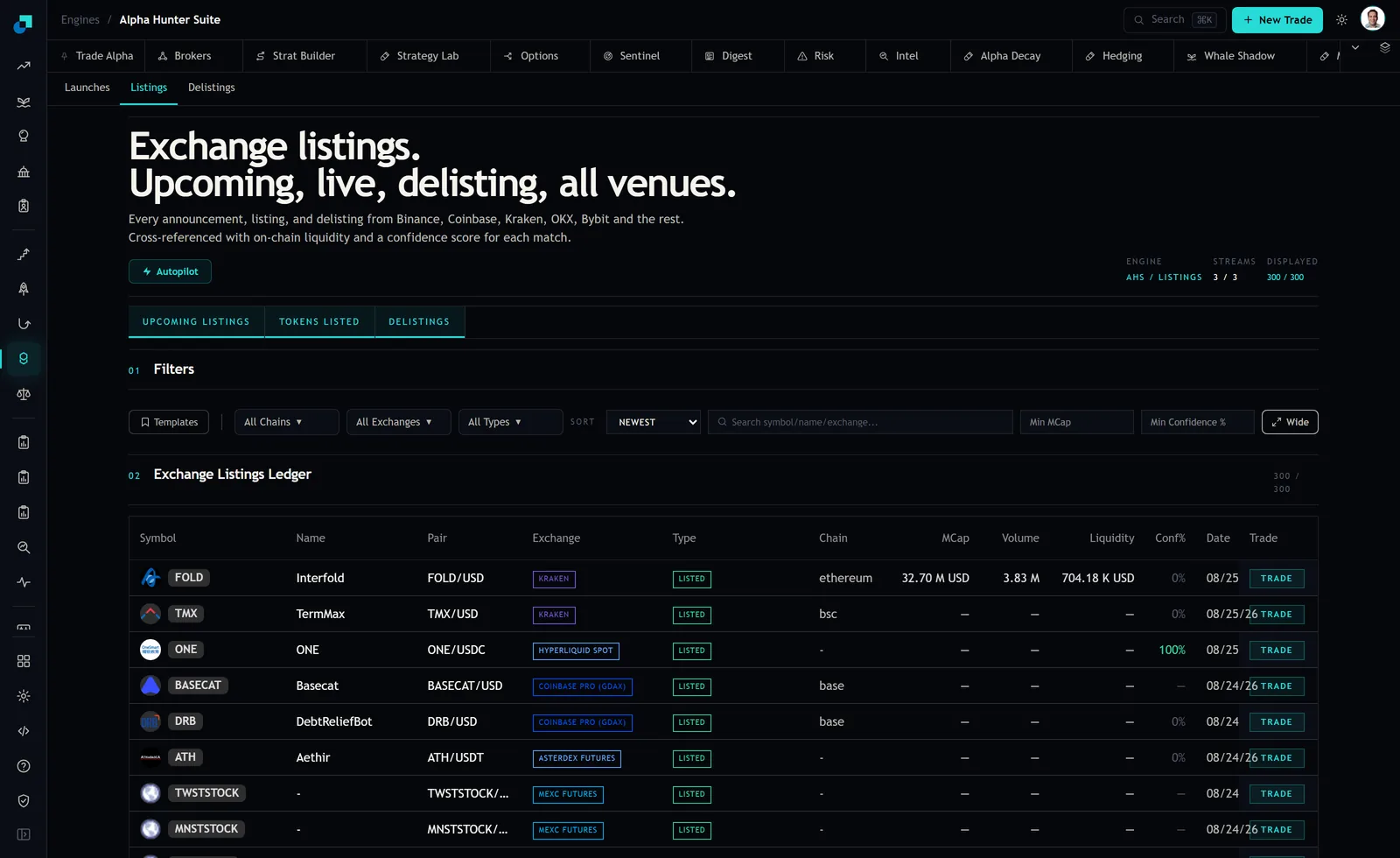
Look at the Pair column on the exchange listings screen and the structure becomes obvious. At capture the visible rows included FOLD/USD and TMX/USD on Kraken, ONE/USDC on Hyperliquid Spot, ATH/USDT on Asterdex Futures, and BASECAT/USD and DRB/USD on Coinbase Pro. Six rows, four different quote assets, and the Symbol column on its own would not have told you that.
So the row is a market. Symbol tells you the base asset, Pair tells you the whole instrument, Exchange tells you where it trades. If you filter or search on the symbol alone you will pull every market on that token across every venue, and you will need to read the Pair column to know which one you are actually looking at.
That is also the answer to why the count of rows is bigger than the count of tokens. Three streams turned on showed 300 of 300 rows at capture, and those rows are markets rather than distinct assets.
Why the venue chooses the quote asset
A quote asset is inventory. The exchange has to hold it, settle in it, price its fees in it, and offer withdrawals in it. Venues therefore standardise on the quote assets they already run their business in, and a project listing on four venues gets four different quotes without ever having asked for any of them.
There is also a regulatory and banking dimension. A pair quoted in dollars on a venue with banking relationships is a different operational animal from a pair quoted in a stablecoin, and that is why you see USD pairs on some venues and stablecoin pairs on others for tokens of similar profile.
The practical consequence for you is that the quote asset is not information about the token. A USDC pair is not more legitimate than a USDT pair. When a venue adds a newer dollar token as a quote asset, USD1 for instance, the same logic applies: it tells you about the venue's inventory decisions, not about anything the project did.
Finding the pair that actually carries the depth
This is the part that matters for execution, and it is worth being precise about what the ledger can and cannot answer.
The Liquidity column on a listings row is on-chain pool depth. The screen cross-references announcements with on-chain liquidity, so that figure is a chain-side measurement of the asset. It is a property of the token, not of the exchange pair, which means it does not split by quote asset and it will not rank the venue books for you. Two rows for the same token with different quotes can carry the same liquidity number and completely different order books.
So the depth question is answered on the venue, not on the ledger. Open the book for each pair and look at three things: the spread, the size resting within a percent or two of mid, and whether the book has depth on both sides or only on one. Five minutes of this beats any inference from the ledger.
Two rules of thumb hold up. Where a venue lists a token against multiple quotes, one of those pairs is usually the real one and the others are conveniences with wide spreads. And where a token trades on several venues, the pair on the venue with the largest overall business is usually the deepest, even if another venue announced first.
The cost of trading the wrong quote
Picking the thin pair is not just a slippage problem, it is a two-leg problem, and the second leg is invisible until you unwind.
Say you hold USDT and the deep book is quoted in USDC. You convert, you buy, and at some point you sell and convert back. You have now paid the token spread twice and the stablecoin conversion spread twice. On a normal day the conversion is cheap. On a day when something is wrong with a stablecoin, it is not cheap at all, and the moment you most want to exit a position is disproportionately likely to be a day when stablecoin markets are also stressed.
There is a subtler version of the same problem. Your profit and loss is denominated in the quote asset. A gain in a stablecoin you do not intend to hold is not realised until you convert, and if you keep proceeds in three different quote assets across three venues you have quietly built a small currency book you never decided to run.
And a pair quoted in USD is not the same as a pair quoted in a stablecoin for withdrawal purposes. One takes a bank, the other takes a wallet. That is an operational difference that decides how fast you can actually get money back, and it is worth knowing before you need to know it.
The habit that makes this a non-issue
Trade the quote you already hold, unless the depth difference is large enough to pay for the conversion twice over. That single rule handles most cases and it takes no analysis.
When you do need to compare, price the whole round trip before you place the first order. Token spread in, conversion in, conversion out, token spread out. Write the four numbers down. If the deeper book saves you thirty basis points on the token and the conversion costs twenty each way, the shallow book on the venue you are already funded on was the better trade.
Finally, when you record a position, record the pair rather than the symbol. It sounds pedantic until the day you go to exit and discover the row you have been watching was the futures pair on a venue you do not have an account with, while the position you actually hold sits in a book half its size.