The regime card is the first thing on the screen and it is designed to be read in three seconds. A name, a percentage, three tiles. That is a good design and it is also the reason people misread it, because three seconds is not long enough to notice that the five values on the card are not the same kind of thing as each other.
Two of them are live readings. One is a label. One is a direction word. One is a percentage that looks like a probability and is not one. Here is how I read the card, in the order I read it.
The five values and what each one is actually measuring
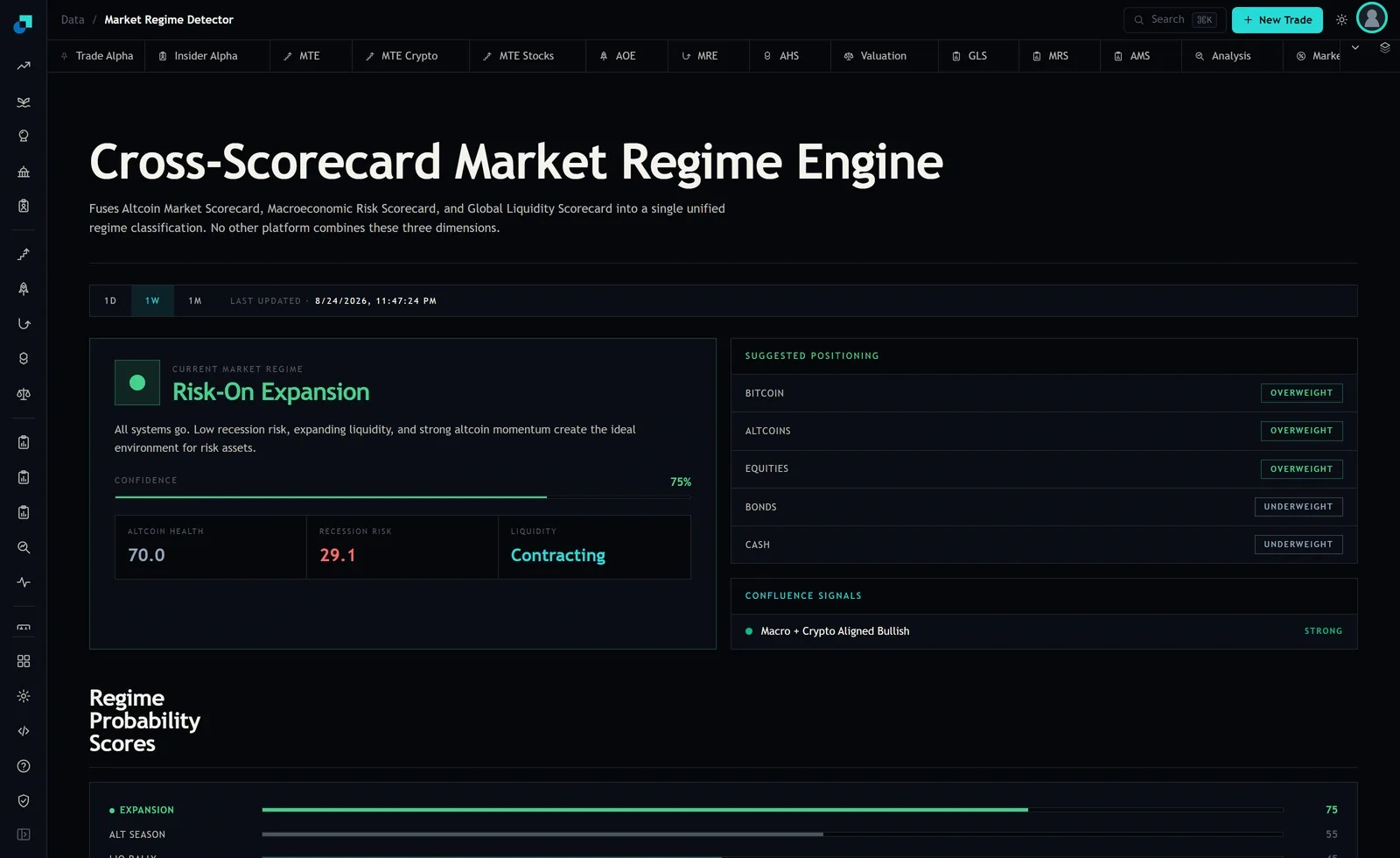
At the capture I am working from, the card read Risk-On Expansion with a confidence bar at 75 percent, altcoin health 70.0, recession risk 29.1, and liquidity Contracting.
The regime name is the output, not an input. It is the engine's summary of everything below it, which means it is the last thing to change and the least informative thing on the card once you have looked at the components. If you only ever read the name, you are reading a conclusion without its evidence.
Altcoin health and recession risk are the two numeric readings, and they come from different worlds. The engine fuses three scorecards, the Altcoin Market Scorecard, the Macroeconomic Risk Scorecard and the Global Liquidity Scorecard. Altcoin health is downstream of crypto market data. Recession risk is downstream of macroeconomic data. That difference in source is the single most useful thing to know about the card and I will come back to it.
Liquidity is not a number on this card at all, it is a direction word. In the capture it read Contracting. A word cannot tell you how fast, and it cannot tell you how close it is to flipping, so treat it as the coarsest of the five values rather than the most decisive.
One presentation note worth absorbing before it fools you. The recession risk figure is printed in red. That is the colour the card assigns to that metric, not a verdict on the value, because the regime description on the same card calls the same 29.1 reading low recession risk. Read the number, not the colour.
Confidence is an agreement count wearing a percentage sign
The 75 percent is the value most likely to be misused, because a percentage next to a market call reads as a probability of being right, and sizing follows from that reading.
Think about what the engine can actually compute. It fuses three scorecards into one classification. A confidence figure produced by that construction is describing how strongly the inputs agree with each other about the current environment. Nothing in that calculation needs to look at what happened next, which means it cannot be a statement about how often this label has been followed by gains.
The distinction is not academic. A probability of being right has to be calibrated against outcomes, meaning somebody checked that the things labelled 75 percent worked out about three quarters of the time. An agreement score is computable the instant the inputs arrive and never touches an outcome. Both print as a percentage and the card gives you no way to tell them apart, so assume agreement, which is the reading that keeps your position sizes sane.
The practical consequence is that confidence should scale how much you lean, not whether you are right. A drop from 75 to 55 with the label unchanged is the components starting to disagree, and that is genuinely useful information about the durability of the current environment. It is not a forecast.
When the sentence and the tiles disagree, the tiles win
The most instructive thing in the whole capture is a contradiction sitting inside one card. The regime description reads that low recession risk, expanding liquidity and strong altcoin momentum create the ideal environment for risk assets. The liquidity tile two lines below it reads Contracting.
Those cannot both be current. The resolution is almost certainly that the description is boilerplate bound to the Risk-On Expansion label, written once for that label and displayed whenever the label is active, while the tile is a live component reading. That is a normal way to build a dashboard and it is not a defect, but it does mean the prose on the card is not evidence about today.
So make it a habit. Read the tiles, then read the sentence, and if they conflict, believe the tiles and mentally discard the sentence. The same rule applies to the confluence signal in the right column, which read Macro plus Crypto Aligned Bullish at strength STRONG. That is a derived label too. The components are what you can check.
Which value turns first, and how to find out for your own setup
The honest answer is that the card does not tell you. It stamps a single last-updated time for the whole screen, 8/24/2026 at 11:47:24 PM in this capture, and does not timestamp the components individually, so there is no way to read a lead-lag relationship off one screenshot.
What you can reason about is source. Altcoin health is built on crypto market data, which reprices continuously. Recession risk is built on macroeconomic data, which arrives on a release calendar and often gets revised. A number that can move every minute will move before a number that can only move when a statistical agency publishes, and that is a property of the data rather than an opinion about markets.
So my prior is that altcoin health moves first, liquidity direction flips second because it is a coarse word that needs a real move before it changes at all, recession risk moves third, and the regime name changes last because it is a summary of the others. The confidence bar is the interesting exception. It should soften before the name changes, because the name only switches once the disagreement is large enough.
Do not take my prior. Test it, cheaply. Open the card once a week at the same time, on the same timeframe toggle, and write five values in a note. The name, the confidence, altcoin health, recession risk, liquidity. That is thirty seconds a week and after three months you will have a small table that tells you which number in your own market moved before the label did. That table is worth more than any general claim about lead and lag, including this one.
What a 75 percent card is worth this week
Here is the decision the card supports for an account you run yourself, and it is narrower than the card's confidence bar suggests.
A high-agreement risk-on reading is a reason not to be defensively positioned. It is not a reason to add leverage, because the number driving it is agreement between three scorecards and not a measured success rate. If you are sitting in cash out of vague unease and the card is at 75 with altcoin health at 70 and recession risk at 29, the card is telling you your unease is not currently shared by the three input scorecards, and that is a fair prompt to get to your normal weights.
The value that should worry you in this particular capture is the liquidity word. Contracting liquidity underneath a risk-on label is a genuine internal tension, not a rounding error, and it is exactly the kind of thing that gets resolved by the label changing rather than by the tile changing back. Write down the confidence figure today, and if it is materially lower the next time you look while the name has not moved, that is the components resolving the tension in front of you.