When a bank's funding comes into question, the share price falls faster than anyone can analyse, and within a few days somebody will point at a Form 4 and say that management is buying. It is the most emotionally persuasive signal in the entire filing universe, and it is also one of the weakest, for reasons that are structural rather than anything to do with the people filing. Understanding why is worth more than any single filing.
What the sector board can and cannot tell you about banks
Start with what the panel actually offers, because it is less than the question needs. Sector Flow buckets everything into ten sectors, and banks do not have one. They sit inside Financial Services along with insurers, brokers, asset managers, exchanges and payment companies, which are businesses with almost nothing in common in a funding crisis.
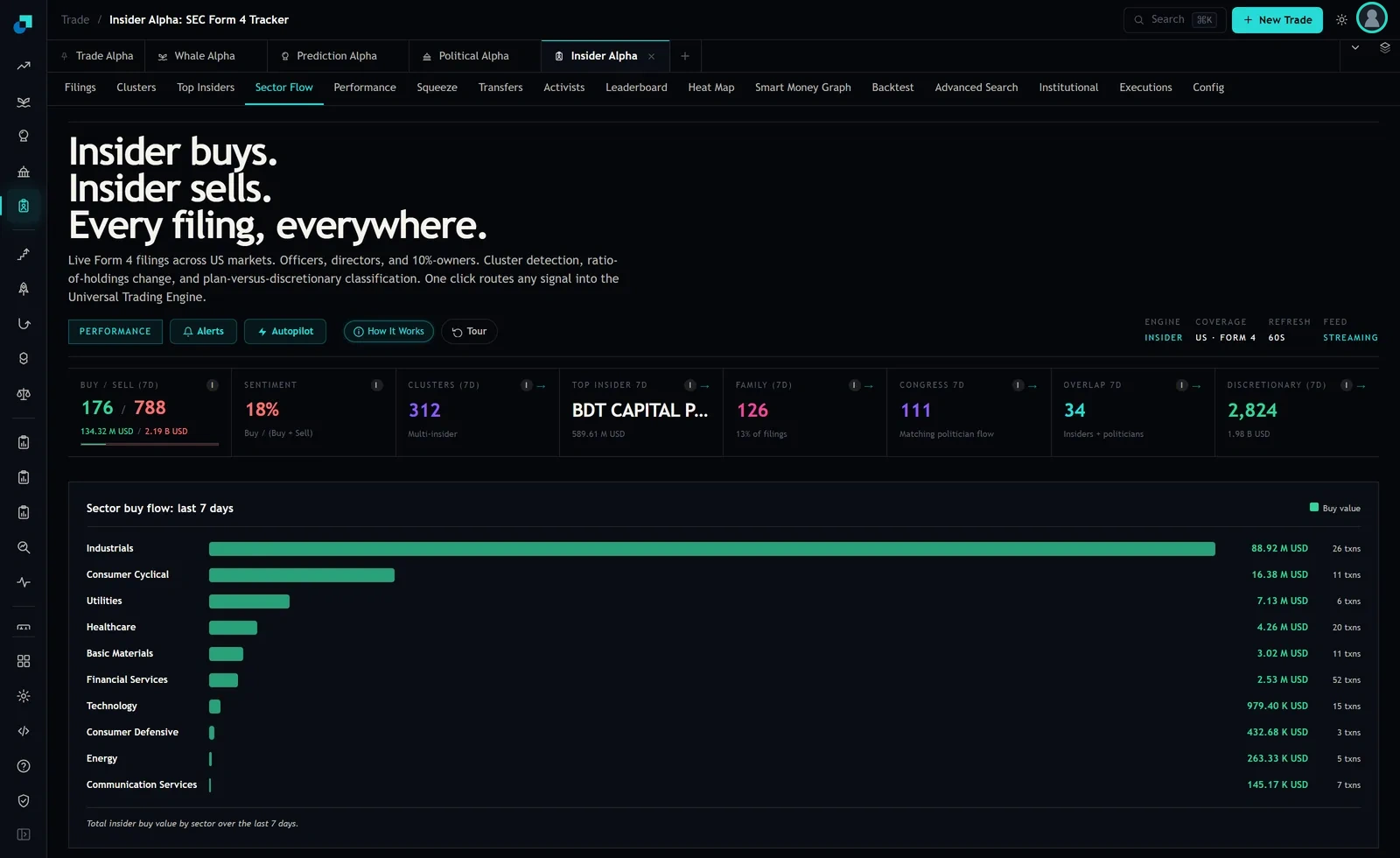
On the capture in front of me, Financial Services showed 2.53 M USD of insider buying across 52 transactions over seven days. Set that against the rest of the board. Industrials was 88.92 M USD from 26 transactions. Healthcare was 4.26 M USD from 20. Financial Services had a third of all the transactions on the board, 52 out of 156, and about two percent of the dollars.
Divide it through and the average Financial Services purchase was under 50 thousand dollars, the smallest average ticket of any sector on the panel. That is the concrete fact this article is built on, and it is worth sitting with for a second, because it is the opposite of what the crisis narrative predicts.
Many small buys is ambiguous, not bullish
A high transaction count with low dollars has at least three readings and the panel cannot distinguish between them.
It can mean broad participation, which is the reading everyone reaches for: lots of separate people, independently, decided to buy. That would be meaningful. It can also mean routine accumulation, since directors at financial companies frequently buy modest amounts on a regular schedule, and a week of those produces a high count that carries no information about the week. Or it can mean one active buyer filing repeatedly, because a transaction count is not a headcount, and a single director buying eight times contributes eight.
The panel gives you a count, not a roster. Until you go down to the filings and count distinct people, a high transaction count in Financial Services is a prompt to look, not a finding. The header tiles do offer one adjacent read: the clusters tile showed 312 multi-insider clusters across the whole board over seven days, which is the module's own attempt to separate several people acting from one person acting repeatedly. That is the concept you want, though it is computed at the company level rather than per sector.
Why the signal is weakest exactly when you want it most
Here is the structural problem, and it is not a criticism of anyone who files.
A bank in funding stress is not a company whose value depends mainly on management's judgement about its own business. It depends on whether depositors and short-term lenders keep funding it, and that is a collective outcome that no individual officer controls or can forecast reliably. An officer can know the loan book intimately and still not know whether the funding holds, because the funding depends on what other people do this week. Their information advantage is about assets. The question is about liabilities and about confidence, and those are the parts nobody has an edge on.
There is a second complication. A purchase made in public during a visible stress episode is also a communication. It is seen, and it is intended to be seen, and that is entirely legitimate. But it means you cannot separate the investment decision from the signalling act by looking at the filing, because the filing looks identical in both cases. The information content of a purchase is lower precisely when the audience for it is largest.
Third, banks are leveraged claims. If the funding does not hold, the equity is not marked down, it can be extinguished. That is a different distribution of outcomes from an industrial company having a bad year, and it means the usual reasoning about buying a fallen name with insiders alongside you does not transfer.
The checks that separate the two cases, decided in advance
You cannot tell in the moment which purchases will look prescient and which will look reckless. What you can do is decide beforehand what would have to be true, so that you are applying a rule rather than reacting to a headline.
- Count distinct people, not filings. Several independent officers and directors buying is a different fact from one person buying repeatedly.
- Confirm the transaction is an open-market purchase rather than an award, an exercise or an issuer transaction, and check the price paid falls inside that day's range.
- Check whether the purchase was made under a plan adopted earlier. A plan purchase executing during a crisis was decided before the crisis and says nothing about it.
- Size relative to the buyer, not in absolute dollars. A director putting a year of compensation in is evidence. An entity adding to a stake it already controls is a different act.
- Look at whether anyone with a genuinely independent view is buying, rather than only the people whose reputations are attached to the outcome.
None of this tells you the bank survives. It tells you whether the filing you are looking at contains any information at all, which is a lower bar and the only one you can actually clear from public documents.
Sizing a position you might be entirely wrong about
The arithmetic here is the whole discipline. On a 5,000 dollar account, a bank equity in visible funding stress is not a 1,000 dollar position with a stop underneath it. Stops do not help when a name reopens far below where it closed, and in this specific situation that is the outcome you are exposed to.
Treat it as a position you might lose entirely. That puts it at 150 to 250 dollars, which sounds absurdly small next to the potential upside and is the correct response to a distribution with a real point mass at zero. If that size feels too small to bother with, that is useful information about whether you were sizing on analysis or on the story.
The one thing I would not do is let a Form 4 be the reason. A filing can be a reason to spend an evening on the funding disclosures, the deposit mix and the maturity profile. If that work leads you somewhere, the position is justified by the work. If the only support is that an officer bought, you have taken a leveraged position in an institution's confidence on the strength of one person's opinion, made public, at the moment when their incentive to make it public was highest.