There is a small three way toggle on the Whale Feed filter rail that reads Active, Resolved, All. Most people never touch it, which is a shame, because it is the difference between reading a whale's record and reading a whale's highlight reel.
A win rate is arithmetic over trades that finished. An open position has not finished, so it is in neither the numerator nor the denominator. That single mechanical fact means any wallet that closes its winners promptly and sits on its losers will display a win rate that looks superb for exactly as long as it declines to take the loss.
Which trades a win rate is allowed to count
Think about what has to happen for a trade to land in the record. It has to end. On a prediction market that means the event resolved or the whale sold out. On spot or perps it means the position was closed.
Closing a winner is easy. You get to book a number you like, the position stops occupying attention, and the statistic goes up. Closing a loser is the opposite of all three. So the natural drift of almost every trader, whale or otherwise, is toward a book where the closed trades skew good and the open trades skew bad. Nothing sinister is required. It is just what happens when one of the two actions is pleasant and the other is not.
Prediction markets sharpen this further. A NO position that has drifted to two cents is worth nearly nothing and is still technically open until the event settles. It sits in the Active bucket, contributes zero to the win rate, and only lands in the record on resolution day, which might be months out. Until then the wallet's displayed track record simply does not know about it.
The same wallet under three toggles
The routine is to read the wallet three times and write down the row count each time. Active, then Resolved, then All. If the Active count is a large fraction of the All count, you are looking at a holder, and a holder's resolved record is not a record yet.
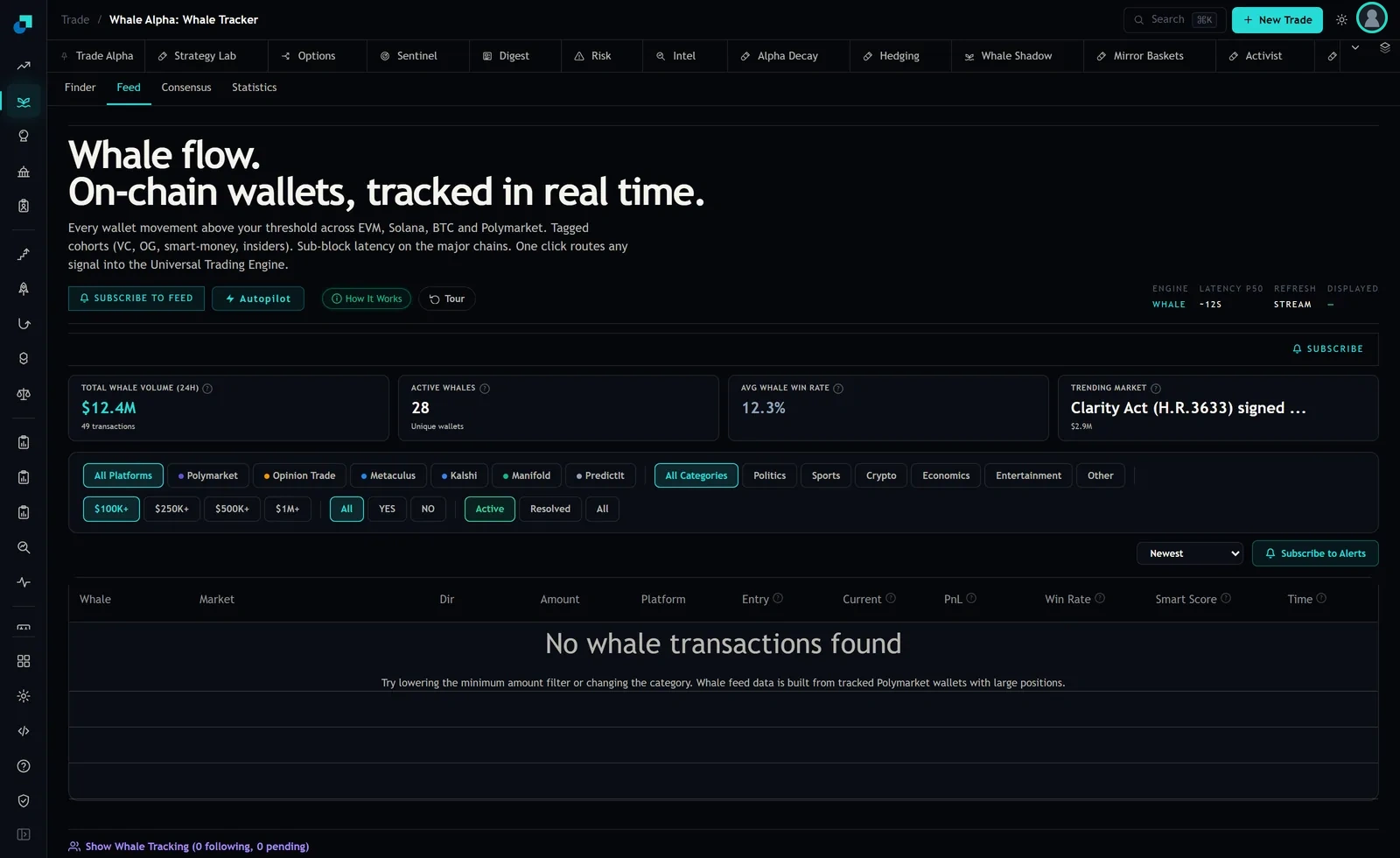
The Entry and Current columns are what make this workable. For every open position the grid is already showing you the price the whale got in at and where it is now. That is an unrealised profit or loss per row, sitting in plain sight, that the Win Rate column is not allowed to see.
Working the flattery out with arithmetic
Take a wallet with twenty closed trades, thirteen of them wins. Displayed win rate, 65 percent. Respectable, and it is the number that will end up in whatever screenshot gets passed around.
Now switch to All and find that the same wallet has eight open positions, six of them well underwater. Assume, generously, that half the underwater ones recover. The honest count over the full book is then thirteen wins against seven closed losses plus three that are heading that way, so sixteen against twelve, or 57 percent. Assume none recover and it is thirteen against thirteen, a coin flip.
The gap between 65 percent and something between 50 and 57 is not a rounding difference. It is the entire reason you were considering following the wallet. And the direction of the error is always the same, because the mechanism that produces it is one sided: open positions are disproportionately the ones the trader did not want to close.
The correction takes ten seconds. Count the open positions, look at how far each one sits from its entry, and assume the bad ones eventually land in the loss column. If that assumption changes your view of the wallet, the wallet was never as good as displayed.
Zero rows is not zero risk
One trap to know about before you conclude anything from an empty screen. In the capture, the feed had Active selected and a $100K minimum on the size chips, and the table returned no whale transactions found. Meanwhile the tile directly above it still reported 49 transactions and $12.4M of whale volume over the previous 24 hours.
Those two things are not in conflict, they are answering different questions with different filters. But if you had glanced at that empty table and concluded the wallets you follow are flat, you would have been wrong on the basis of a size filter you set yourself and then forgot about.
So when a toggle produces an empty list, drop the size threshold to the lowest chip and check again before drawing any conclusion. Small open positions are still open positions, and a whale quietly holding six losers of $40K each will not appear at all above a $100K floor.
The check before you copy anyone
Four steps, and they take about a minute per wallet.
- Set the size filter to its lowest setting. You are looking for what is there, not for what is impressive.
- Read the wallet under All, and count open against closed. If more than about a third of the positions are open, the displayed win rate is an estimate with a known upward bias and should be treated as an upper bound.
- For each open position, compare Entry to Current. Add up the ones that are badly underwater and ask whether the closed record still looks the way it did a minute ago.
- Check how old the open losers are. A position opened last week is a position. A position opened eight months ago and left to rot is a decision the wallet has already made and has not yet reported.
What makes this worth doing is that it is the cheapest available filter on copy trading, and it catches the specific failure that costs the most. Nobody loses money following a whale with an honest 52 percent record, because they size it accordingly. People lose money following a whale with a displayed 78 percent record that is really 51, because they size that one as though it were a sure thing.
One last thing worth saying plainly. None of this means a wallet with open losers is a bad wallet. Plenty of good traders hold positions through drawdowns on purpose and are right to. The problem is not the holding, it is the accounting, and the accounting is fixable by you in under a minute with a toggle that is already on the screen.