Most people work the Asset Outperformer board with one column. They sort by Score, take the top rows, and treat the number as a verdict. That gets you a defensible starting list and it also throws away the half of the information that decides how much money to put behind any of it. Strength and conviction are not the same quantity, they live in different cells, and on this board they can disagree sharply.
What the score is made of, and what it leaves out
The composite score runs 0 to 100 and it is built from four ingredients: short-term momentum across 1, 3 and 7 day windows, medium-term trend over 30 and 90 days, long-term strength over 180 and 365 days, and the consistency of outperformance across those horizons. Alongside it the engine assigns a phase, Phase A for early recovery, Phase B for a confirmed uptrend, Phase C for a strong outperformer, plus Accumulation and Distribution.
That construction has a consequence worth internalising. Because seven timeframes go in and one number comes out, the score is an average of averages, and averages hide dispersion. A 72 can be an asset that scored moderately well on every horizon, or an asset that was spectacular on two and mediocre on five. The score cannot tell you which, and the difference is exactly what determines whether the reading survives next week.
The columns that carry conviction
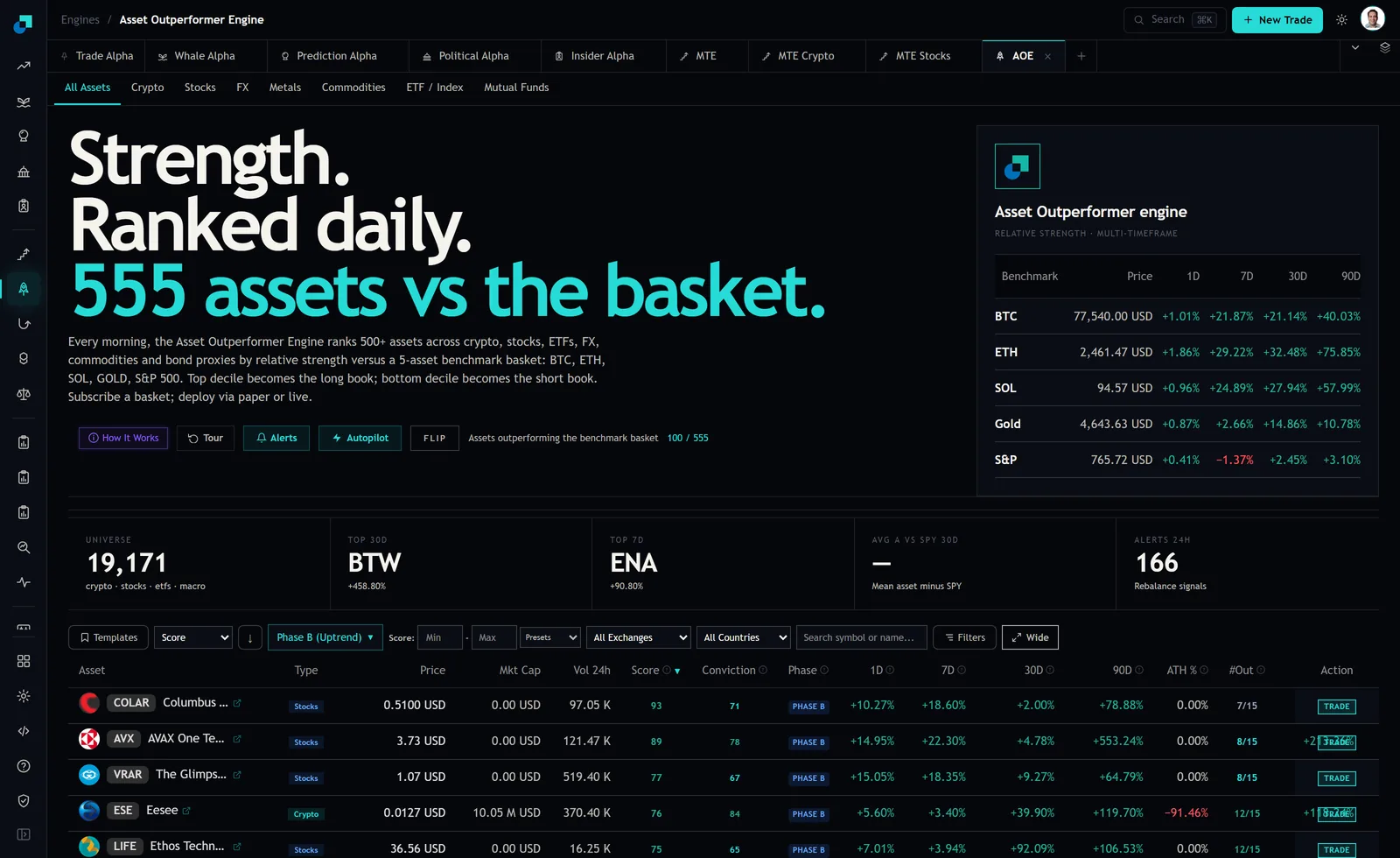
Conviction has its own cell, sitting immediately to the right of Score, and the two disagree more often than you would guess. At capture the top of the All Assets board read COLAR 93 against a conviction of 71, AVX 89 against 78, VRAR 77 against 67, ESE 76 against 84 and LIFE 75 against 65. Four of those five carry a conviction below the score, and one runs the other way. If the two numbers were saying the same thing they would track each other, and they plainly do not.
Read alongside them is the #Out column, which counts how many of the fifteen benchmark and timeframe checks the asset won. ESE and LIFE both showed 12 out of 15 while COLAR showed 7 out of 15, which is the breadth reading underneath the headline. Score tells you how strongly the asset is ranking. The conviction and breadth cells tell you how much agreement sits behind that ranking. A high score on narrow agreement is a different proposition from the same score on broad agreement, and the board separates the two for you rather than making you infer it.
Four combinations, four position sizes
Cross high and low score against high and low conviction and you get four cases. They are not four flavours of the same trade. They deserve genuinely different amounts of money, and on a small account that difference is the entire game.
High score with broad, sizeable outperformance is the only combination that earns a full-size position. Everything agrees, across horizons and across benchmarks, and the score is not resting on one lucky window. On a five thousand dollar book, full size for me means somewhere near a fifth of it, so a thousand dollars, and I am willing to hold it through a couple of rebalances.
High score with thin outperformance is a half-size position at most, and often a watchlist entry rather than a trade. The board at the time of writing had COLAR at 93 on a 30-day move of +2.00% and CRWN at 85 on +0.80%. Those are real high scores and the recent price action behind them is close to flat. Something in the longer horizons is carrying that number. It may be entirely valid. It is not something to size aggressively into on the strength of the score alone.
Low score with high conviction is the awkward one and it is usually a timing story rather than a quality story. On the crypto tab at capture, XFEE showed a 69 with a 30-day move of +455.30%. A score in the sixties next to a move of that size means the long-horizon components have not caught up, which is what you would expect from something that has only recently started working. If you take it, take it small and treat the stop as the whole thesis.
Low score with low conviction is not a trade. It is the majority of the board and the reason a filter exists.
The two combinations that actually cost people money
Both of the mixed cases have a characteristic failure, and they are opposite failures.
The high score, thin margin case fails by slow bleed. Nothing dramatic happens. You buy it, it does very little, the score drifts down over a few scans as the older windows roll off, and you close it flat minus costs a month later having tied up capital you needed elsewhere. Nobody records this as a loss and it is one of the most expensive habits a small account has, because the cost is entirely in the position you did not take.
The low score, huge margin case fails by arriving late. A move of several hundred percent is visible to everyone with a screener, and by the time the composite catches up to it the easy part is behind you. This is the one that hurts, because it produces a large loss quickly rather than a small one slowly, and it does so on an asset that looked like it was working right up until the entry.
The practical defence against both is the same and it is unglamorous: read the second set of columns before you decide the size, not after you have decided the trade.
Sizing rules I can actually hold to
The rules that survive contact with a live account are the ones simple enough to apply while tired, so mine are crude on purpose.
Full size only when score and conviction agree, and only when I can name which benchmarks the asset beat. Half size when the score is high and the margin is thin, with the explicit expectation of a slower position and a wider time stop. Quarter size or less when the margin is huge and the score is lagging, with a hard price stop set before entry. Nothing at all when neither reading is convincing, no matter how good the story attached to it sounds.
Two operational notes that affect all four. The board rescans every six hours, so a score is a snapshot rather than a live value, and sizing off a reading you took yesterday afternoon means sizing off something that has already been recalculated several times. And the market cap column is not part of either reading. At capture the crypto tab carried names at 1.79 M USD and 2.52 M USD sitting in the sixties and seventies, and no combination of score and conviction makes a position sensible if a few hundred dollars moves the price. Check that cell last, and let it veto the other two.