The order most people use is backwards. They find a new token, open the chart, decide they like it, and then work out how much to buy. By that point the size has already been decided by enthusiasm and the liquidity check becomes a formality you talk yourself past.
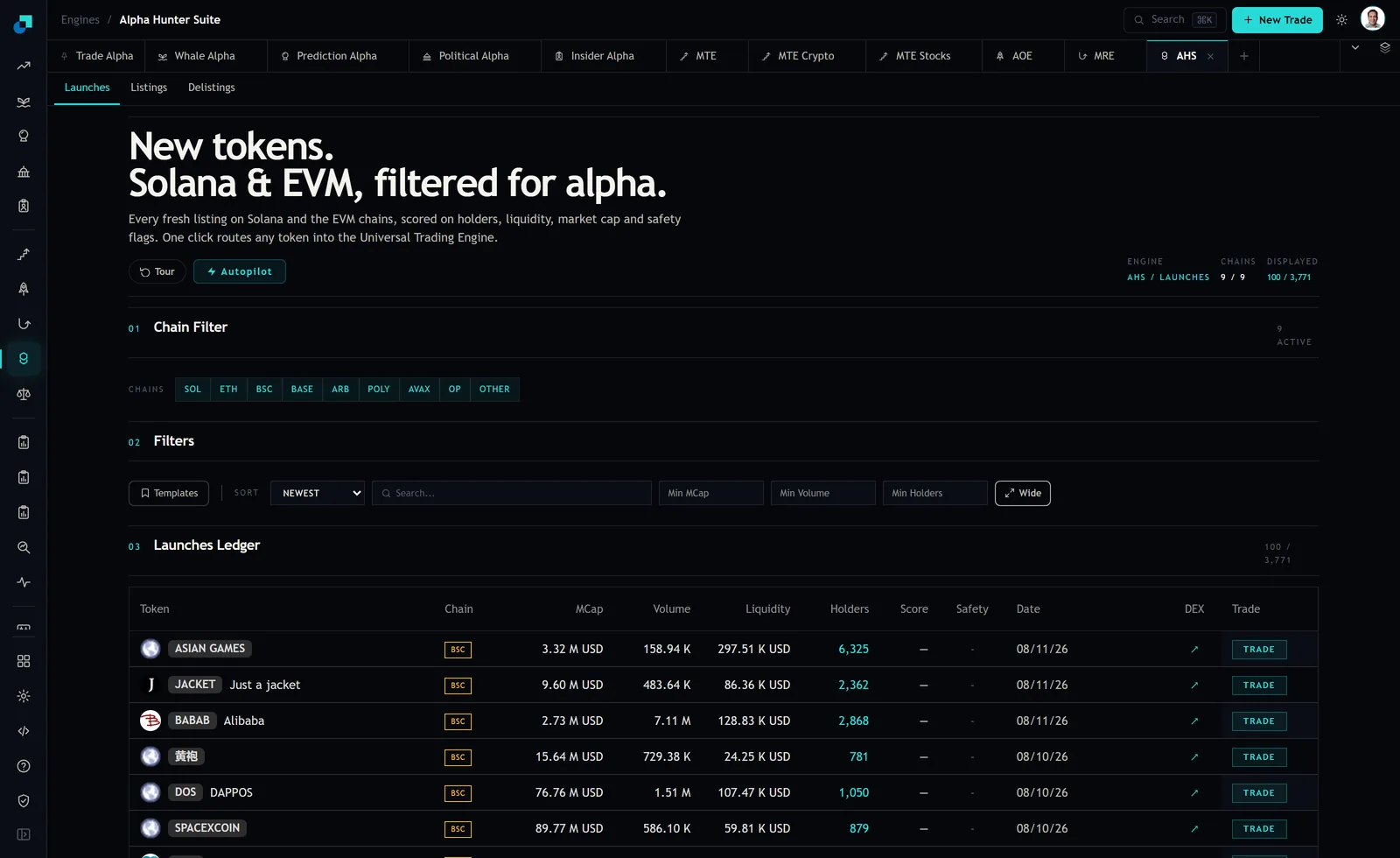
Reverse it. The launches ledger gives you a Liquidity figure on every row, and that one number sets a hard ceiling on the ticket you can put on without paying more in slippage than the trade is worth. Work out the ceiling first. If it comes out below the smallest position you are willing to bother with, you have saved yourself an hour of research and you never have to have an opinion about the chart at all.
What the liquidity figure is actually measuring
Liquidity on a launch row is the headline value of the on-chain pool behind the token. In a standard two-sided pool that value is split roughly in half. Half of it is the token. The other half is the paired asset, and the paired asset is the only real money in the arrangement. It is what you receive when you sell and what every other holder receives when they sell.
So a row showing 297.51 K of liquidity is describing roughly 150 K of paired asset. A row showing 59.81 K of liquidity is describing roughly 30 K. That is not a lot of money for the number of people who might want out of it at the same time, and it is the number your position size has to respect.
Market cap has no part in this calculation. A row showing 89.77 M of market cap against 59.81 K of liquidity, which is a real pairing from the ledger, is not telling you the token is worth 89 million dollars to sell into. It is telling you supply multiplied by last price equals 89 million. Sizing off cap is sizing off arithmetic.
The arithmetic from a slippage budget to a ticket
In a constant product pool, the price impact of a buy is close to the size of that buy expressed as a fraction of the paired side of the pool. It is not exactly that, the curve steepens as you go, but for small trades it is close enough to size with and it errs in the direction of caution.
That gives you a one-line rule. To keep one-way impact near one percent, buy about one percent of the paired side, which is about half a percent of the headline liquidity figure. A round trip is two of those, plus the pool fee both ways. So for a round trip costing roughly one percent in total, the ticket is around a quarter of a percent of the headline liquidity number.
Run it on the rows from the ledger. Take the quarter-percent multiplier and apply it:
- 297.51 K of liquidity gives a ticket of about 744 dollars.
- 128.83 K gives about 322 dollars.
- 107.47 K gives about 269 dollars.
- 86.36 K gives about 216 dollars.
- 59.81 K gives about 150 dollars.
Those numbers surprise people, and the surprise is the useful part. A token with a market cap in the tens of millions supports a two hundred dollar entry at a one percent round trip. If you want to put two thousand dollars into that row, you are not paying one percent, you are paying something closer to ten, and you are paying it twice.
If you want a wider budget, scale the multiplier. Half a percent of liquidity for a two percent round trip. One percent of liquidity for a four percent round trip. Beyond that the linear approximation stops being kind and the real cost runs ahead of the estimate, so treat one percent of headline liquidity as the outer edge of anything you would call a considered trade.
Turning the ceiling into a decision you can make in ten seconds
Write down your minimum position size, the smallest ticket that is worth the gas, the tax record and the attention. For a lot of people that is somewhere between two hundred and a thousand dollars. Call it your floor.
Now the rule is a comparison rather than a calculation. A quarter of a percent of the row's liquidity, against your floor. If the row cannot support your floor, the row is not tradable by you, regardless of what the token does next. That is not a judgement about the token. It is a statement about the relationship between its pool and your account, and it disposes of most of the ledger in a few seconds per row.
The inverse of the rule is more useful still. Divide your floor by 0.0025 and you get the minimum liquidity figure worth looking at. A five hundred dollar floor means you need 200 K of pool depth. That number can go straight into the Min MCap habit most people have and replace it, because the ledger's filters take a minimum but the useful minimum is on liquidity, not on cap. Sort, scan the liquidity column, and everything below your line is gone before you have read a single ticker.
Three things that make the ceiling optimistic
The arithmetic is honest about the pool as it stands. It is not honest about the pool as it will be, and there are three specific ways the real cost comes in above the estimate.
The first is that liquidity is deposited, not locked. Whoever put the paired asset in can take it out. Your quarter-percent ticket was sized against 128 K of depth that can be 30 K by the time you sell, at which point the same position is four times the size it was priced as. Nothing on the row tells you this has happened, because the row shows the current pool, not a commitment.
The second is that you are not alone. The impact estimate assumes your order is the only one in flight. On a day-one token the whole point is that other people are arriving at the same moment, and their orders move the price your order executes against. The estimate is a floor on cost, never a ceiling.
The third is the one that actually hurts. Entry and exit happen at different depths. Buying happens when interest is high and the pool is at its fattest. Selling happens later, usually when interest has gone, and the pool has often shrunk in the meantime. If you want one number to size on, size on the depth you expect at exit rather than the depth you can see at entry, and if you have no basis for that expectation, halve the figure and use that.
The rule to put on a card this week
Decide the round trip cost you will tolerate before you look at anything, because after you look you will negotiate with yourself. One percent is a reasonable place to start for a speculative position. Then the multiplier is a quarter of a percent of the Liquidity column, and that is your maximum ticket for that row.
Check it twice on anything you actually intend to buy. Once when you find the row, once immediately before you send the order. What you are watching for is the liquidity figure moving down, because a pool that is shrinking while you deliberate is telling you that the best informed participant in this token has decided to have less money in it than they had an hour ago.
And keep the sizing rule separate from the thesis. The most expensive habit in new token trading is letting conviction override depth, because conviction is about whether the price goes up and depth is about whether you can get out. Those are independent questions, and only one of them is settled by the chart.