The losses that hurt most on event contracts are not the ones where you were wrong about the world. They are the ones where you were right about the world and wrong about the number on the screen. You saw a contract at 6 cents, you thought the true odds were 15, you bought, and the answer came in your favour, and you still ended the month down because 6 cents was where somebody left the price on a Tuesday last week and nobody has been near it since.
This is the quietest common loss in the category and it is almost entirely preventable. It just requires knowing which cells on a market row carry a clock and which ones do not.
Yes and No add to exactly 100 on every row
Open the Prediction Alpha markets tab and look at the first two price columns rather than the market names. On the four rows visible in the capture I have, they read 18.5 and 81.5, then 0.9 and 99.1, then 1.2 and 98.8, then 55.5 and 44.5. Add each pair. Every one of them comes to exactly 100.0.
That is not a coincidence and it is not a market being efficient. It is the screen computing the second number from the first. The No cell is one hundred minus the Yes cell, which means the row is showing you one figure dressed up as two.
The consequence matters more than the curiosity. A real order book has a bid and an ask, and the distance between them is the first thing a trader wants to see, because it is the cost of changing your mind. A single derived pair cannot show you that distance. It also cannot show you when the figure was set. There is no last-trade timestamp on the row, so a contract that traded four seconds ago and a contract that traded six days ago look identical in the columns most people read first.
The only cell on the row with a clock in it
Two columns on the row are time-bounded and one of them is doing all the work. The 24h Vol column has a window baked into its definition, so it is the only cell that answers the question you actually care about, which is whether anyone has been here recently. The End Date column is the other clock, and it tells you when your money comes back rather than when the price was last touched.
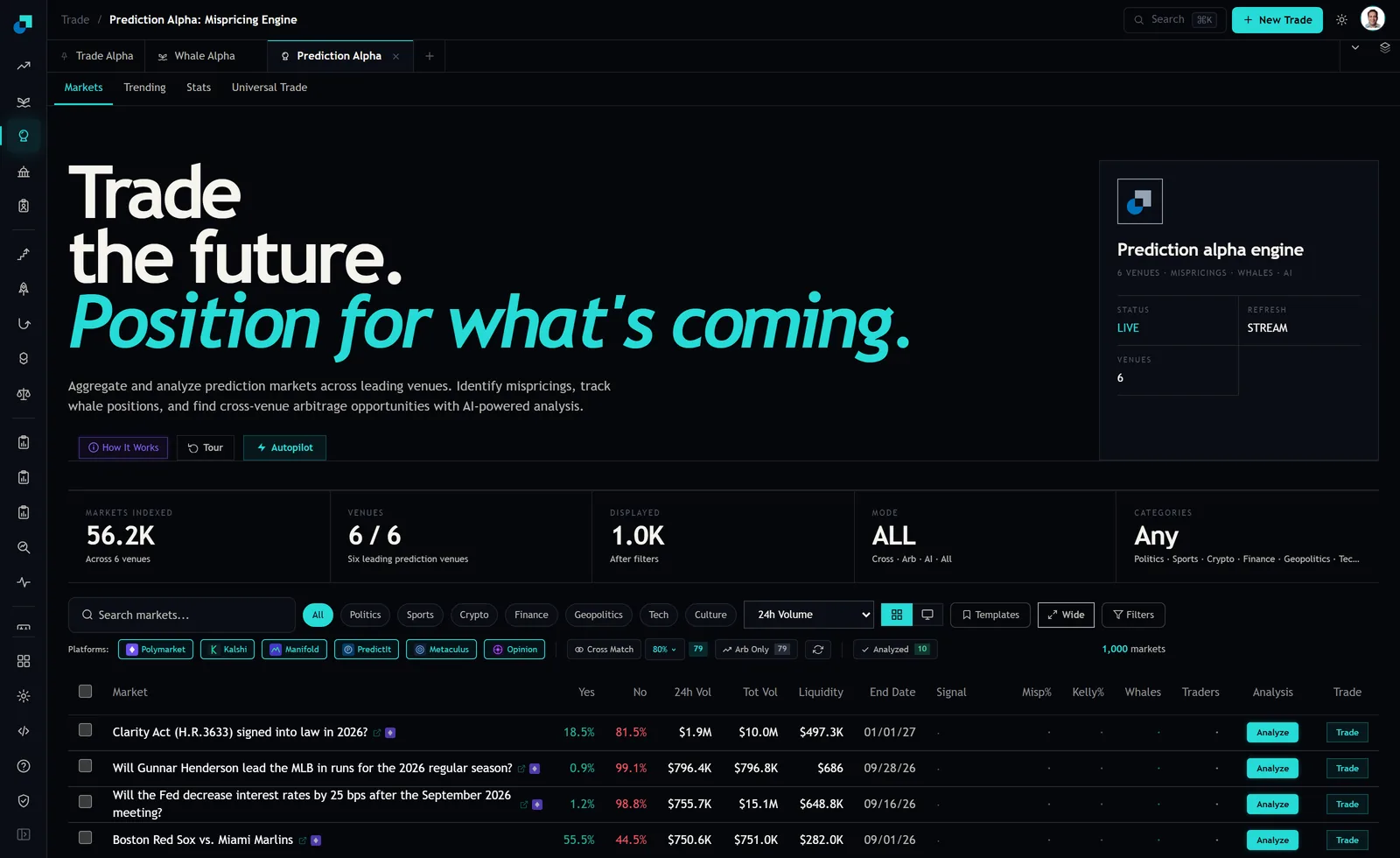
Liquidity is a stock, not a flow. It tells you what is resting on the book right now, which is useful for a different question, but a book can sit there untouched for a week and still show a number. Total Volume is cumulative over the contract's whole life, so a contract that did all its business in March still shows an impressive figure in August. Neither of them tells you about today.
So the recency check is one column wide. If 24h Vol is small or zero, the price above it is a historical artifact and you should treat it as such until the venue's own book proves otherwise.
The ratio that separates a live market from a museum piece
Divide 24h Vol by Total Volume and you get a turnover fraction that says what share of a contract's entire history happened in the last day. Run it across the four captured rows and the spread is enormous.
- The Clarity Act contract shows $1.9M against $10.0M, so roughly 19 percent of its life traded yesterday. That is a live, busy market.
- The Fed rate contract shows $755.7K against $15.1M, about 5 percent. A deep market with a long history, still moving.
- The Gunnar Henderson contract shows $796.4K against $796.8K. That is 99.9 percent. Essentially the entire recorded life of that contract sits inside the last day.
- The Red Sox contract shows $750.6K against $751.0K, the same pattern.
A ratio near 1.0 is not automatically a warning, because a contract listed yesterday genuinely has all its volume in the last day. But it is always a question, and the answer changes what you do. Either the market is brand new, in which case the price has had almost no time to be tested by anyone, or the volume column is measuring something other than what you assumed. Both readings argue for opening the venue's own page before you size anything.
The Henderson row carries a second flag that settles it. Liquidity reads $686. A contract that supposedly turned over three quarters of a million dollars in a day is resting on under seven hundred dollars of book. Whatever that combination means, it does not mean you can transact meaningfully at 0.9 cents.
A price is a break-even win rate, and stale prices carry stale ones
The reason a week-old number is dangerous rather than merely untidy is that the price on an event contract is not decoration. It is your break-even.
Take the Henderson row at face value. Buying the No side at 99.1 means you put up 99.1 cents to collect one dollar. You make 0.9 and you risk 99.1. For that to be a fair bet you need to be right 99.1 percent of the time, which is exactly the price, because that is what the price means. Now suppose the 99.1 was set six days ago and something has happened since. A move of a single cent against you wipes out more than a full year of these trades stacked end to end. There is no version of that trade where a stale input is survivable, and the payoff shape means you will not notice the damage until it arrives all at once.
The same logic runs in the other direction on the cheap side. If you think a 6 cent contract is worth 15, your entire thesis rests on 6 being a real, current, transactable number. If the true current price is 11 because the market repriced and the screen has not, most of the edge you thought you found was already taken by somebody else days ago.
The three-line check before any ticket
This takes about twenty seconds a row and I have never regretted it.
First, read 24h Vol before you read the price. If it is thin relative to Total Volume, or thin in absolute terms against what you intend to trade, the price is provisional. Second, read Liquidity against your own ticket size. If your order is a meaningful share of what is resting, you are not taking the displayed price, you are setting a new one, and the displayed price was never available to you anyway. Third, open the contract on the venue itself and look at the actual two-sided book and the actual last trade time. The screener is an excellent way to find a candidate out of a thousand rows. It is not the thing you should be pricing against.
If you only adopt one of the three, adopt the third. Everything else is triage for deciding which contracts are worth the click.
When the stale price is right and you still should not touch it
Here is the case that catches careful people. Sometimes a dormant contract is dormant because nothing has changed and the price is perfectly fair. The world has not moved, so nobody has traded, and 6 cents really is 6 cents.
You still have a problem, and it is the exit. A market with no recent volume has no recent counterparties. If your thesis plays out and the contract should reprice to 40, somebody has to be there to take the other side while you sell. On a book that has been quiet for a week, that somebody may only turn up at resolution, which means the trade you thought was a two week position is actually a hold to expiry whether you planned it that way or not.
So treat dormancy as a position sizing input rather than a red light. On a quiet contract, only take a position you would be content to hold all the way to the End Date shown on the row, at a size you would be content to have locked up for that long. That single rule converts the most common stale price loss into an inconvenience, which is all it should ever have been.