The largest rows in any insider feed are usually not people, and if your signal construction treats a filing from a general partner entity the same way it treats a chief executive buying stock in the open market, you have built a model of fund administration and labelled it conviction. This is not a subtle contamination. It sits at the top of the leaderboard, it dominates the dollar weighted aggregates, and it is the first thing an allocator will find if they look at the trades behind your attribution.
The module is explicit that all three roles arrive together. Its coverage description lists officer, director and ten percent owner transactions in one feed, which is correct behaviour for a filing tracker and a problem for anything downstream that has not separated them.
What the leaderboard looks like once you read the names
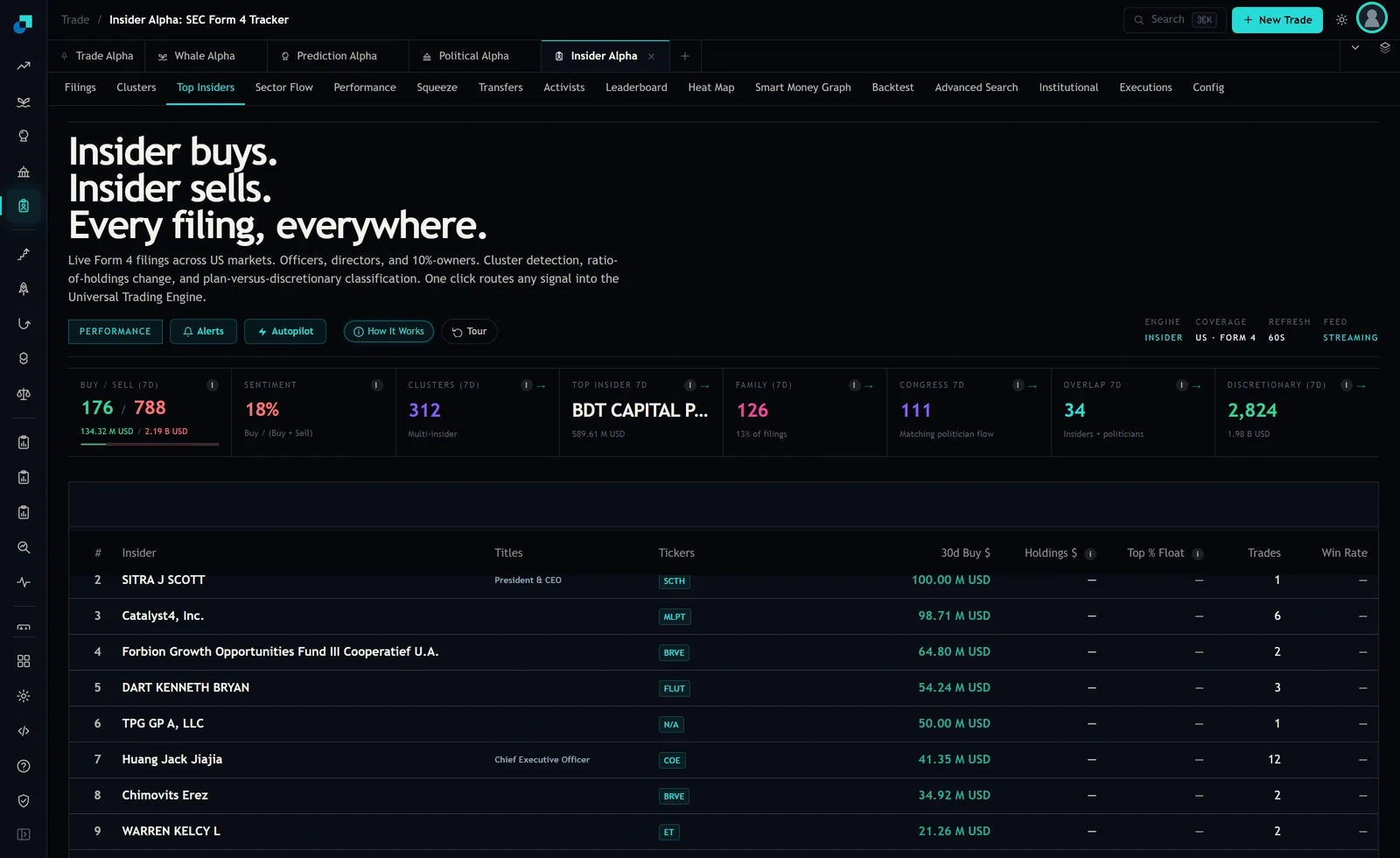
At capture the seven day top insider tile named a capital partners entity with 589.61 M USD of activity. On the Top Insiders table below it, the visible rows included Catalyst4, Inc. at 98.71 M USD across six trades, Forbion Growth Opportunities Fund III Cooperatief U.A. at 64.80 M USD across two, and TPG GP A, LLC at 50.00 M USD across a single trade with the ticker field reading N/A. Interleaved with them were named individuals with officer titles, Sitra J Scott as President and CEO at 100.00 M USD and Huang Jack Jiajia as Chief Executive Officer at 41.35 M USD across twelve trades.
Roughly half the visible rows were entities rather than humans, and the entity rows carried some of the largest dollar figures. Any dollar weighted sentiment measure built on this table is therefore substantially a measure of financing activity. That is a real phenomenon worth tracking, but it is not what the word insider is doing in most people's models.
Three things a ten percent owner filing can be
The taxonomy that matters is not by fund name, it is by what caused the filing. Three categories cover almost everything.
A negotiated subscription. A venture, growth or crossover sponsor participating in a financing, a registered direct, a private placement into public equity, or the conversion of an instrument agreed months earlier. The price was set by negotiation, the size was set by the allocation, and the timing was set by the company's funding needs. There is information in it, but it is information about the company's access to capital, not about a holder's view that the stock is cheap today.
A lifecycle movement. Transfers between affiliated vehicles, distributions in kind to limited partners, reallocations between a fund and its general partner, restructurings ahead of a fund's end of life. These generate filings that look like trades and are not trades in any economic sense. The counterparty is usually another pocket of the same organisation.
An accumulation toward influence. A concentrated holder buying in the market with the intention of pressing management. This is the only one of the three that resembles what people mean by insider conviction, and it is also the one that tends to surface elsewhere. The module's activist view is built around those forms, with filters for 13D, 13D amendments, 13G and tender offers, and an intent filter that separates activist from passive. A holder crossing a threshold with an activist intent disclosure is a different animal from the same dollar amount arriving as a passive position report, and the intent filter is the cheapest way to make that split.
Round numbers are the tell
You will not always know the sponsor type from the name, and you will rarely have time to read the underlying document for every row. Two fields on the leaderboard get you most of the way there, and both were visible at capture.
The first is round dollar amounts. Fifty million dollars exactly, or one hundred million dollars exactly, is not what accumulation looks like. Market buying produces untidy totals because it is the sum of many fills at many prices. A figure that lands on a round number is almost always a subscription, where somebody agreed to invest a stated amount at a stated price. The 50.00 M USD and 100.00 M USD lines read differently from the 98.71 M, 64.80 M, 41.35 M and 34.92 M lines for that reason alone.
The second is the trade count. One trade for fifty million dollars is a single ticket, which is a subscription or a transfer. Twelve trades for forty one million dollars is a programme executed over time, which is behaviour. If you want one ordering rule to replace dollar ranking, rank by trade count and price dispersion within the filer, then look at dollars. It will reorder the leaderboard substantially and the reordering is the point.
The calendar you are trading when you trade sponsor flow
Sponsor filings do carry tradable information. It is just information about supply and timing rather than about value. Three horizons are worth tracking.
Lockup structure comes first. A sponsor that has just subscribed in a financing is typically restricted for a period, which tells you when a block of stock becomes eligible to move and roughly how large it is. That is a forecastable overhang, and it is more reliable than most things you can forecast about a small company.
Distribution mechanics come second. When a fund distributes shares in kind, the recipients are limited partners with no mandate to hold the position, and the selling that follows is price insensitive. It looks like informed selling on a tape and it is nothing of the kind.
Affiliate resale constraints come third. Holders who count as affiliates sell under volume limits tied to the size of the outstanding share count and to recent average trading volume, which puts a mechanical ceiling on how fast a large position can be unwound in the market. That ceiling is the reason large stakes so often exit as negotiated blocks instead, and a negotiated block is a price event you can prepare for rather than react to.
What to add before this reaches a model
Be specific about the gap, because it determines who does the work. What the module confirms it does is classify plan versus discretionary activity, report titles for officers, and separate forms and intent on the activist view. I did not see a control that classifies a ten percent owner by sponsor type, distinguishing a venture fund from a buyout general partner from a strategic corporate holder from a family office. If that control exists it was not on the screens I read, so I am going to assume the mapping is yours to maintain.
It is a small table and it is durable. Key it on the filer identifier rather than the display name, since entity names change and sponsors file under dozens of related vehicles that all belong to the same house. Assign each filer a sponsor type and a default treatment. Review the unmapped filers once a month, which in practice is a short list, since the same sponsors recur.
Then make the treatment explicit in the strategy document. Either ten percent owner rows are excluded from the conviction signal and tracked separately as a supply and calendar input, or they are included with their own base rate computed over their own history rather than borrowing the officer base rate. Both are defensible. What is not defensible, and what will be found, is a dollar weighted insider sentiment measure whose largest contributors turn out to be a fund honouring a subscription agreement and a general partner moving stock from one pocket to another.