The trending tab defaults to 24 hours, and 24 hours is the window that flatters the wrong contracts. A single fixture with a two hour betting window can post more volume in an afternoon than a policy question does in a month, and the default view will rank it first every time. Sitting immediately to the right of that default are two toggles, 7d and 30d, and the useful thing about them is not either board on its own. It is the difference between them.
What was actually on the 24 hour board
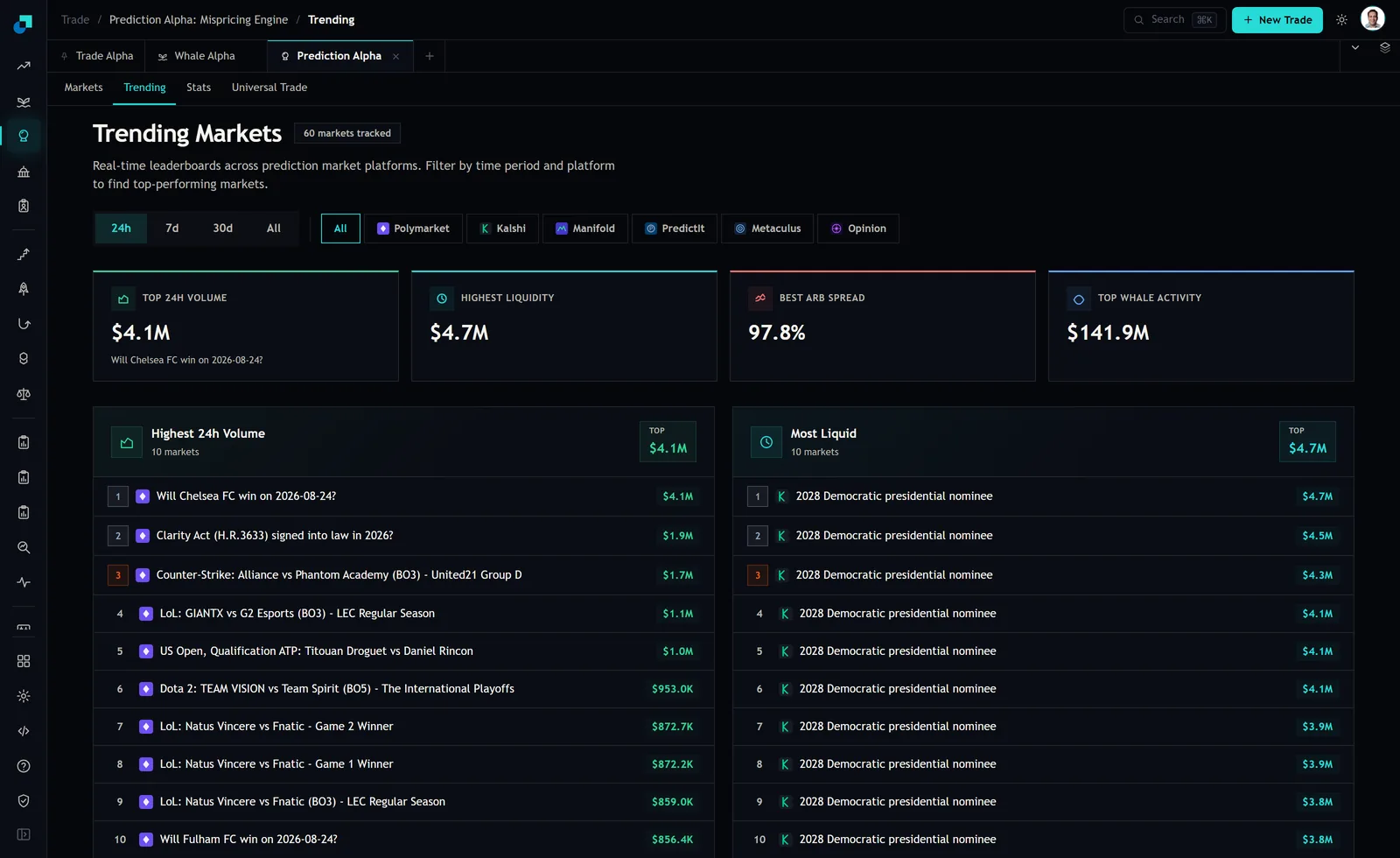
Here is the top ten by 24 hour volume from the capture I have, in order: a Chelsea fixture at $4.1M, the Clarity Act contract at $1.9M, a Counter-Strike series at $1.7M, a League of Legends series at $1.1M, a US Open qualifying match at $1.0M, a Dota 2 playoff series at $953.0K, then three rows for the same Natus Vincere against Fnatic match at $872.7K, $872.2K and $859.0K, and a Fulham fixture at $856.4K.
Count the categories. Nine of the ten are sports or esports fixtures resolving within about a day. One, the Clarity Act, is a policy question with an end date more than a year out. That is what a 24 hour attention window looks like on this asset class, and if you only ever open the default view, that is the entire universe you will ever be shown.
Ten rows are rarely ten events
Before you compare anything across windows, deduplicate. The trending page tracks sixty markets, ten across each of six boards, and on the capture those sixty rows contained substantially fewer than sixty distinct questions.
On the volume board, rows seven, eight and nine are the Natus Vincere against Fnatic fixture listed three ways. That is one match occupying thirty percent of the leaderboard. On the Most Liquid board, all ten rows read the same nominee question, once per candidate, on one venue. On the Most Cross-Listed board, the top three rows are one Toronto mayoral question and the next seven are one UK leadership question.
This matters for the window comparison specifically, because listing granularity does not decay the way attention does. A multi outcome market with ten legs will hold ten slots on a 30 day board simply by existing, while a single fixture holds one slot for one afternoon. If you compare raw board membership across windows without collapsing legs into events first, you are mostly measuring how each venue chose to slice its listings.
The difference between the boards is the signal
Once you are comparing events rather than rows, three patterns come out of flipping the toggle, and each one implies a different action.
- On 24h only. The contract had one day of business and the day is the story. Almost always a fixture, an expiry, or a news event that arrived and resolved. There is no position here for someone who is not already at the screen.
- On all three boards. Volume has been arriving steadily enough that the contract clears the bar over a rolling month as well as a rolling day. This is the population worth reading. It usually means a question with a real horizon, a genuine disagreement, and enough repeat participation that a book exists when you want to leave.
- On 30d but not 24h. Interest has faded. The contract accumulated its volume earlier in the window and is now quiet. Sometimes that means the question has effectively been answered and the price has settled near a boundary. Sometimes it means everyone got bored and the book thinned out. Those are very different situations and the board will not distinguish them for you, so this is the group where you go and look at the contract itself.
The practical version takes five minutes. Open the tab on 24h, screenshot or copy the volume board, flip to 30d, do the same, and write down which events appear on both. On the capture I have, the only row on the 24 hour board that plausibly survives a 30 day window is the Clarity Act contract, because it is the only one with a horizon long enough to have been accumulating volume for weeks. Everything else was created, traded and retired inside the window.
Which of the two a retail account should actually trade
The persistent group, without much hesitation, and the reason is not that day fixtures are unprofitable. It is that they are unresearchable at retail speed.
A same day esports contract gives you no time to be early and wrong, which sounds like a feature and is not. Every trade is a coin you flip once, at a price set by people watching the match, and your research half life is measured in hours. There is no version of a working process where you read a screen in the evening, form a view, and act on a contract that resolves before you next sit down. You are competing on speed with people who have the stream open, and speed is not a retail advantage.
The persistent group gives you the thing you actually need, which is time. Time to check the resolution wording, time to look at the venue book rather than the screener row, time to decide a size, and crucially time to change your mind and exit at something other than the resolution price. Persistence across windows also correlates with the thing that makes an exit possible, which is that other people keep coming back.
The tradeoff is real and worth stating. Long horizon contracts lock your money up. A question ending in January 2027 is a commitment of more than a year, and on a small account, capital committed is capital not compounding. So the honest rule is not that persistent contracts are better. It is that they are the only ones a part time process can trade competently, and that you should size them knowing the money is gone until the end date.
Check which boards the toggle actually moves
One caveat before you build a routine on this, and it is the kind of thing that is cheap to verify and expensive to assume. The time toggle sits at the top of the page, above all six leaderboards, but not every board on that page is obviously a function of a rolling window. Highest 24h Volume clearly is. Biggest Total Volume is cumulative over a contract's entire life by definition, and Most Cross-Listed is a structural property that has nothing to do with a time period at all.
So the first time you use this, flip the toggle and watch which boards change and which do not. It takes thirty seconds and it tells you exactly which of the six panels your comparison is entitled to use. Build the routine on the boards that respond, and read the others as standing context rather than as evidence about attention.
The same applies to the platform chips beside the toggle. All six venues are selected by default, and on the captured 24 hour volume board every single row carried the same venue badge. Filtering to one venue at a time and re-reading the board is the fastest way to find out whether a contract is genuinely busy or whether one venue's listing conventions are doing all the work.