The Brokers page opens with a catalog and a filter row, and at capture the filter read 195 showing. That number is an invitation to do the wrong thing. The instinct is to connect broadly, because connecting is free and it feels like preparation, and three months later you have six accounts, two of them funded, four of them holding a hundred dollars of dust and an API key you have forgotten exists.
The right number for most people is two. Not because two is a magic number, but because the signal feed you are executing against covers a handful of asset types, and asset type is the thing that actually determines whether a given venue can fill your order. Work backwards from the rows, not forwards from the catalog.
List the rows you actually take, in order of frequency
Open the Trade Alpha feed and look at the Type column rather than the ticker. In the capture I am working from, the visible rows carried types of STOCKS and METALS, and the coverage list on the same page enumerates what the feed can produce across all its engines: crypto spot and perpetuals on CEX and DEX venues, US equities, forex majors and minors, commodities, precious metals, and prediction markets.
Now be honest about which of those you trade. Not which you find interesting. Which ones you have taken a position in during the last three months. For most people the list collapses fast, and it usually collapses to two clusters: something in crypto, and something in listed US equities. If your list has five clusters in it, the problem is not your broker setup, and no amount of connecting will fix it.
Write the list down with a rough frequency next to each. That list is the specification. Everything that follows is just satisfying it with the fewest moving parts.
The panel has already made the important split for you
The filter row is more useful than it first looks, because the primary split it offers is the split that matters.
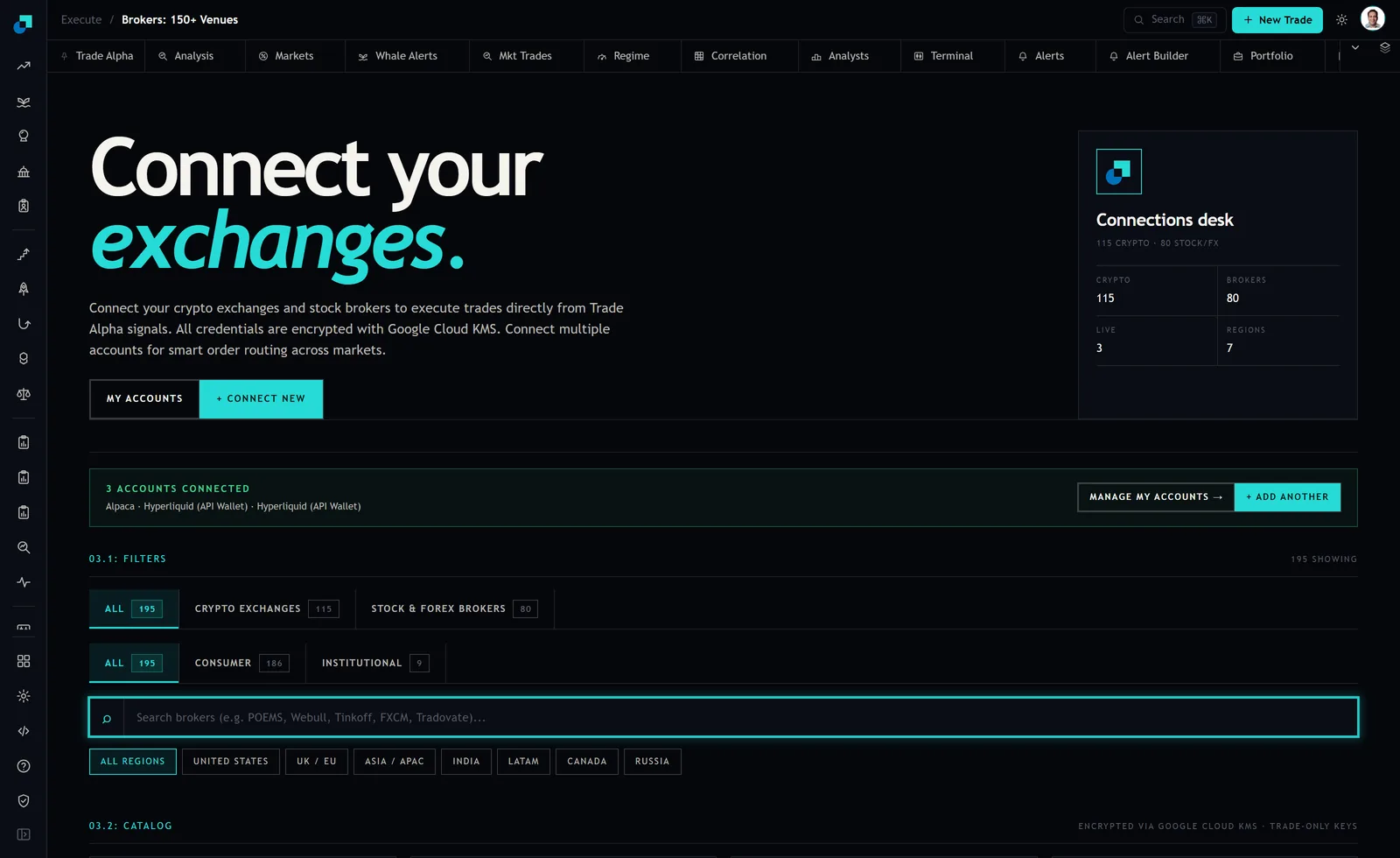
115 crypto exchanges on one side, 80 stock and forex brokers on the other. That is not a cosmetic grouping. A crypto exchange cannot fill a US equity order and a stock broker cannot fill a perpetual, and no routing cleverness changes that. So the shape of the minimal setup is one connection per side of that line, and the work is choosing which one on each side.
The second filter row is worth a glance even though it is aimed at a different reader. At capture it split the catalog 186 consumer against 9 institutional. You want the consumer side. That is not a downgrade, it is the correct product for an account you fund yourself and manage yourself.
The region row underneath is the constraint that will actually eliminate candidates for you. At capture it offered all regions, United States, UK and EU, Asia and APAC, India, LATAM, Canada and Russia. Your residence decides which venues will accept you long before your preferences do, so filter by region first and choose from what survives. There is no point building a plan around a venue that will reject your application.
Where the two-connection plan honestly breaks
I would rather tell you the limits of this than sell you a tidy answer.
The first limit is that the catalog does not publish an instrument-by-instrument capability list. The panel tells you a venue is a crypto exchange or a stock and forex broker, and it gives you a search box, and it does not tell you whether a specific broker carries a specific instrument. So the last step of choosing is always the same, and it is manual: go to the venue's own instrument list and confirm the specific things on your frequency list are there. Two minutes, once, and it prevents the most annoying possible discovery, which is finding out at the moment you want to trade.
The second limit is metals and commodities. A metals row like the XAG one in the feed can be expressed in more than one way depending on the venue, and a stock broker, a futures broker and a crypto venue offering a perpetual are three different answers to the same signal. They carry different costs, different margin, and different tail risk. If metals or commodities sit high on your frequency list, that is the one case where the honest answer might be a third connection rather than a contortion, and it is worth paying for rather than faking.
The third limit is prediction markets. The coverage list includes them, and they do not live behind a broker connection in the way an equity does. Treat that cluster as its own thing rather than something your two accounts will absorb.
What the account you never fund actually costs you
Connecting is free, which is exactly why the cost is invisible. It is not zero.
Every connected account is a live credential against a venue holding some amount of your money, however small. Dust balances are still balances, and they sit on someone else's balance sheet. Every extra account is one more login, one more set of recovery details, one more place to check when something looks wrong, and one more thing to remember to close properly rather than abandon.
Then there is the split-cash problem, which is the one that bites in practice. If you keep 3,000 dollars spread across four venues to be ready for anything, you have 750 dollars of buying power at the venue where the trade you want actually appears. Concentrating the same cash in two accounts means position sizes that are worth the effort of managing, and it means you are not moving funds between venues in a hurry, which is the situation where people make expensive mistakes.
The counter argument is redundancy, and it is a real argument. One venue having an outage while you hold a position is a genuine risk. But redundancy from a funded second account you trade regularly is real redundancy. Redundancy from an empty account you have never placed an order through is a comfort blanket, because the first time you use it under pressure is the first time you will discover its quirks.
Connecting the pair without giving away more than trading
Once you have picked two, the setup step deserves more care than it usually gets, and there is one rule that is not negotiable.
Create a key that can trade and cannot withdraw. Every serious venue lets you scope this at issuance, and the Brokers page states that credentials are encrypted with Google Cloud KMS and describes the keys it uses as trade-only. Take that as the standard to hold your own setup to rather than as a reason to stop thinking about it. The point of the separation is simple: a trading credential that is compromised costs you bad trades, which is recoverable. A credential that can move funds costs you the funds, which is not.
Then the operational rules, which are short. One key per connection, so that revoking one does not require revoking everything. Never send a key or a secret to anyone, in any channel, for any reason, including anyone claiming to be support for the venue or the platform. No legitimate party ever needs it, and there is no version of that conversation that ends well. Do not screenshot the key. If you cannot remember where a key came from, revoke it and issue a new one, because the cost of being wrong is asymmetric and the cost of reissuing is four minutes.
Set a reminder for ninety days to open the connections list and read it. At capture the panel showed 3 accounts connected, and the useful version of that number is one you can account for line by line without thinking. When you look at the list and find something you do not recognise or no longer use, disconnect it at the platform and revoke the key at the venue. Doing only the first half leaves a live credential in the world, and that is the half people skip.