Most people set up whale alerts the same way, which is to say they turn on everything and then turn it all off again three weeks later. The reason is not that the data is bad. It is that the default configuration answers a question nobody actually has. An entry alert tells you a wallet you have never heard of has opened a position in something you do not own. It arrives as a suggestion, and suggestions from strangers arrive faster than you can evaluate them.
The inversion is worth trying. Alert on exits from the small set of wallets you are already following, and let the entries go. That configuration produces fewer notifications, and every one of them lands on a position you actually hold.
Which alert arrives attached to a decision
Think about what you can do in the sixty seconds after each alert type fires.
An entry alert requires you to do research before you can act. You need to know who the wallet is, whether the position is a view or a hedge, how big it is relative to that wallet's normal size, and whether the asset is one you would hold at all. That is fifteen minutes of work minimum, by which point the entry price you were reacting to is gone. In practice the entry alert either gets ignored or gets acted on without the research, and the second is worse than the first.
An exit alert on a wallet you are copying requires none of that. The research is already done, because you did it when you entered. The position is already in your account. The alert is simply telling you the person whose thesis you borrowed no longer holds it, and the decision in front of you has three options rather than infinite ones: close, reduce, or consciously keep holding on your own reasoning. That is a decision you can make in the sixty seconds you actually have.
What the counters say about each stream
The Whale Alerts feed reports its own composition, and it is worth reading before configuring anything. At capture the tracked window held 7,437 entries, 6,004 exits, 846 token buys, 303 token sells and 6,682 size changes, summing to 21,272 total events.
Two things fall out of those numbers, and the first one is inconvenient for the argument I am making. Switching from entries to exits cuts the stream from 7,437 to 6,004, which is about a fifth fewer notifications. That is not the reduction that makes this workable. The exit stream is a firehose too, and anyone who flips the filter and nothing else will be back to muting it inside a month.
The second is where the actual leverage is. Token sells printed 303 times against 846 token buys, so an outright sell is roughly a third as frequent as a buy. Rare events carry more information per print, and if you want the single highest signal filter on the page, it is that one.
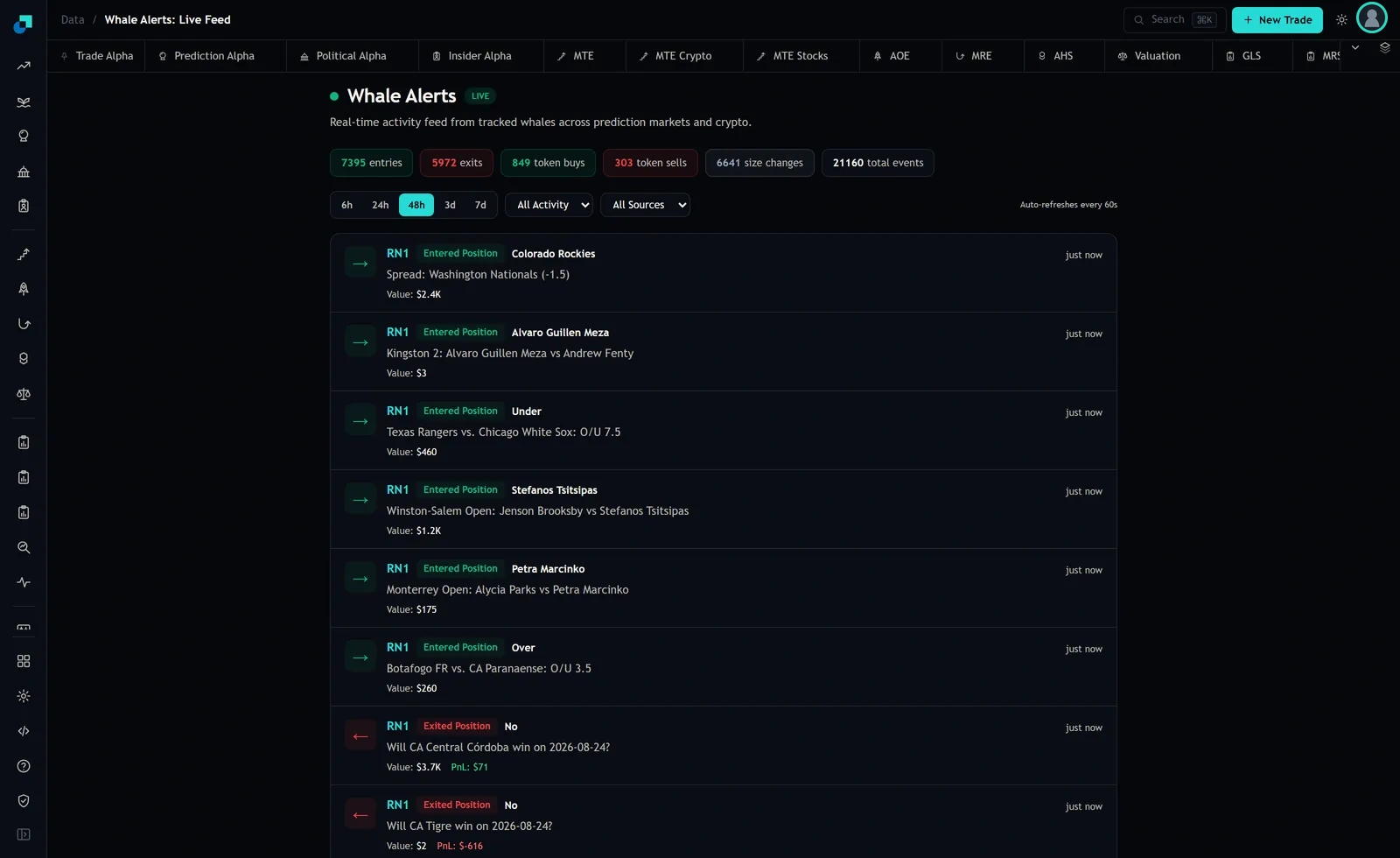
Setting the feed to the exit side
The controls I can confirm on the page are the activity chips listed above, a source selector covering All Sources, Polymarket, EVM and Solana, and a window running 6h, 24h, 48h, 3d and 7d. The feed states that it auto-refreshes every 60 seconds.
Set activity to Exits, source to whichever chain your positions actually live on, and window to 24h. That last choice matters more than it looks: a 24 hour window read once a day gives you complete coverage with one visit, whereas the 6h window either misses things or demands four visits.
Now the part the feed does not do for you. I cannot confirm a control that restricts the stream to a personal watchlist of wallets, and a size floor is not among the filters I can see either. So the watchlist lives in your notebook, and it needs to be short enough that scanning a day of exit prints for those wallets takes a minute. Three to six wallets, written down with their truncated addresses in a file you can search, is the practical size. If your list is thirty wallets long you have not built a watchlist, you have rebuilt the firehose with extra steps.
This is also the honest limit of the method. You are doing the wallet matching by eye, and eye matching fails when you are tired or in a hurry, which is exactly when a real exit prints.
The exits that never print as exits
An exit alert is a negative signal only when it fires. The gaps are where the damage is.
The first gap is scaling out. A whale reducing a position across four sessions generates Decreases rather than an Exit, and by the time the Exit prints the wallet has already sold most of it into the market you are still holding. This is why the Decreases chip is worth checking alongside Exits, even though it is the largest single category in the feed at 6,682 events. Check it weekly rather than daily and only against your own list.
The second gap is structural to prediction markets. A position can end at resolution rather than by being sold, and a position that resolves does not need anyone to exit it. So the absence of an exit print on a Polymarket wallet is not evidence that the whale still holds a view. It may simply mean the market ended.
The third gap is timing. The feed refreshes every sixty seconds, so at absolute best you are a minute behind an on-chain event that itself took time to index. You are not going to sell in front of anyone. The value of an exit alert is not speed of execution, it is that the reason you were holding has been withdrawn by the person who supplied it, and that stays true whether you find out in one minute or in six hours.
Deciding your response before the alert fires
The reason exit alerts get ignored is almost never that they were missed. It is that they arrive during the working day and the recipient has not decided in advance what they mean, so the alert becomes a thing to think about later, and later never comes.
Fix it when you open the position, not when the alert lands. Write one line next to each copied position saying what you will do if that wallet exits: close it, halve it, or hold it because you have your own reason independent of theirs. That third option is legitimate and underused, but it has to be written down beforehand, otherwise it is just inertia with a story attached.
The tell that your list needs pruning is a wallet that generates exit prints constantly. Some of the tracked population trades intraday, and following one of those wallets on an exit alert means being told several times a week that a position you copied at some other price is now closed. That is not a signal about the asset, it is a mismatch between that wallet's holding period and yours, and the fix is to drop the wallet rather than to mute the alert.