Insider buying gets all the attention and it deserves most of it. There is essentially one reason to buy your own company's stock with your own money and a long list of reasons to sell, which is why every serious treatment of this data leans on purchases. The consequence is that the sell side of the feed gets treated as noise in its entirety, and that is one step too far.
There is a narrow case worth attention. Several insiders, selling at their own discretion rather than under a plan, within a short window, in sizes that are large relative to what they hold. That specific combination is rare. Everything else on the sell side genuinely is noise, and the work is in telling them apart.
Why almost all insider selling means nothing
Start with what you are filtering out. An insider is paid in stock and has been for years. Shares vest on a schedule set before anyone knew what this quarter would look like. Taxes come due on vesting whether or not anybody wants to sell. Trading windows open for a few weeks after earnings and close again. Financial advisers tell concentrated executives to diversify, and they are right to.
Stack those up and the default expectation is a steady drip of selling from any company that pays its people in equity, forever, in all conditions. A feed that flags every code S will flag that drip every quarter and be useless. Worse, it will feel informative, because there is always something on it.
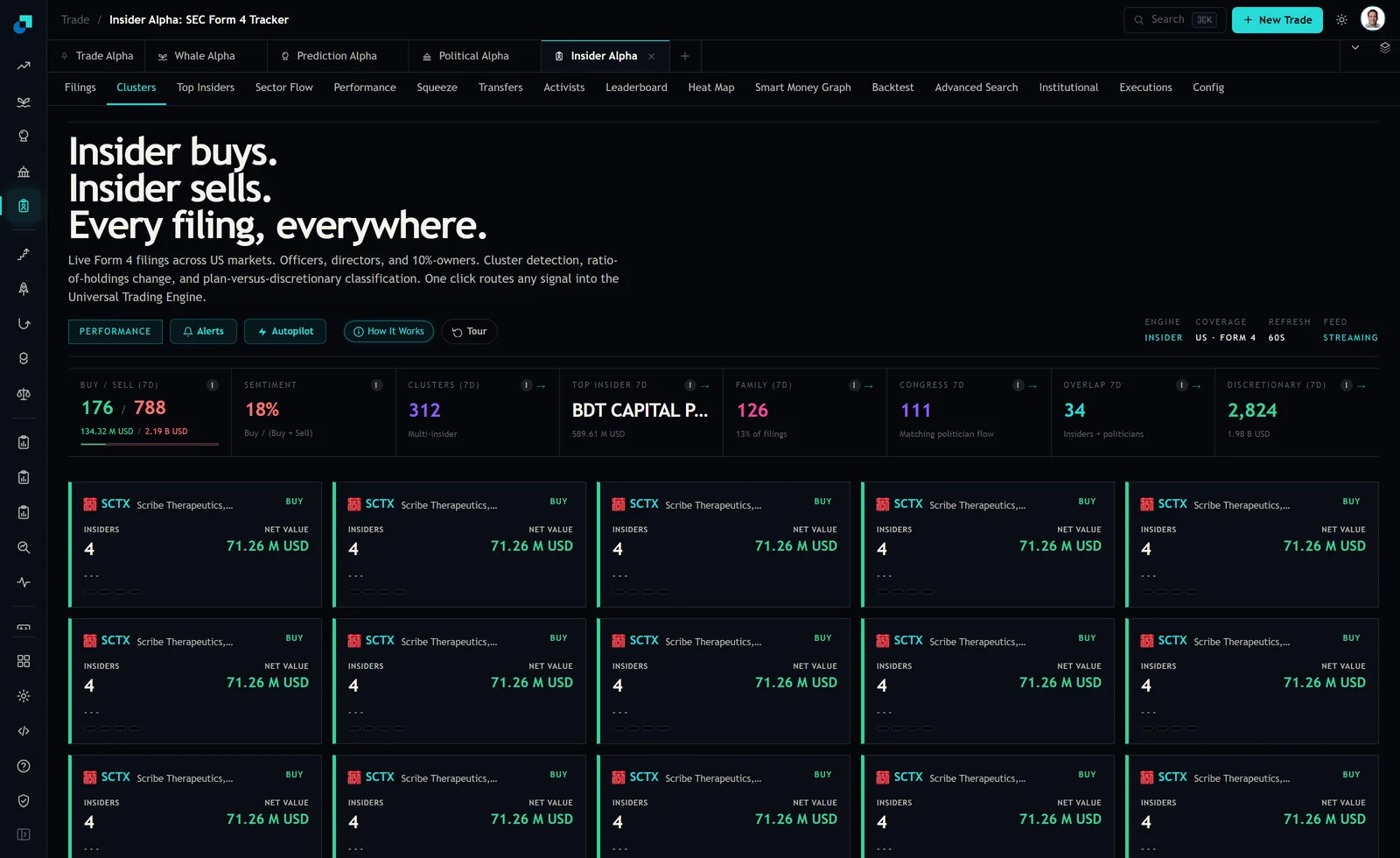
You should also know how the tooling is built, because it shapes what you see. Insider Alpha's cluster detection is defined on buys, described on the page as multiple insider buys at the same company within a short window. There is no equivalent prepackaged view for coordinated selling, which means if you want this setup you assemble it yourself out of the filings feed. That is a fair design decision and it tells you something about the relative value of the two sides.
The four checks that separate an exit from housekeeping
Work through these in order. If a candidate fails any of the first three, delete it and move on.
Is the plan box unchecked. The Form 4 carries a checkbox indicating the transaction was made under a trading plan intended to satisfy the Rule 10b5-1 conditions. If it is checked, the sale was scheduled in advance and the date the insider sold tells you nothing about what they knew last week. If it is unchecked, someone made a decision recently. That is the entire premise of this setup and it is a single field.
Is it code S and nothing else. Codes F and D are shares going back to the company for tax withholding or forfeiture. Code M paired with code S on the same day is an exercise and immediate sale, which is compensation being converted to cash and which happens on a schedule driven by option expiry. What you want is a plain open-market sale, code S, with no exercise attached to it.
Is it large relative to what they hold. This is the check that does the most work and the one people skip because it takes thirty seconds per filing. The form reports shares owned following the transaction. An executive selling five percent of their holding is diversifying. An executive selling forty percent of their holding is doing something else. Dollars alone will not tell you which, because the person with the biggest dollar sale is usually just the person with the biggest holding.
Is it more than one person, within a few weeks. Three insiders is a reasonable bar for the same reason it is a reasonable bar on the buy side. Count people rather than filings, so a spouse's account and a family trust attached to the same individual count once.
The transfers that look like an exit and are not
Before you conclude anything, check that the dispositions you are looking at were actually sales. A large amount of stock leaves insider hands every quarter without a market transaction, and a feed reading dispositions naively will present all of it as selling.
Insider Alpha keeps these in a separate Transfers view with its own categories, gifts to family, trust funding, divorce settlements, estate planning and internal moves, and it grades them by how much concern each type warrants. The categories are worth knowing even if you never open the view, because they are the list of things you are trying not to mistake for an exit. A founder funding a family trust is estate planning. Two executives whose shares moved in a divorce settlement in the same quarter is a coincidence, not a signal. None of these involve anyone deciding the stock is expensive.
What a real one looks like and what to do with it
The shape that clears every check is narrow. Three or more separate people, plain code S sales, no plan box checked, each disposing of a material fraction of their own holding, inside a window of a few weeks, at a company where the recent news has been good rather than bad. That last condition matters more than it sounds. Insiders selling into weakness are often meeting margin calls or personal obligations. Insiders selling into strength, at their own discretion, having chosen the timing, are expressing a view about price.
What to do with it is less dramatic than you might hope. I do not short on this. The base rate for coordinated selling predicting a decline is not good enough to carry the cost of being short a stock that is going up, and the borrow on the small caps where this setup appears most often is expensive when it is available at all.
What it changes is my behaviour on the long side. If I hold the name, it is a reason not to add, and a reason to move a stop up to somewhere I can defend. If I was about to buy, it goes on a watchlist with a review date instead. If I hold a large position relative to my account, it is a reason to take part of it off, which is a decision I can make immediately and cheaply and which does not require me to be right about anything.
The honest summary of this setup is that it is a downgrade, not a trade. It shifts your assessment of a company by one notch and it should size accordingly. Anyone telling you that insider selling reliably predicts declines is either selling something or has not looked at how much ordinary, scheduled, meaningless selling the same filter picks up.