A signal you cannot act on is not neutral. It is not a free look at what the market is doing. It costs you attention, it costs you a small amount of frustration, and often enough it costs you a bad trade, because the thing people do with an idea they like and cannot execute is find something nearby they can.
The fix takes about ten minutes once and roughly zero seconds a day after that. Most of the ten minutes is not spent on the platform at all.
Where the exchange filter sits and what it actually does
The feed carries a row of filters directly above the signal table, and it is worth knowing all of them because the exchange filter works best in combination.
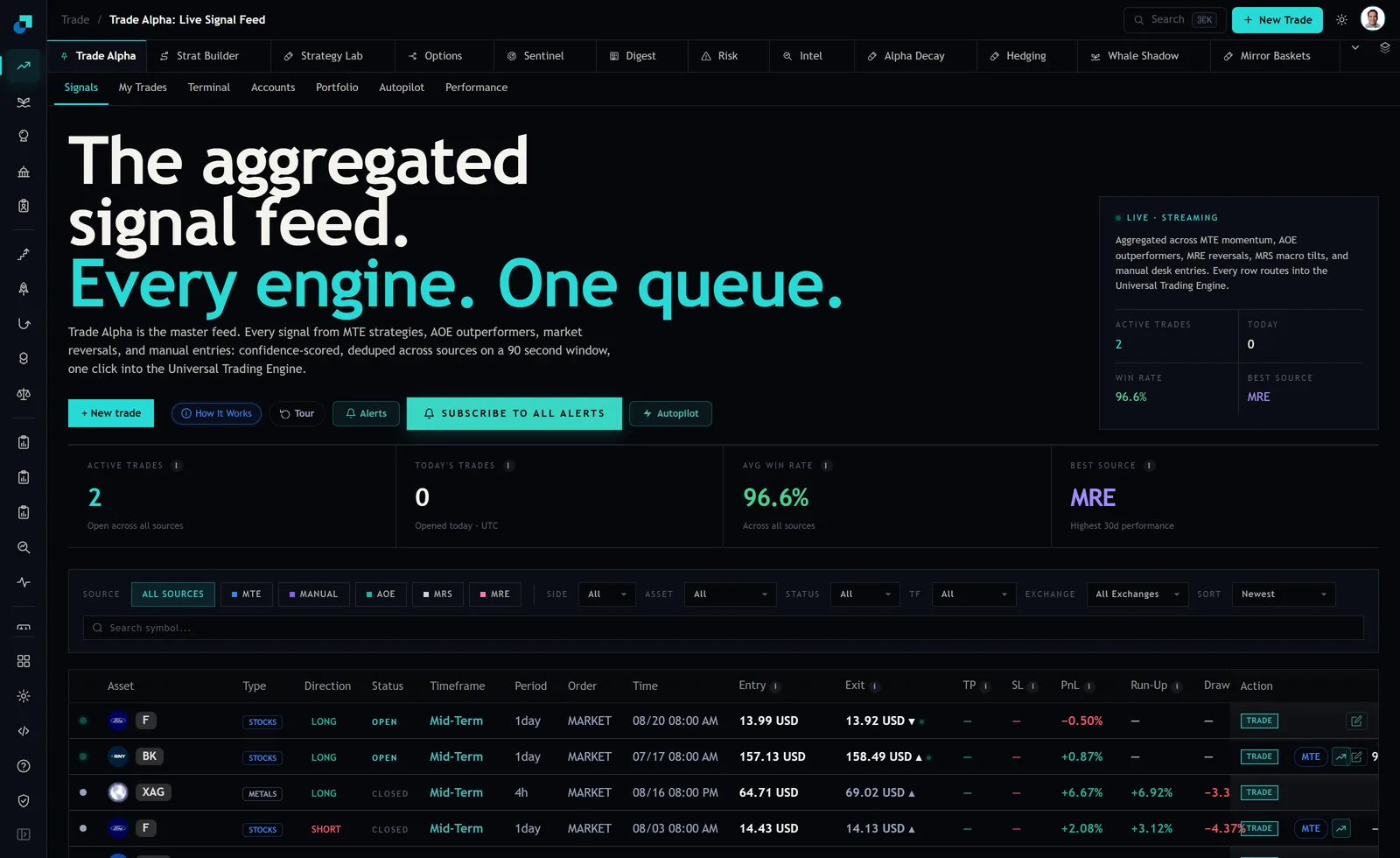
At capture the row held source chips for all sources, MTE, MANUAL, AOE, MRS and MRE, then dropdowns for side, asset, status and timeframe, then the exchange dropdown showing All Exchanges, then a sort control set to newest, with a symbol search box underneath.
All Exchanges is the default, and defaults are decisions somebody else made for you. In this case it is the right default for the product, because the product does not know anything about your accounts, and showing you less than everything by default would be presumptuous.
That is the important limitation to hold on to. The exchange filter is a view control. It narrows what appears on your screen. It does not check a balance, it does not know which venues you have funded, and it will not warn you that the row you are about to act on is at a venue where you have nothing. The mapping between the filter and your actual capacity to trade is yours to maintain, and if you skip that part the filter does nothing useful.
The audit that has to happen before the filter means anything
Open a note and write three columns. Venue. Roughly how much sits there. What you can trade there.
The third column is the one people get wrong from memory. The feed at capture showed rows typed STOCKS for Ford and BNY and METALS for silver, and the platform's coverage spans crypto spot and perpetuals, equities, forex, commodities, metals and prediction market contracts. Almost nobody has a single account that covers that. So the honest version of your third column is specific: this venue does spot crypto, that one does US equities, this other one does perpetuals.
Then be strict about the second column. A venue where you have 40 dollars is not a funded venue. It is an account. If the smallest position you would sensibly take in that asset class is 300 dollars, then anything below that is not capacity and should not be in your funded list, because the whole point of this exercise is that the list tells you the truth.
Now set the filters to match. Exchange first, and asset class alongside it if the exchange filter alone does not narrow things enough. What you should end up with is a feed where every visible row is a row you could act on today with money you already have.
Why an unfillable row is worse than a blank feed
This is the part that sounds like an overstatement until you have watched it happen to yourself a few times.
The first cost is the substitution trade. You see a signal on an instrument you cannot reach, you like the reasoning, and you take the nearest thing you can trade instead. The nearest thing has different liquidity, different volatility and a different reason for moving. You have kept the feeling of acting on the signal and discarded the signal, which is the worst possible split of the two.
The second is the funding scramble. Somebody sees a good row, decides to open an account at that venue, and starts a process that involves identity verification and a transfer. By the time it clears, days later, the idea is gone and the money is sitting at a new venue you opened under time pressure without reading anything about it. Opening a venue during a moment of urgency is how people end up funded somewhere they would not have chosen calmly.
The third is the quietest and the most expensive. If most of what you see is unactionable, you learn to skim. Skimming is a trained response and it does not distinguish between rows you cannot take and rows you can. Six weeks of a mostly-irrelevant feed and you are missing the ones that were yours, because you have taught yourself that this screen is background noise.
Put a number on it. If two thirds of what you see is unfillable, then every minute of attention you give the feed buys you twenty seconds of relevant information. Filtering does not just remove noise, it triples the value of the time you already spend there.
Making the narrow view the default rather than a choice
Set the filters and then leave them set. The decision you want to make once is which venues you trade at, and the decision you do not want to make forty times a week is whether this particular row is one you can act on.
A practical detail worth checking: confirm whether your filter selections persist when you come back to the page. If they do, you are done. If they reset to All Exchanges, then setting them becomes the first ten seconds of every session, which is annoying but still worth doing. Either way, check rather than assume, because a filter you believe is applied and is not is worse than no filter, since you will trust the rows in front of you.
The symbol search box is the companion control for the opposite situation. When you want to know whether a specific instrument has had anything on it recently, search it rather than widening the exchange filter and scrolling. Widening the view to answer one question and then leaving it wide is how the narrow default erodes over a couple of weeks.
When to widen it on purpose, and the cost of the obvious fix
Never widening is its own mistake, so put it on a schedule instead of doing it by impulse.
Once a month, set the exchange filter back to All Exchanges and read what you have been missing. Not to trade any of it. To count it. If a particular venue accounts for a meaningful number of rows in your asset classes month after month, that is a real argument for funding it, made on months of evidence rather than on one attractive row you saw on a Tuesday. If it does not, you have just confirmed your setup is fine and you can stop wondering.
Widen it also when a venue you rely on is down or in maintenance, since knowing what you cannot currently reach is genuinely useful, and before you add new capital, since the question of where to put it is exactly this question.
The obvious fix, which is to fund every venue a little so that everything is actionable, is worse than it sounds and deserves a plain statement of why. Every venue you fund is money exposed to that venue. Four accounts holding 500 dollars each is 2,000 dollars of counterparty exposure earning you nothing while it waits, and idle balance spread thin is also below the size where any of it is tradable. Fund the smallest number of venues that covers the asset classes you actually trade, keep execution keys scoped to trading only with withdrawal permission never enabled, and keep anything you are not actively trading with somewhere separate from the venues you route through. A narrower feed is a side benefit of that discipline. The discipline is the point.