There is a stretch before every rate decision when the people who will make it stop speaking in public. No speeches on policy, no interviews, no answering the question at a conference. The window opens more than a week before the meeting and lifts the day after the decision. The exact dates are published on the central bank's own calendar and you should look them up rather than trust my paraphrase, because knowing precisely when the quiet starts is the entire point of this article.
What matters for a portfolio is not the courtesy of the arrangement. It is that during those days the flow of new information about policy drops close to zero while the amount of money positioned around the outcome keeps climbing. That is an unusual combination and it has a predictable effect on how markets behave.
An information-starved component is not a calm one
The temptation is to read the quiet as calm. It is the opposite. Think about what a policy view is made of. It is made of the data prints that have arrived since the last meeting, plus the running commentary of officials reacting to those prints in public. During the blackout the first source keeps flowing and the second stops entirely.
So every new piece of economic data lands without any official reaction to interpret it. The market has to guess how the committee read the print, and there is nothing to check the guess against. Guesses without a correction mechanism drift, and drift in a crowded position is how disorderly moves start.
This is why a strong or weak data release during the blackout period often produces a larger move than the identical release would produce a month earlier. Nothing has changed about the data. What changed is that the usual dampener, an official saying in public that the print does or does not change their thinking, has been switched off.
What the scorecard can and cannot tell you about this
The Macro Risk Scorecard has a Policy tab, sitting fifth in the row after Dashboard, Sentiment, Regime and Credit and Liquidity, and the module's coverage includes Federal Reserve policy, Treasury yields and inflation data. That is the right place to keep your policy inputs. It is not a countdown clock, and I am not going to pretend the page tells you where you are in the meeting cycle.
The scorecard's job is the slower one. Its header at the time of writing reads a combined M7 score of 29 out of 100 tagged LOW, a regime label of SLOWDOWN, a macro health grade of C at 59 out of 100, and a counter for models at or above 60 sitting at 0 out of 7. Those are built from published statistics on their own release schedules and they do not care what week of the meeting cycle it is.
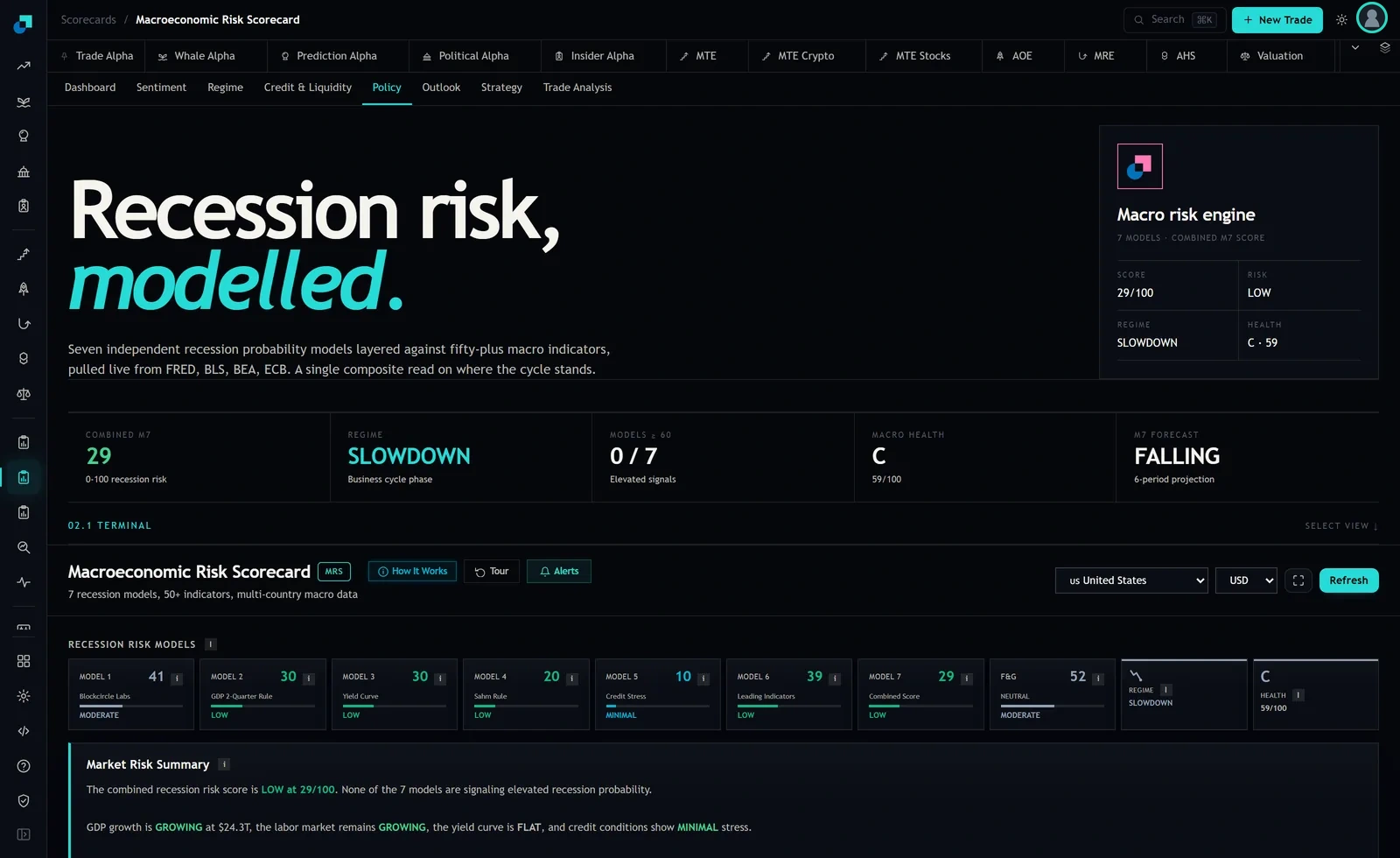
That stability is the useful property. During a period when the narrative gets loud and unanchored, having a set of numbers that only respond to published data is a genuine service. Write the header down on the day the blackout opens. Compare it the day after the decision. If the four figures are unchanged, then whatever you felt during those ten days was sentiment, not information.
The two things that actually change during the quiet
First, positioning concentrates. Traders who intend to express a view on the meeting have to get on before it, and the last window to do that is the blackout. Crowding rises for a mechanical reason rather than a psychological one.
Second, the cost of protection rises. Option premia around a scheduled event are higher because everybody knows the date. That has a specific consequence for retail investors that is worth being blunt about: if you decide in the last few days before a meeting that you want a hedge, you are buying it at the most expensive moment on the calendar, from people who priced the event weeks ago.
Both effects point at the same conclusion. Decisions about how much risk you want to carry into a rate decision are cheap when made early and expensive when made late. There is no informational advantage to waiting, because by definition no new official information is arriving.
A concrete routine for the ten days
This is what I actually do, and it takes about fifteen minutes a month.
- Put the blackout start dates for the year in your calendar once, from the published meeting schedule. Do it in one sitting in January and you never think about it again.
- On the day the window opens, do your normal position review and answer one question in writing: is there anything here I would not want to hold through a surprise on the policy path? Not a prediction of the surprise, just an inventory of what is fragile.
- Deal with anything on that list in the first two days of the window, while spreads and premia are still normal. A leveraged position, a concentrated single name that has run hard, an expiry that falls just after the meeting. These are the items that turn an ordinary repricing into a real loss.
- Then stop trading the topic. No adding, no trimming, no reading the fifth article about what somebody thinks the committee is thinking. There is no new official information, so extra attention produces extra activity and no extra edge.
- The day after the decision, reopen the note and compare the scorecard header against what you wrote down. Then resume normal behaviour.
The value here is not in predicting anything. It is in moving a decision from a moment when it is expensive and emotional to a moment when it is cheap and unhurried, which is a repeatable improvement rather than a lucky one.
The failure mode this is designed to prevent
The specific damage the blackout does to retail investors is that it makes the environment feel like it demands action while supplying nothing to act on. Ten days of speculation with no correction produces a lot of confident content, and confident content in the absence of new facts is how people talk themselves into changing an allocation they had spent months building.
The check I keep coming back to is this: if the reason for a trade is something an official said, that is information. If the reason is what somebody thinks an official is going to say, that is a forecast about a forecast, and each layer strips out reliability. During the blackout, everything on offer is the second kind.
The scorecard header is a useful antidote precisely because it is boring. It reads what it reads, it moves when data moves, and it will still be sitting there the morning after the decision. Comparing your emotional state during the quiet against a set of numbers that did not budge is an unglamorous exercise, and it is the one most likely to keep a position intact that deserved to survive.