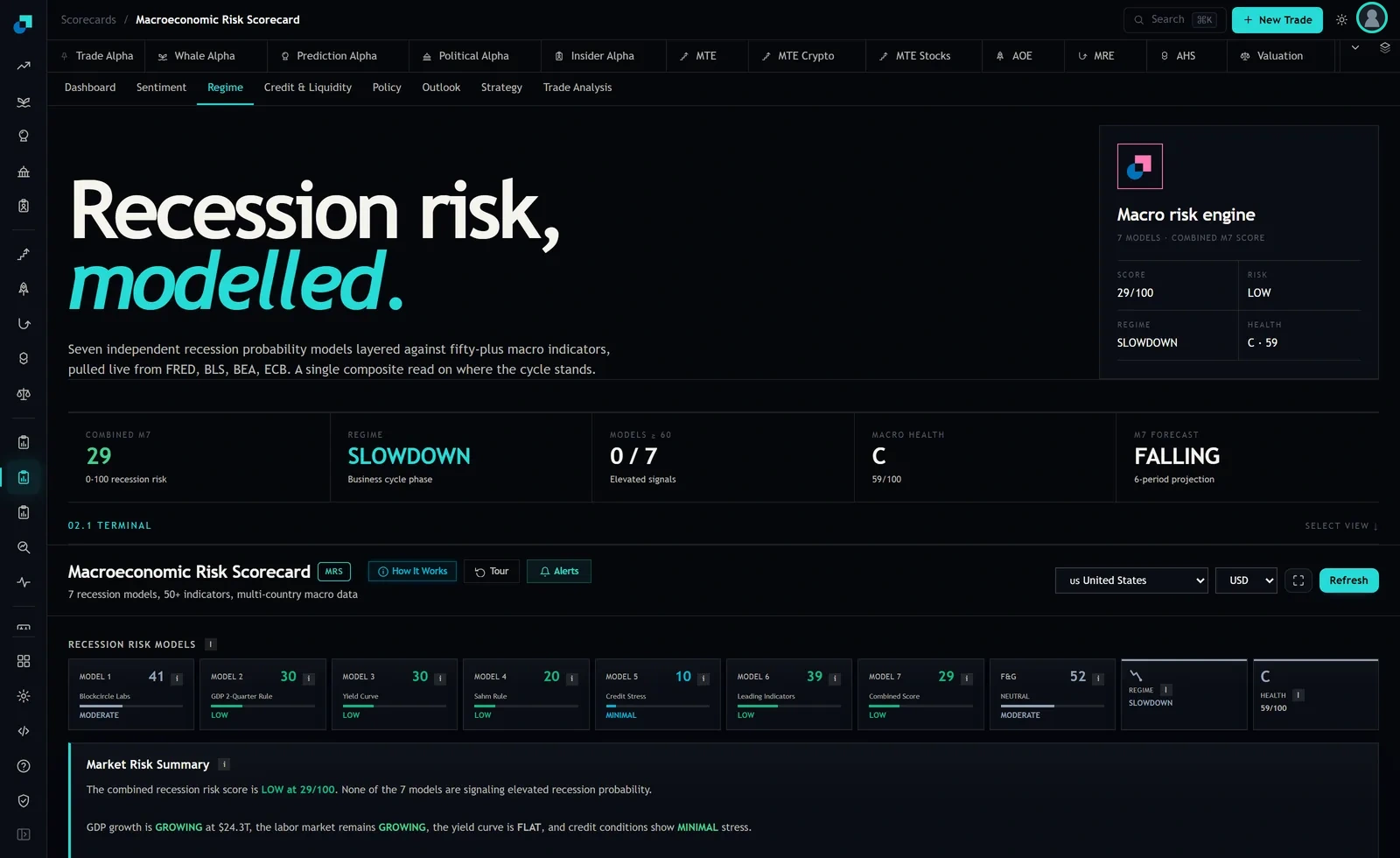
The regime tab on the Macroeconomic Risk Scorecard reports one word, SLOWDOWN, and labels it as the business cycle phase. The question everybody has on seeing that is entirely reasonable and almost never asked out loud: is this thing just getting going, or is it nearly over. Because those two situations call for opposite behaviour, and restructuring a portfolio into the back end of a phase is one of the more expensive mistakes available to a retail account.
I want to give you a real answer to that, which means starting with why the answer you are hoping for does not exist in the form you want it.
The month counts you find online are softer than they look
Search for how long each macro regime lasts and you will get confident tables of average durations in months. Three things make those numbers less useful than their precision suggests.
The first is that regime labels are model specific. This scorecard's SLOWDOWN is produced by its own definitions over its own indicator set. Another provider's slowdown, another textbook's four-phase cycle, and an official recession dating committee's contraction are three different objects with overlapping but non-identical boundaries. A duration statistic computed on one taxonomy does not transfer to another, and most of the tables you will find do not say which taxonomy they used.
The second is that dating is retrospective. Phases get assigned once enough data has arrived to see the shape, and the underlying data revises for years. So a historical duration series is built out of labels that nobody could have applied in real time, which makes it a poor guide to a decision you are making in real time.
The third is sample size. The number of complete cycles in the modern data era is small. Small enough that one long or one short episode moves the average meaningfully, and the distribution of durations is skewed, which means the average is a worse summary than usual. The memorable long expansions pull the mean up above the typical case.
So no, I am not going to give you a table saying slowdowns last eleven months. I do not have a defensible number and neither, mostly, do the tables that give you one.
The shape that is safe to rely on
Strip out the false precision and there is a real asymmetry underneath, and it is the part worth internalising.
Economies spend most of their time growing. Expansion phases occupy the large majority of the historical record and contraction phases occupy a small minority. That is why buy-and-hold works at all, and it is the single most important base rate in investing even without a month count attached.
The transitional phases, the slowdowns and the recoveries, are where the uncertainty concentrates. A slowdown is precisely the state where the economy has stopped accelerating and has not yet resolved into either a reacceleration or a contraction. It can do either. That is not a failure of the model, it is the definition of the phase, and it means the honest expected duration of a slowdown has a genuinely wide range around it.
Which produces the practical conclusion: the phase where you most want to know the duration is structurally the phase where duration is least knowable. Any framework promising otherwise is selling you confidence rather than information.
Build the log that gives you the one number that matters
You cannot get the population base rate honestly. You can get something more immediately useful, which is the age of the current label, and you get it by keeping a log.
Once a month, one row: the date, the regime label, the combined score, and the count of models at or above 60. Ten minutes, eleven or twelve times a year. From that you compute the only duration figure you can actually stand behind, which is how many consecutive months this label has been showing.
That number changes how you read everything else. A SLOWDOWN label in its second month with the score at 29 and rising is an early-phase reading. The same label in its fourteenth month with the score at 29 and flat is a very different thing, and it is a serious argument that this particular slowdown is resolving upward rather than downward. Neither reading is available from the tile itself. Both are available from four columns in a spreadsheet you started a year ago, which is the argument for starting one today even though it pays nothing for twelve months.
Design the portfolio so the duration does not decide it
Here is the part that matters more than the base rates. If your allocation only works when the regime lasts a particular length of time, you have made a duration bet, and you should price it as one.
Take a concrete case. Twenty thousand dollars, currently sixty five percent in broad equities, fifteen percent crypto, twenty percent cash. You read SLOWDOWN and consider restructuring to thirty percent equities and fifty percent cash. That move only pays if the slowdown becomes a contraction reasonably soon. If it resolves upward in four months, you have parked seven thousand dollars out of the market through a recovery and paid spread and possibly tax for the privilege.
Three alternatives that do not require you to know the duration.
- Rebalancing bands rather than a call. Set a rule that you rebalance to target weights whenever any holding drifts more than five percentage points from target. That mechanically trims what has run and adds to what has not, and it works in any regime of any length without you predicting anything.
- A cash buffer sized in months of spending, not percent of portfolio. Three to six months of actual expenses, held outside the trading account. This is the one holding whose adequacy genuinely does not depend on the macro regime, and it is what stops a long downturn from turning into forced selling.
- Trim the position that fails worst on a long slowdown. Not everything, one holding. Usually the most growth-sensitive thing you own. On the twenty thousand dollar account, moving a thousand dollars out of the crypto sleeve costs you very little if the slowdown ends next quarter and helps meaningfully if it does not.
The thread running through all three is that they are robust across durations. They give up some of the upside available to someone who correctly calls a fourteen month slowdown, and in exchange they do not require you to make that call, which is a good trade given that the call is not reliably makeable and the penalty for getting it wrong is paid in realised losses and missed recoveries.
The regime label is best used as an input to how carefully you are watching, and how much drift you tolerate before you rebalance. It is a poor input to how much you own. That decision belongs to your written weights and your spending needs, both of which you can compute exactly, unlike the number of months this phase has left to run.